




01. Edit your form online
Type text, add images, blackout confidential details, add comments, highlights and more.

Type text, add images, blackout confidential details, add comments, highlights and more.

Draw your signature, type it, upload its image, or use your mobile device as a signature pad.

Send it via email, link, or fax. You can also download it, export it or print it out.
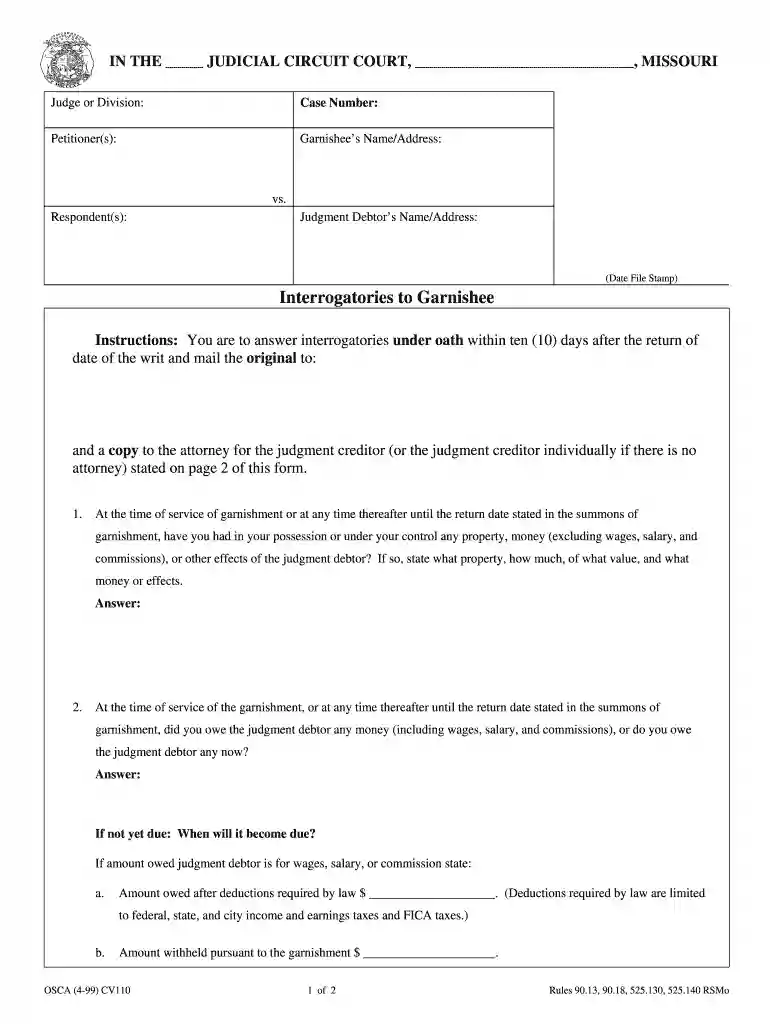
The "Interrogatories to Garnishee - Missouri" is a legal form used in the Missouri Judicial Circuit Court proceedings related to garnishment. This document plays a crucial role by obligating the garnishee to provide detailed responses under oath. The focus is on uncovering information about any assets, funds, or other properties the garnishee may hold on behalf of the judgment debtor. By understanding the debtor's financial connections, the court can determine the availability of assets for satisfying the judgment.
Consider a scenario where a garnishee is a financial institution holding funds for the debtor. The garnishment form would require the institution to disclose these assets, allowing the court to assess what might be used toward satisfying a legal judgment.
This form is typically used by attorneys representing creditors in garnishment proceedings. Its completion involves gathering and presenting information requested by the interrogatories, providing a pathway for debt recovery through legal channels.
For a business holding goods on consignment from a debtor, the garnishee would disclose these goods as assets, potentially subject to garnishment to satisfy a debt.
Grasping the terminology used in this form is crucial for accurate completion and compliance.
Understanding these terms aids in recognizing scenarios, such as when a garnishee is entrusted with property or funds intended for the debtor, highlighting what must be declared on the form.
Accurate completion of the form is mandatory for compliance and successful garnishment proceedings.
In situations where the garnishee possesses no assets of the debtor, they must clearly indicate this in their responses.
Missouri follows specific rules for garnishment proceedings, which this form adheres to for legal consistency.
The form’s structured approach assists in navigating Missouri’s specific legal landscape, ensuring the creditor’s interests are upheld through lawful means.
Ensuring the form is utilized within the legal framework is essential for its effectiveness and enforceability.
Consider a wage garnishment scenario where employment status and income details must be disclosed, highlighting the form's role in comprehensive asset listing for debt resolution.
Grasp the core components essential for fulfilling the form’s purpose effectively.
By detailing these elements, the form exhausts all potential avenues where the debtor’s assets might be concealed or overlooked, providing clarity and completeness.
Identifying parties likely to engage with this form provides insight into its typical application and utility.


In a case involving unpaid child support, an employer would use this form to report available income for garnishment, ensuring legal obligations are met.
We've got more versions of the Interrogatories to Garnishee - Missouri form. Select the right Interrogatories to Garnishee - Missouri version from the list and start editing it straight away!
At DocHub, your data security is our priority. We follow HIPAA, SOC2, GDPR, and other standards, so you can work on your documents with confidence.
by KE Sooter 1981 Cited by 1 Furthermore, consideration of such a motion is premature if it cuts off the garnishors right to serve interrogatories on the gar- nishee. See Squires ShopRead more
If the interrogatories show that money is held, this is also the date the payment is due. For a garnishment, the returnable date is the date that it expires.Read more


