







Definition & Purpose
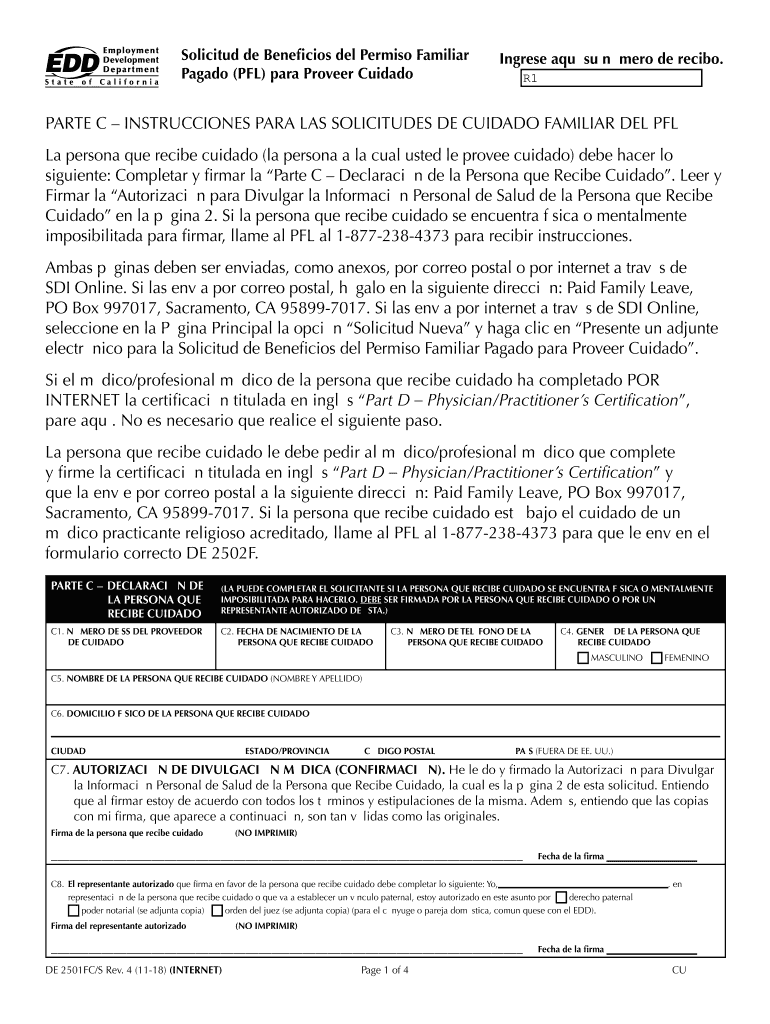
The "Solicitud de Beneficios del Permiso Familiar Pagado para Proveer Cuidado (DE 2501FC S Rev 4 (1)" is a form used in California to apply for Paid Family Leave (PFL) benefits. This document allows caregivers to obtain financial support while taking time off work to care for a family member with a serious health condition. These benefits are part of California's State Disability Insurance (SDI) program, aimed at providing monetary aid during such challenging times.
Eligibility Criteria
Eligibility for this form—and the benefits it provides—depends on certain conditions:
- You must be a California resident.
- You must have paid into the State Disability Insurance program, generally through paycheck deductions.
- The family member you are caring for must have a qualifying serious health condition.
- Certification from a healthcare provider is required to validate the need for caregiving.
The precise definitions of "serious health condition" and "eligible family member" are outlined in the relevant California legislation, and applicants should consult these guidelines to determine their eligibility before proceeding.


Steps to Complete the Form
Successfully filling out the form involves several carefully followed steps:
-
Gather Required Information: Ensure you have all personal, employment, and health details at hand, including your Social Security number, employer details, and healthcare provider information.
-
Fill Out the Caregiver's Section: Provide details about the care you will offer, the expected duration of care, and personal information.
-
Healthcare Provider Certification: Submit the form to a licensed health professional who can certify the family member's condition and the necessity of your care.
-
Signatures and Authorizations: Obtain all necessary signatures, including your own, the health provider's, and sometimes the patient’s, depending on privacy laws.
-
Submit the Form: Submit completed forms either via mail to the address provided in the form instructions or through an online submission portal where available.
Common Mistakes
Avoid these pitfalls to ensure a smooth process:
- Missing signatures.
- Incorrect or incomplete personal information.
- Lack of required documentation, such as medical certifications.
Important Terms to Know
Understanding certain terms will aid in correctly completing the application:
- PFL (Paid Family Leave): A state-provided program offering partial wage replacement for specified family caregiving scenarios.
- SDI (State Disability Insurance): A payroll-funded insurance program providing short-term financial aid to eligible workers.
- Serious Health Condition: Defined by specific criteria involving medical treatment, inpatient care, or continuing treatment by a healthcare provider.
Legal Implications
Using this form secures legal rights to receive wage replacement benefits under California law. It is crucial to be truthful and accurate, as misrepresentation can lead to penalties, including repayment of benefits, fines, or legal action.
State-Specific Rules
Primarily for California residents, this form adheres to state guidelines regarding family leave and wage replacement. Other states may have differing policies and forms; hence California-specific knowledge is essential when dealing with this form.
Required Documents
Submission requires several essential documents:
- Proof of identity (e.g., a driver's license or state ID).
- Medical certification completed by a healthcare provider.
- Recent pay stubs or other evidence of employment and wage history.
Submission Methods
- Online: Through the state's dedicated SDI Online portal.
- Mail: Physical forms can be sent to the address detailed on the instructions.
Both methods necessitate complete and accurate forms to avoid delays in processing.
Application Process & Approval Time
The approval process typically involves:
- Initial review of documents upon receipt.
- Verification from healthcare providers and employers.
- Approval decisions within 14 days, though this can vary based on application completeness and verification speed.
Delays and Issues
Delays may stem from incomplete applications, missing medical certifications, or discrepancies in reported data. Applicants should aim to ensure thoroughness to prevent holdups.
Who Typically Uses This Form?
This form is crucial for:
- Employees needing to provide prolonged care for a family member.
- Individuals ineligible for other state programs, yet requiring financial assistance due to family caregiving duties.
These scenarios underscore the pivotal role that this form plays in securing necessary monetary support during family medical crises.




