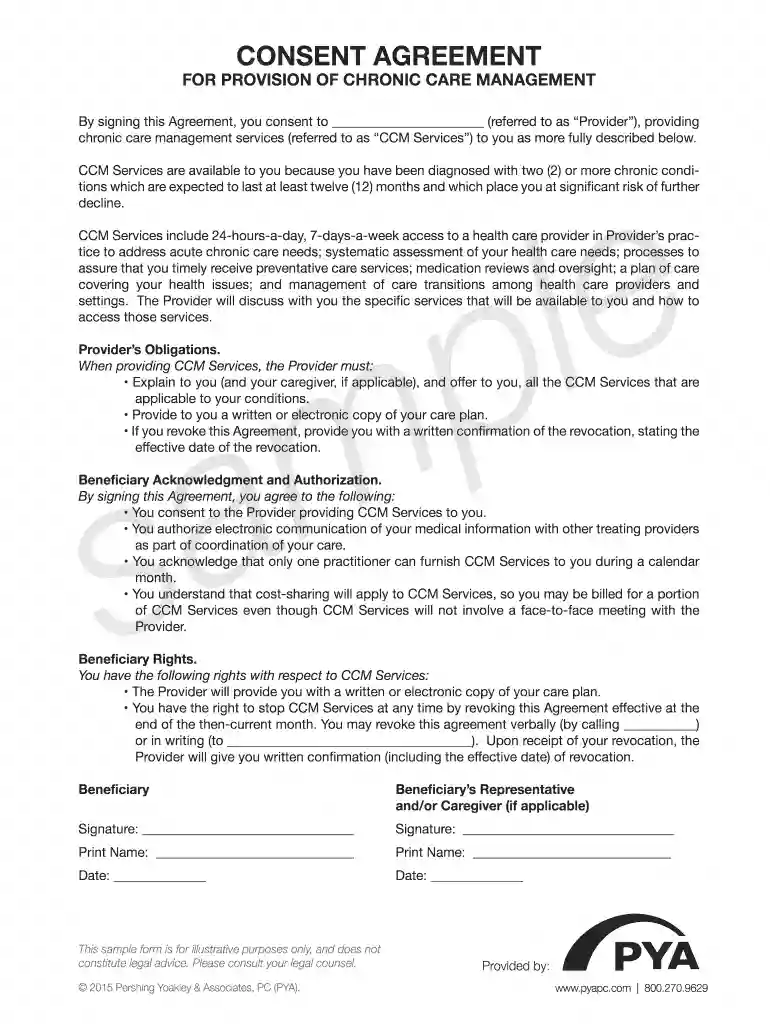
Chronic care management consent form 2026

Get Form
chronic care management agreement form Preview on Page 1

Here's how it works

01. Edit your chronic care management agreement form online
Type text, add images, blackout confidential details, add comments, highlights and more.

02. Sign it in a few clicks
Draw your signature, type it, upload its image, or use your mobile device as a signature pad.

03. Share your form with others
Send chronic care management consent form via email, link, or fax. You can also download it, export it or print it out.

Definition and Meaning of Chronic Care Management Consent Form

A chronic care management consent form, often abbreviated as CCM consent form, is a legal document that a patient uses to authorize a healthcare provider to deliver chronic care management services. This form is crucial in the context of U.S. healthcare, as it facilitates the management and coordination of care for patients with multiple chronic conditions. The consent form ensures that patients are fully informed about the services they will receive, the responsibilities of the provider, and any associated costs. By signing this form, patients acknowledge their understanding and agreement to participate in a comprehensive care plan designed to improve their health outcomes.

Components of the Form

  • Patient Information: Includes the patient's full name, address, and contact details to clearly identify the individual consenting to receive services.
  • Provider Details: Lists the healthcare provider's name, address, and contact information responsible for delivering care services.
  • Statement of Consent: A clear declaration that the patient consents to receiving chronic care management services, outlining what such services entail.
  • Privacy and Data Sharing: Details how the patient's medical information may be shared electronically, maintaining compliance with HIPAA regulations.
  • Cost and Billing Information: Explains potential costs associated with receiving chronic care management services and any relevant insurance information.
  • Revocation Clause: Provides the patient with the right to revoke consent at any time, along with instructions on how to do so.

How to Use the Chronic Care Management Consent Form

The chronic care management consent form is used by healthcare providers and patients to formalize the agreement for chronic care services. Both parties must understand their roles and commitments to ensure effective communication and coordination.

Steps for Patients

  1. Review the Form Thoroughly: Understand the full scope of services offered, including how they will benefit your healthcare.
  2. Discuss with Your Healthcare Provider: Clarify any doubts or concerns, particularly concerning costs, confidentiality, and modus operandi.
  3. Sign the Form: Use DocHub to sign the form electronically, if applicable, ensuring the use of legally binding electronic signatures as per the ESIGN Act.
  4. Retain a Copy: Keep a digital or paper copy of the signed form for personal records and future reference.

Steps for Healthcare Providers

  1. Provide a Detailed Explanation: Ensure the patient comprehensively understands the services and their implications.
  2. Present the Form in Multiple Formats: Use platforms like DocHub to offer the form electronically, ensuring ease of access and completion.
  3. Confirm Authorization: Obtain the necessary signatures and ensure that the patient has authorized all sections of the form.
  4. Store Securely: Utilize secure cloud storage, protected by 256-bit SSL encryption, for seamless and safe access.

Steps to Complete the Chronic Care Management Consent Form

Completing the CCM consent form involves a few critical steps to ensure the document is valid and effective in setting up chronic care management services.

  1. Access the Form: Obtain the form through your healthcare provider or download it from a reliable medical platform or website.
  2. Provide Accurate Information: Fill out the sections that require personal information, such as name and contact details.
  3. Understand the Terms and Conditions: Carefully read the contractual elements regarding consent, billing, and refusal options.
  4. Electronically Sign the Form: Use DocHub's ESIGN Act-compliant tools to provide a valid electronic signature, ensuring legal validity.
  5. Submit the Form: Return the signed form to your healthcare provider via email or a secure document sharing platform.
  6. Receive Confirmation: Await acknowledgment from the provider that your form has been received and processed.

Why You Should Use a Chronic Care Management Consent Form

Using a CCM consent form is pivotal in managing complex patient care efficiently. Here’s why this document is indispensable:

Benefits for Patients

  • Comprehensive Care Coordination: Ensures you receive all necessary services to manage chronic conditions effectively.
  • Clear Communication: Establishes a written record of what the care entails, facilitating better communication between you and your provider.
  • Protection and Rights: Safeguards your rights to access information, refuse services, or withdraw consent if needed.

Benefits for Providers

  • Legal Compliance: Meets the legal requirements for consent documentation, minimizing potential liabilities.
  • Structured Management: Assists in organizing and detailing care plans tailored to individual patient needs.
  • Enhanced Patient Engagement: Encourages patient involvement in their care, improving adherence and outcomes.

Key Elements of the Chronic Care Management Consent Form

Understanding the key elements of the CCM consent form ensures that all necessary aspects are addressed for its proper completion and execution.

  • Understanding of Services: Outlines the specific chronic care services, such as medication management and follow-up scheduling.
  • Consent to Share Information: Authorizes the sharing of patient health information with designated care coordinators.
  • Financial Agreement: Details any applicable costs and payment responsibilities, highlighting insurance coverage implications.
  • Revocation Capabilities: Allows for withdrawal of consent and describes the process to formally revoke it.

Legal Use of the Chronic Care Management Consent Form

The legal use of a chronic care management consent form ensures that both patients and healthcare providers operate within the boundaries of U.S. law and healthcare regulations. Adhering to these guidelines prevents disputes and ensures ethical medical practices.

Compliance Standards

  • HIPAA Regulations: Ensures patient information privacy during data transmission and storage.
  • ESIGN Act Adherence: Legally binds electronic signatures, providing legal integrity and recognition.
  • Medicare Guidelines: Aligns with Medicare’s requirements for billing and service delivery for reimbursable chronic care management.

Examples and Scenarios of Using the Chronic Care Management Consent Form

Practical examples illustrate how CCM consent forms are implemented in typical healthcare settings:

Scenario 1: Elderly Patients

An elderly patient with diabetes and hypertension signs a consent form to receive ongoing chronic care management. The form allows the provider to coordinate care with specialists and manage medications electronically, enhancing the patient’s health outcomes.

Scenario 2: Post-Surgery Follow-Up

A patient recovering from heart surgery agrees to chronic care management services for rehabilitation support. By signing the consent form, the patient authorizes medical staff to access previous records and monitor recovery progress coordinated by the primary care provider.

Obtaining a Chronic Care Management Consent Form

To obtain a CCM consent form, follow these straightforward steps:

  1. Contact Healthcare Provider: Most providers supply the form during an initial consultation or appointment.
  2. Access Online Platforms: Many health systems and document management platforms like DocHub offer digital versions for download.
  3. In-Person Requests: Visit your healthcare provider’s office to receive a physical copy, facilitating any immediate questions about the form.

These guidelines help ensure you have comprehensive, correct information to support your healthcare journey effectively.

be ready to get more

Complete this form in 5 minutes or less

Get form

Got questions?

We have answers to the most popular questions from our customers. If you can't find an answer to your question, please contact us.
Contact us
Consent form 1 is for adults and those patients having anaesthetic Consent form 2 is for paediatrics Consent form 3 is for procedures without sedation Consent form 4 should be used when the patients lack capacity and should be completed by the professional doing the procedure.
Requirements: Two or more chronic conditions expected to last at least 12 months (or until the death of the patient) Patient consent (verbal or signed) Personalized care plan in a certified EHR and a copy provided to patient.
The following should be documented in the EHR: Patient consent, Comprehensive care plan, including, but not limited to, a problem list, measurable treatment goals, planned interventions, medication management, and interaction and coordination with outside resources and practitioners and providers, and.

Security and compliance

At DocHub, your data security is our priority. We follow HIPAA, SOC2, GDPR, and other standards, so you can work on your documents with confidence.

Learn more
ccpa2
pci-dss
gdpr-compliance
hipaa
soc-compliance