




01. Edit your form online
Type text, add images, blackout confidential details, add comments, highlights and more.

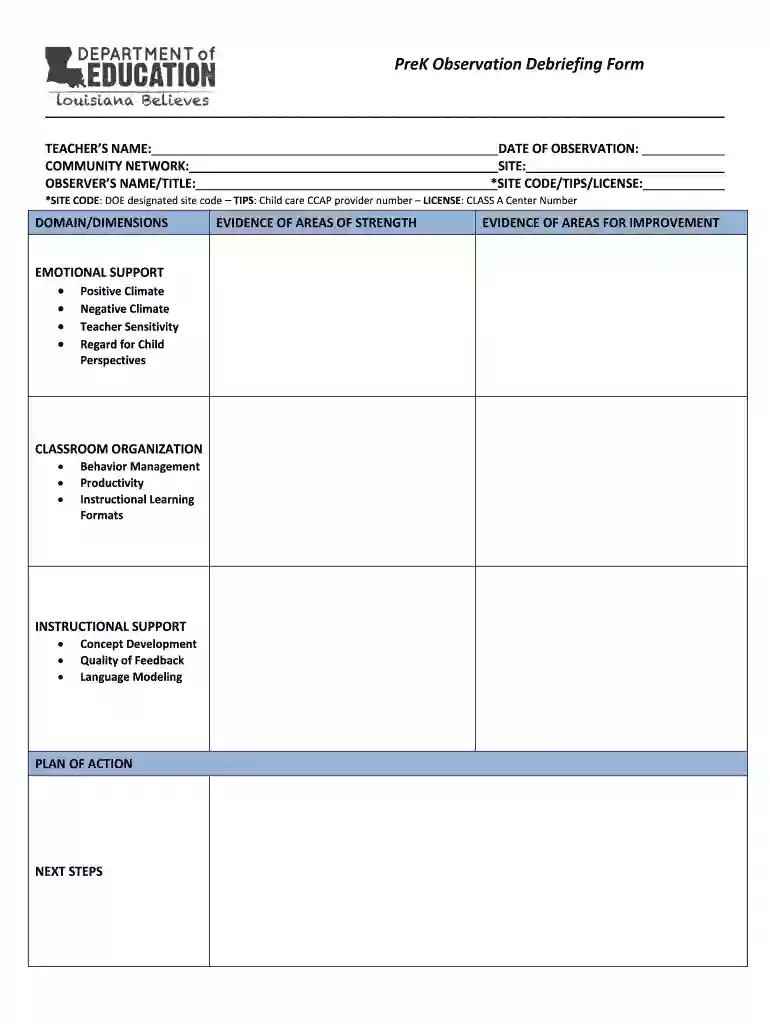
Type text, add images, blackout confidential details, add comments, highlights and more.

Draw your signature, type it, upload its image, or use your mobile device as a signature pad.

Send it via email, link, or fax. You can also download it, export it or print it out.
The PreK Observation Debriefing Form is a structured tool used to evaluate and analyze teaching effectiveness in PreK classrooms. It focuses on various domains such as emotional support, classroom organization, and instructional support, providing educators and observers with a clear framework for discussion and feedback. The form's primary purpose is to document strengths and areas for improvement in teaching practices, facilitating a plan of action to enhance educational outcomes.
To effectively use the PreK Observation Debriefing Form, one must approach it as both a reflective and collaborative tool. Here's a step-by-step guide on how to utilize the form:
Preparation Before Observation:
Conducting the Observation:
Completing the Form:
Post-Observation Debrief:
The form includes several critical sections designed to encompass comprehensive observation and feedback:
Teacher and Observer Information:
Observation Details:
Strengths & Areas for Improvement:
Plan of Action:
Next Steps:
Completing the form requires careful attention to detail and an organized approach:
Start with Identifying Information:
Detail the Observation Context:
Analyze Domains of Teaching:
Document Strengths and Improvements:
Develop an Action Plan:
Set Follow-Up Procedures:
The form is primarily used by educational administrators, instructional coaches, and teacher mentors who are responsible for evaluating and supporting classroom instruction in PreK settings. These individuals use the form to provide structured feedback and drive instructional improvement.


Understanding key terminology is crucial for effective use of the form:
The PreK Observation Debriefing Form serves an essential function in ensuring transparency and accountability in educational settings. It can sometimes be analyzed during performance reviews or legal proceedings related to teacher evaluations. Notably, federal and state education regulations underscore the importance of documented evaluations as part of teacher support and development.
Real-world applications of the form demonstrate its utility in improving teaching practices:
Case Study on Emotional Support:
Classroom Organization Improvement:
Instructional Support Enhancement:
These examples underscore the form's role in fostering meaningful enhancements in PreK educational settings.
We've got more versions of the PreK Observation Debriefing Form form. Select the right PreK Observation Debriefing Form version from the list and start editing it straight away!
| Versions | Form popularity | Fillable & printable |
|---|---|---|
| 2015 | 4 Satisfied (31 Votes) |
At DocHub, your data security is our priority. We follow HIPAA, SOC2, GDPR, and other standards, so you can work on your documents with confidence.


