




01. Edit your minor travel consent form uk online
Type text, add images, blackout confidential details, add comments, highlights and more.

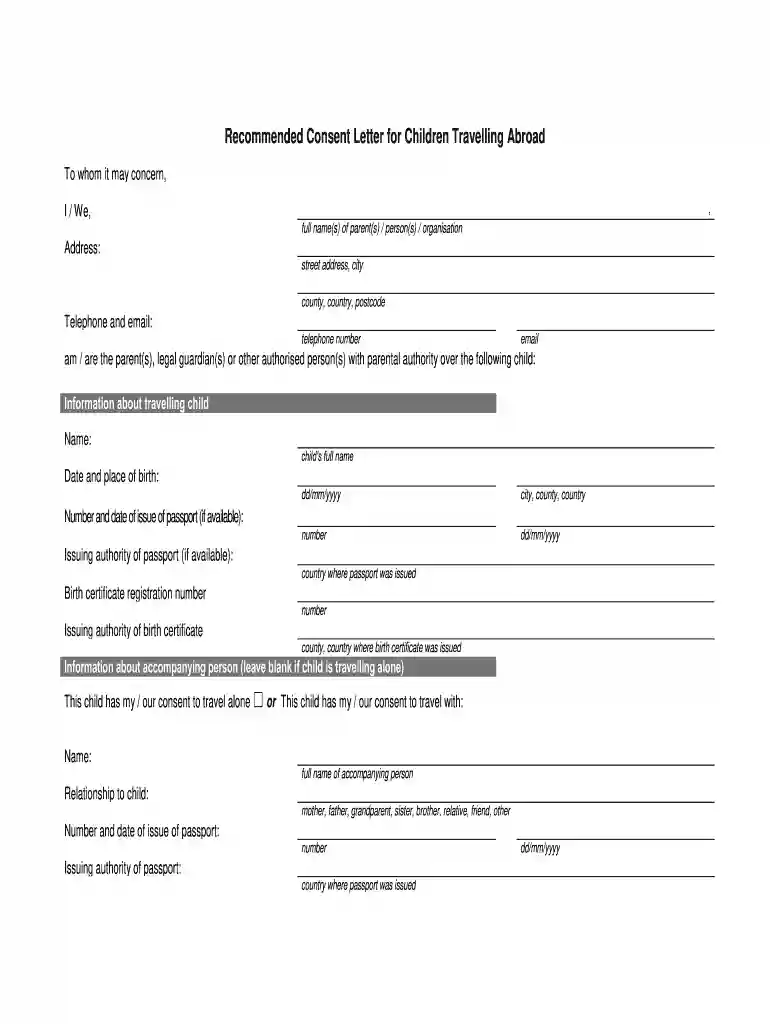
Type text, add images, blackout confidential details, add comments, highlights and more.

Draw your signature, type it, upload its image, or use your mobile device as a signature pad.

Send permission to take child abroad template uk via email, link, or fax. You can also download it, export it or print it out.
A consent letter for a child to travel abroad is a critical document that grants permission for minors to leave the country, either alone or accompanied by someone other than their parents or legal guardians. This document is commonly required by airlines and border authorities to prevent possible abductions and ensure the safety of minors during international travel.
Creating a comprehensive consent letter involves including several key components to ensure it meets legal requirements:
Child's Personal Information: Include the full name, date of birth, and passport number of the child. This information helps establish the identity of the minor traveling abroad.
Details of Accompanying Adult: If the child is traveling with another adult, their full name, relationship to the child, and contact information must be included. This section clarifies who is responsible for the child during the trip.
Travel Information: Outline the destinations the child will visit, including the dates of travel. This section is crucial for confirming the travel itinerary and duration.
Contact Information: Provide contact details for the parents or guardians during the trip. This should include phone numbers and email addresses for easy communication.
While consent letters for a child traveling abroad are not universally required, many jurisdictions and airlines mandate them, especially when traveling without one or both parents. Here are some legal considerations to keep in mind:
Notarization: Some jurisdictions require that consent letters be notarized to be considered valid. Notarization adds an extra layer of authentication, establishing that the signatures are genuine.
State-Specific Laws: Different states may have varying requirements for child travel consent letters. It is essential to verify local regulations or seek legal advice if unsure of the requirements.
Traveling With Different Last Names: If the child has a different surname from the accompanying adult, including additional documentation, such as a birth certificate or legal custody documents, may be necessary to clarify the relationship.
Having a well-prepared consent letter is beneficial in various situations. Here are some scenarios illustrating its importance:
Traveling with Grandparents: A child traveling to Europe with grandparents would need a consent letter to present if requested by airline personnel. This document would clarify the grandparents’ authority to travel with the child.
Single-Parent Travel: A single parent taking their child to visit relatives in another country might need a consent letter from the other parent, depending on custody arrangements. This ensures that the trip complies with any custody agreements.
Group Travel: When children participate in school field trips to foreign countries, a travel consent letter may be required, ensuring that parents authorize the institution to take responsibility for their children during the journey.
Creating a consent letter involves a few steps that ensure completeness and legality. Here’s an effective process:
Gather Required Information: Collect all necessary details about the child, traveling adults, and travel itinerary.
Draft the Document: Use clear and concise language to draft the letter, making sure each section is clearly labeled.
Review Legal Requirements: Check the specific requirements based on the destination's laws and airline policies to ensure compliance.
Sign and Notarize If Needed: Have both parents or guardians sign the document, and if required, take it to a notary public for authentication.
Distribute Copies: Make several copies of the consent letter to keep with the traveling child and for any authorities that may request it during the journey.
Utilizing digital platforms can significantly enhance the process of creating and sharing consent forms. Tools like DocHub offer features such as:
Document Editing: Users can easily edit templates and add necessary fields and information.
Collaboration Features: Parents can collaborate on the consent letter, allowing multiple individuals to provide input and review.
Secure Signatures: Electronic signature options ensure that consent letters are signed quickly and securely.
Digital solutions streamline the workflow, allowing for efficient creation, sharing, and management of travel consent forms.
In summary, a consent letter for a child to travel abroad plays a vital role in ensuring safe international travel for minors. Complete and legally compliant forms are crucial to prevent misunderstandings at checkpoints and airports. Utilizing modern digital tools further simplifies the process of document preparation and management.
We've got more versions of the minor travel consent form uk form. Select the right minor travel consent form uk version from the list and start editing it straight away!
| Versions | Form popularity | Fillable & printable |
|---|---|---|
| 2014 | 4.5 Satisfied (55 Votes) |
At DocHub, your data security is our priority. We follow HIPAA, SOC2, GDPR, and other standards, so you can work on your documents with confidence.
However, the passport authorizing officer retains discretion to request the legal parent/legal guardians written consent to passport issuance. Visit travel.Read more
Oct 5, 2018 Sec. 1. Short title; table of contents. DIVISION ASPORTS MEDICINE LICENSURE. Sec. 11. Short title. Sec. 12. Protections for covered sportsRead more
GSUSA is asking all minors to have BOTH PARENTS sign two (2) permission forms, which MUST be DocHubd. If parents are not together, parent consent fromRead more


