





Definition & Purpose of the Associate Degree Nursing Program
The Associate Degree Nursing (ADN) program at Robeson Community College is designed to prepare students for a career in nursing by providing them with the necessary education and training. The program focuses on delivering foundational knowledge in nursing practices, patient care, and healthcare systems. Successful students earn an Associate Degree, which qualifies them to sit for the NCLEX-RN exam and become registered nurses.
Eligibility Criteria
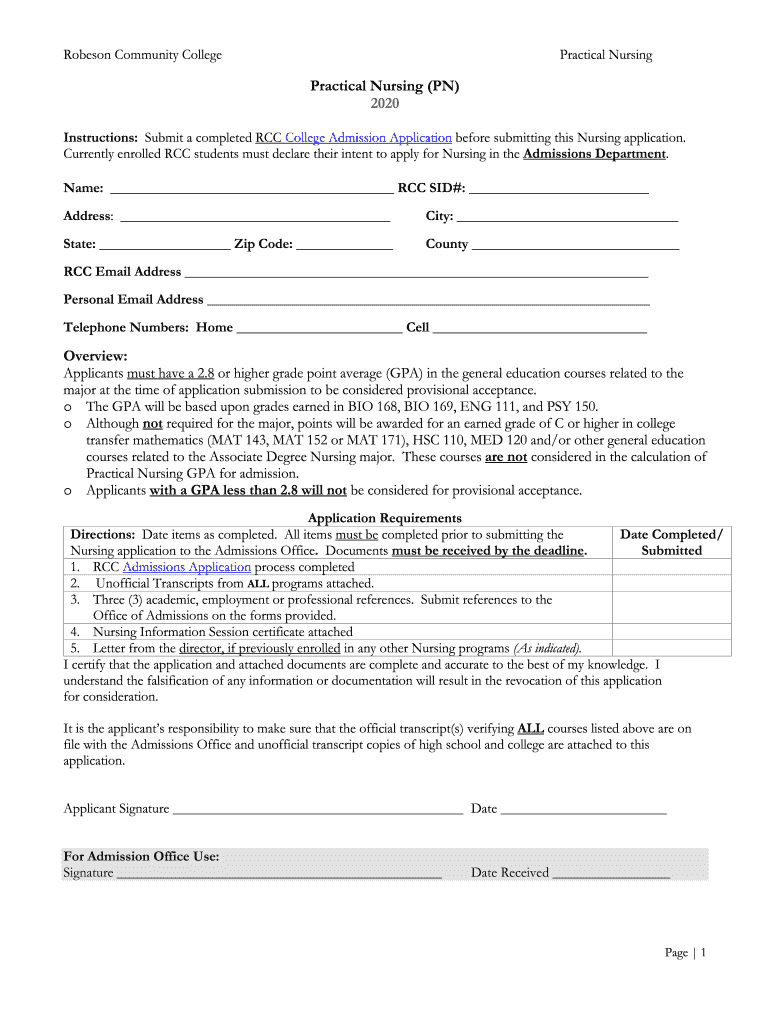
To apply for the Associate Degree Nursing program at Robeson Community College, candidates must meet specific eligibility criteria. These include:
- A minimum GPA of 2.8 in designated prerequisite courses.
- Completion of specific coursework in mathematics, biology, and English.
- Submission of unofficial transcripts and letters of reference.
- Additional points may be awarded to applicants based on completed courses and their Test of Essential Academic Skills (TEAS) scores.

Application Process & Approval Time
The application process for the Associate Degree Nursing program is structured and competitive. Applicants need to:
- Attend an information session as part of the application process.
- Submit completed applications along with all required documentation before the established deadlines.
- Await provisional acceptance, which can be confirmed after meeting health and background check requirements.
The approval time varies depending on the volume of applications received and the completeness of the submitted application materials.
Steps to Complete the Associate Degree Nursing Application
When applying for the program, candidates should follow these steps:
- Review all eligibility requirements and ensure they meet the criteria.
- Attend a mandatory information session to gain a comprehensive understanding of the program.
- Gather required documents, including transcripts and references.
- Prepare for and take the TEAS, if necessary.
- Submit the application form and requisite documents by the specified deadline.
Key Elements of the Associate Degree Nursing Program
The program includes several key elements designed to provide a well-rounded education:
- Core nursing courses covering foundational and advanced nursing practices.
- Clinical rotation experiences in various healthcare settings to gain hands-on experience.
- Learning modules on patient assessment, critical thinking, and healthcare ethics.
- Opportunities for specialization in areas such as maternal health or pediatric nursing.
State-Specific Rules for Nursing Programs
Every state, including North Carolina, has specific rules governing nursing education and licensure. In North Carolina, for example:
- The North Carolina Board of Nursing sets standards for nursing programs and oversees licensing.
- Nursing graduates must pass the NCLEX-RN exam to obtain licensure.
- State mandates require specific clinical rotation hours and content coverage within the nursing curriculum.
Software Compatibility for Application Submission
Applicants for the Associate Degree Nursing program can manage their application process using various digital tools. While Robeson Community College may not specify particular software requirements, documents like applications and transcripts are often submitted in standard formats compatible with software such as Adobe Acrobat Reader for PDFs or Microsoft Word.
Required Documents for Application Submission
To ensure a complete application, the following documents are typically required:
- Completed application form.
- Unofficial academic transcripts from previously attended institutions.
- TEAS scores if applicable.
- Letters of recommendation or references.
- Proof of residency, if applying for in-state tuition rates.
Real-World Examples of Nursing Roles Post-Graduation
Graduates of the Associate Degree Nursing program can anticipate entering various nursing roles, including:
- Registered Nurse (RN) in hospitals, clinics, or long-term care facilities.
- Specialization opportunities in fields such as oncology, intensive care, or community health.
- Continuing education or career advancements, such as Bachelor of Science in Nursing (BSN) programs.