
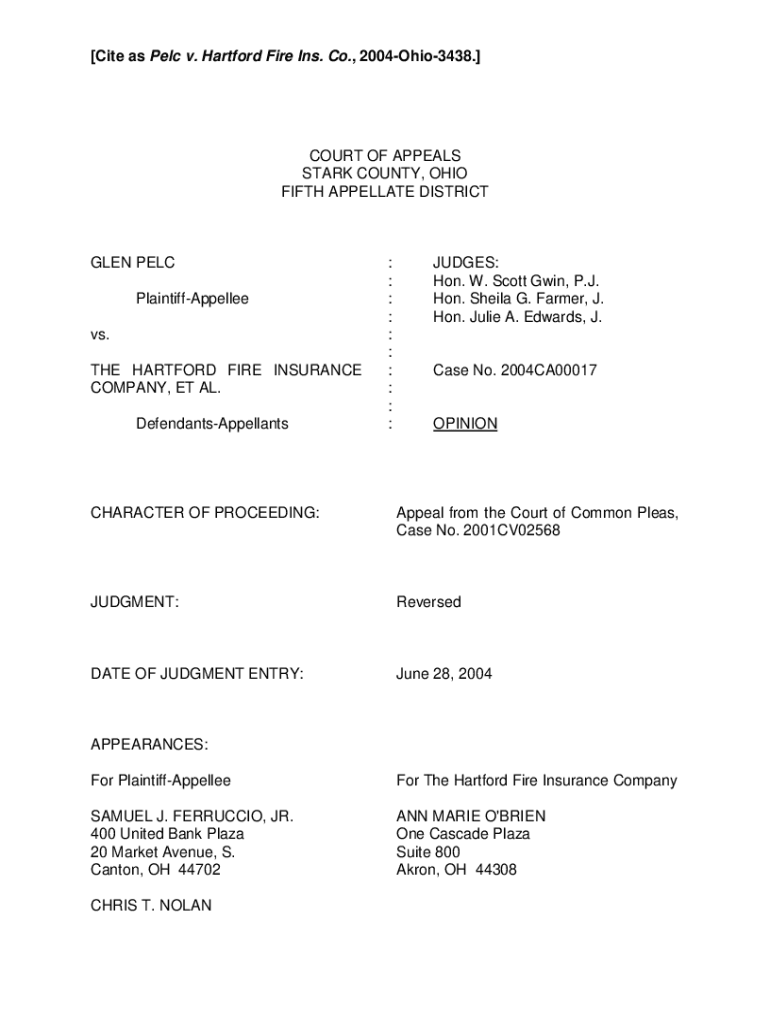







Definition and Core Concepts of Pelc v. Hartford Fire Ins. Co.
The case of Pelc v. Hartford Fire Insurance Company involves a legal examination of insurance coverage disputes after Glen Pelc, not acting within his employment scope, incurred injuries in a car accident. The trial court initially favored Pelc about certain insurance policies but rejected coverage under the general liability policy. Subsequently, the Court of Appeals overturned this decision, aligning with Hartford’s interpretation after referencing a recent ruling by the Ohio Supreme Court, Westfield v. Galatis, which significantly influenced how insurance coverage was determined.
Key Legal Elements in the Case
Several legal elements played a critical role in the Pelc v. Hartford Fire Ins. Co. decision. These elements include:
-
Insurance Policy Interpretation: Understanding the scope and limitations of insurance agreements and how precedent, such as the Westfield v. Galatis case, affects interpretation.
-
Judicial Precedent: Determining how recent court rulings influence ongoing cases, demonstrating the fluidity of legal interpretation based on evolving case law.
-
Employment Context: Evaluating the role of employment status in insurance claims, considering Pelc's accident occurred outside his employment.
Obtaining Court Case Details
To obtain detailed information about the Pelc v. Hartford Fire Ins. Co. case, interested parties can access public domain legal databases or court archives. This typically involves:
-
Accessing Online Legal Databases: Websites such as Westlaw or LexisNexis offer comprehensive case details for subscribers.
-
Visiting Law Libraries: Many university law libraries provide access to legal case records.
-
Contacting Court Clerk's Offices: For physical copies of case documents, reaching out to the Ohio Supreme Court clerk's office can be beneficial.
Steps Involved in Legal Document Review
Reviewing legal documents related to Pelc v. Hartford Fire Ins. Co. requires a structured approach:
-
Identify Key Information: Focus on headings summarizing the decisions and legal reasoning.
-
Analyze the Court's Opinion: Understand the arguments presented and the legal rationale for the final judgment.
-
Compare Case Law: Examine how prior decisions, like Westfield v. Galatis, impact rulings.
Usage of Pelc v. Hartford Fire Ins. Co. in Legal Context
The judgment in this case predominantly serves law firms, insurance companies, and policyholders:
-
Lawyers use it to understand court interpretations of insurance coverage disputes.
-
Insurance Companies apply this precedent to assess policy obligations and exemptions.
-
Policyholders leverage the case for claiming benefits or contesting insurer decisions in similar scenarios.
Important Terms in Pelc v. Hartford Fire Ins. Co.
Understanding key legal terminologies enhances comprehension of the case:
-
General Liability Policy: A type of insurance policy providing broader protection but with specified exemptions.
-
Judicial Precedent: The principle that earlier court decisions should guide the outcomes of similar future cases.
Legal Implications and Developments
Critical legal implications stem from this case, reflecting broader insurance and employment law developments:
-
Effect of Rulings on Policy Interpretation: The decision exemplifies how judicial precedents can redefine policy interpretations, affecting insurance contracts.
-
Impact on Employer Liability: Clarifies when employers are liable for injuries incurred by employees while not on duty or in work-related settings.
Filing and Documentation Guidelines
For those involved directly or indirectly with similar legal cases, proper documentation is essential:
-
Collection of All Insurance Policies: Ensure comprehensive documentation of all policies involved in a legal dispute.
-
Detailed Incident Reports: Collect accurate accounts of incidents leading to insurance claims for cohesive arguments.
State-specific Regulations
In Ohio, insurance-related legal cases like Pelc v. Hartford Fire Ins. Co. can be subject to specific state regulations:
-
Adherence to Ohio Revised Code: Ensures compliance with state-specific laws impacting insurance disputes.
-
Compliance with Ohio Supreme Court Rulings: Understanding the binding nature of state supreme court decisions.
Digital vs. Traditional Legal Resources
With advancing technology, legal professionals now utilize digital resources over traditional paper-based methods:
-
Digital Access to Case Law: Enables quick retrieval and analysis of court decisions and legal precedents.
-
Paperless Documentation Practices: Enhance organization and accessibility for ongoing and future legal reference.
Real-world Applications
The conclusions drawn from Pelc v. Hartford Fire Ins. Co. have real-world applications in insurance claims handling and legal strategies, influencing both practice and policy. This ensures a robust understanding of evolving legal practices and reinforces the importance of up-to-date legal knowledge in professional settings.




