
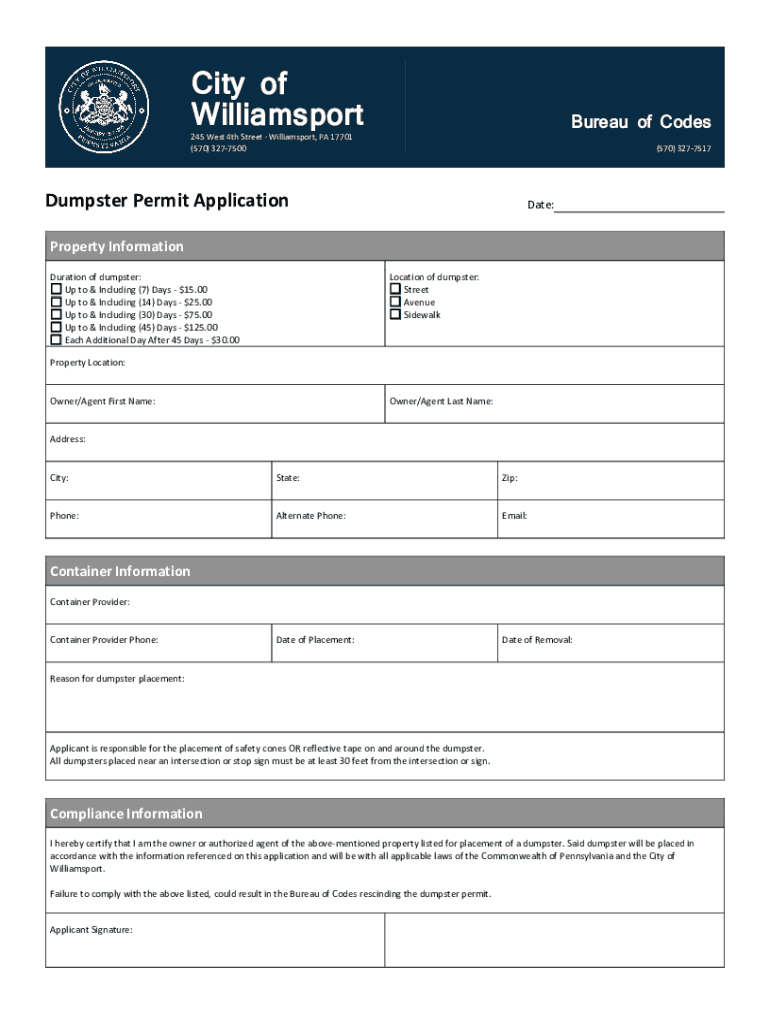







Definition and Meaning of the PA Dumpster Permit Application
The "PA Dumpster Permit Application" typically refers to the official form required by municipalities in Pennsylvania when individuals or businesses wish to place a dumpster on their property, often for construction or renovation projects. This permit ensures that the placement complies with local zoning laws and safety regulations, maintaining orderly public spaces and minimizing potential disturbances to the community.
The form generally includes sections where the applicant must provide personal information, details about the property, and specifics about the dumpster placement, such as dimensions and intended duration. Permit applications are often mandatory for temporary structures like dumpsters to ensure public safety and compliance with local ordinances.
Steps to Complete the PA Dumpster Permit Application
-
Gather Required Information:
- Before starting, collect all necessary information, including property address, size and type of the dumpster, and duration for which the permit is being requested. Also, keep ready the contact details of the applicant or business entity applying for the permit.
-
Download or Obtain the Form:
- The application can typically be downloaded from the official website of the city or municipality where the property is located or obtained in person from the local Bureau of Codes department.
-
Fill Out the Application:
- Complete all sections of the form, providing detailed and accurate information. Pay special attention to required fields, which often include property details, safety measures, and compliance certification by the applicant.
-
Attach Supporting Documents:
- Attach any necessary documentation, such as proof of property ownership or written consent from the property owner if the applicant is not the owner. Also, include any relevant site plans or drawings that illustrate the proposed dumpster placement.
-
Submit the Application:
- Submit the completed application with all required attachments to the appropriate municipal office, either through mail, in person, or via an online submission portal, if available.
-
Payment of Fees:
- Pay any associated fees as prescribed by the municipality. Fees may vary depending on the duration and location of the dumpster placement.
-
Await Approval:
- After submission, the application will undergo a review process. The applicant might receive feedback or requests for additional information before final approval and issuance of the permit.
Key Elements of the PA Dumpster Permit Application
-
Applicant Information:
- This section requires details about the individual or organization applying for the permit, including name, contact information, and role (property owner, contractor, etc.).
-
Property Details:
- Information about the property where the dumpster will be placed, such as the address, dimensions of the property, and any relevant geographic or zoning codes.
-
Dumpster Specifications:
- Details about the dumpster itself, including size, type (open-top, roll-off), and the company supplying it. Information about the duration of planned use is also collected here.
-
Compliance Certification:
- The applicant must certify that the information provided is accurate and agree to comply with local regulations related to dumpster placement, safety, and environmental considerations.
-
Safety Measures:
- Any planned measures to prevent accidents, maintain public safety, and minimize disruption in the area. This might cover signage, lighting, and fencing around the dumpster.
Importance and Utility of the PA Dumpster Permit Application
Securing a dumpster permit is crucial for several reasons:
-
Regulatory Compliance:
- Ensures activities align with local municipal codes and zoning laws, preventing unauthorized use of public space.
-
Public Safety:
- Promotes safety by mandating adherence to placement guidelines, thereby reducing the risk of accidents or injury.
-
Community Harmony:
- Helps in maintaining good relations with neighbors and the broader community by regulating potentially disruptive activities.
-
Environmental Protection:
- Ensures that waste disposal activities do not negatively impact the local environment through provisions for handling types of waste safely.
State-Specific Rules for the PA Dumpster Permit Application
Different cities within Pennsylvania may have unique regulations or requirements concerning dumpster permits. For instance, the City of Williamsport may require applicants to comply with specific safety guidelines or provide additional documentation related to structural safety if the dumpster is near sidewalks or public foot traffic areas.
Applicants should contact their local Bureau of Codes or equivalent authority to understand the precise requirements applicable to their specific area.
Legal Use of the PA Dumpster Permit Application
When using this application, the applicant agrees to adhere to all local and state regulations concerning dumpster usage. Any misuse or placement of dumpsters without necessary permits can result in fines or legal actions.
Municipalities enforce these rules to ensure proper waste management and reduce the negative impact on the community, making adherence crucial for all applicants.
Who Typically Uses the PA Dumpster Permit Application
The application is primarily used by:
-
Construction Companies:
- During renovations or building projects that require substantial waste disposal.
-
Property Owners:
- Individuals undertaking large-scale clean-outs or landscaping projects that necessitate a temporary dumpster.
-
Waste Management Firms:
- Organizations needing to place dumpsters on properties as part of their service delivery.


Submission Methods for the PA Dumpster Permit Application
Applicants can submit their applications through various methods:
-
Online Submission:
- Many municipalities offer online portals for faster and more convenient submissions.
-
In-Person Submission:
- Applications can be submitted directly to the Bureau of Codes office for those preferring face-to-face interactions.
-
Mail Submission:
- Completed applications with necessary documents can be mailed to the appropriate municipal office.
Each method has its advantages, and the choice may depend on personal preference or specific requirements of the local authority.




