







Definition & Meaning
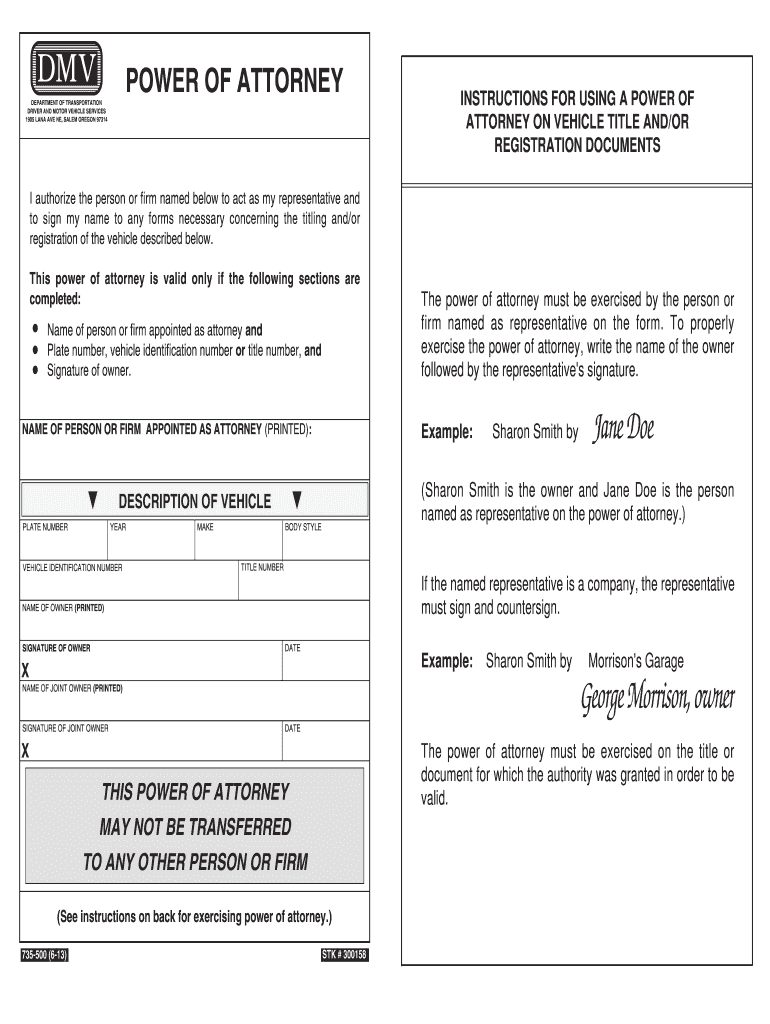
The 735-500 Power of Attorney is a legal document commonly used in the United States to authorize an individual or entity to act on behalf of the vehicle owner regarding title and registration matters. This specific power of attorney form empowers the appointed representative to complete transactions and make decisions about a vehicle’s title and registration details. It is critical that the details on this form, such as the representative’s name and vehicle specifics, are accurately filled out to validate the authorization.
Important Considerations
- A Power of Attorney (POA) is legally binding and grants the representative specified powers.
- The form is specifically for vehicle title and registration, not general or unrelated matters.
- Proper completion of the form is essential for it to be legally effective.
Key Elements of the 735-500 Power of Attorney
Understanding the critical components of the 735-500 Power of Attorney can help ensure it is completed correctly and in alignment with legal requirements.
Essential Information
- Appointed Representative: Includes the full name and contact details of the individual or entity being granted authority.
- Owner Details: Information about the vehicle owner(s), ensuring all parties are accurately represented.
- Vehicle Specifications: Includes make, model, year, and vehicle identification number (VIN).
- Signatures: Required from the owner and any joint owners to authenticate the authorization process.
Possible Attachments
- Supporting Documents: May include identification copies or proof of vehicle ownership.
Steps to Complete the 735-500 Power of Attorney
Detailed instructions for completing the form are essential for proper submission.
- Collect Required Information: Gather details about the vehicle, owner(s), and representative.
- Fill Out Owner Details: Input information accurately to avoid processing delays.
- Provide Vehicle Information: Include make, model, year, and VIN clearly.
- Name the Appointed Representative: Enter the representative’s details completely.
- Signature Section: All required parties must sign for the document to be valid.
- Review for Accuracy: Double-check all entries before submitting the form.
Common Mistakes to Avoid
- Incorrect or Missing Information: Ensuring accuracy is vital for processing.
- Incomplete Signatures: All designated parties must sign properly.
Legal Use of the 735-500 Power of Attorney
Understanding the legal context of using the 735-500 Power of Attorney ensures that it is used appropriately.
Scope of Authority
- The form is limited to title and registration tasks related to vehicles.
- The form does not permit broader escrow or financial management duties.
Limitation of Transferability
- The powers granted cannot be assigned to another representative outside the scope of the form.
Who Typically Uses the 735-500 Power of Attorney
The 735-500 Power of Attorney is designed for use by various stakeholders involved in vehicle transactions.


Common Users
- Vehicle Owners: Individuals looking to appoint someone to handle registration or title matters.
- Dealerships: Act on behalf of vehicle buyers and sellers for processing registrations.

Situational Examples
- Out-of-State Transactions: When the owner is not available to process local documentation.
- Company Owned Vehicles: When corporations need an employee to handle title registrations.
Importance of 735-500 Power of Attorney
The significance of using the 735-500 Power of Attorney cannot be overstated for those handling vehicle registrations.
Benefits of Proper Use
- Efficiency: Streamlines the title and registration process without the owner's physical presence.
- Flexibility: Allows for delegation of specific responsibilities, making it easier for owners to manage vehicle-related paperwork remotely.
Risk Mitigation
- Reduces potential obstacles in vehicle transactions by providing clear authority and representation.
State-Specific Rules for the 735-500 Power of Attorney
Compliance with state-specific regulations is crucial in deploying the 735-500 Power of Attorney effectively.
Variations in State Requirements
- Certain states may require additional notarization or documentation for the form to be recognized.
- It’s important to verify the requirements of the specific state where the vehicle is registered.
Examples of Using the 735-500 Power of Attorney
Practical applications of the 735-500 Power of Attorney highlight its utility.
Real-World Scenarios
- Transfer of Ownership: When selling a car and needing someone to handle the registration transition.
- Title Corrections: Appointing a representative to resolve issues with title documentation.
Case Studies
- Time-Sensitive Transactions: Using the POA to expedite processes for urgent vehicle purchases or sales.




