




01. Edit your form online
Type text, add images, blackout confidential details, add comments, highlights and more.

Type text, add images, blackout confidential details, add comments, highlights and more.

Draw your signature, type it, upload its image, or use your mobile device as a signature pad.

Send it via email, link, or fax. You can also download it, export it or print it out.
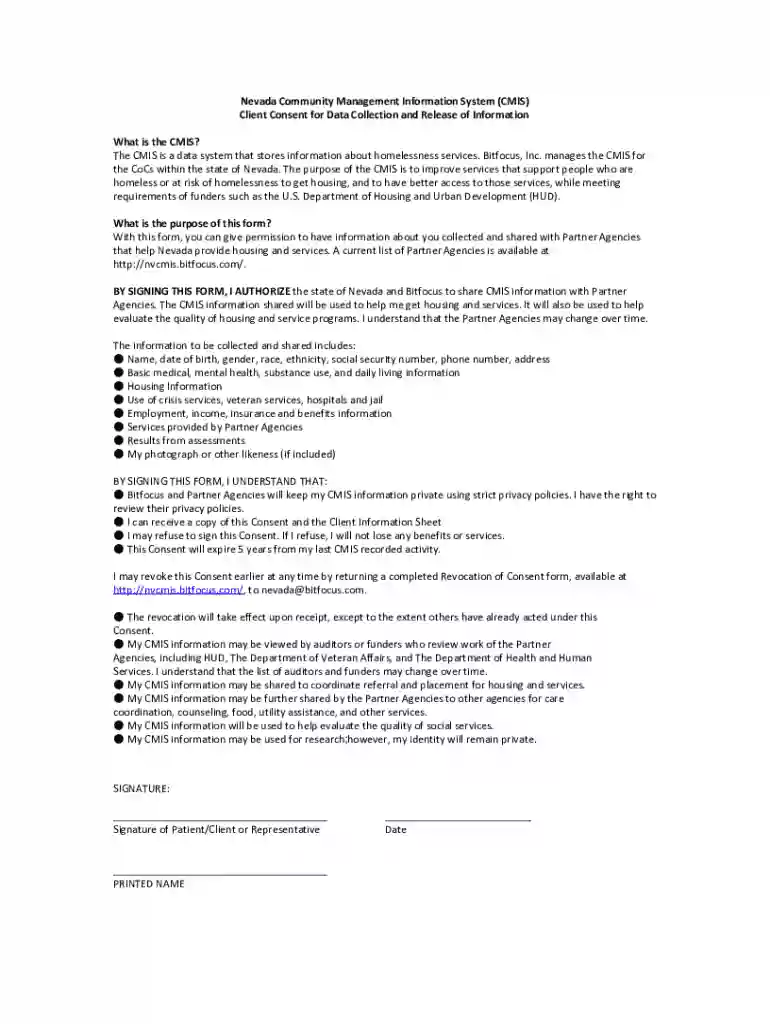
The Nevada Community Management Information System (CMIS) is a vital resource managed by Bitfocus, Inc. that aims to enhance service delivery for individuals experiencing homelessness in Nevada. By collecting and sharing information across various agencies, CMIS improves coordination, accessibility, and effectiveness of services. Its primary function is to store data on homeless individuals, including personal information, service history, and required assistance types. This central repository enables a collaborative approach to service management, ensuring that all necessary parties have relevant, updated information.
The CMIS Client Form acts as a consent mechanism for clients receiving services. It allows clients to authorize the sharing of their personal information with Partner Agencies, facilitating better coordination in service provision. Users must fill out this form accurately to ensure service eligibility and uninterrupted support. Typically, service providers assist with form completion, guiding clients through each field to prevent errors or omissions that could impact service delivery.
Personal Information: Start by entering your personal details, including your full name, birth date, and contact information. This section identifies you within the system.
Consent Authorization: Indicate whether you consent to share your personal information with Partner Agencies. This decision is crucial as it affects how your data will be used and shared.
Service Details: Provide information about your current service needs. Be as detailed as possible to ensure accurate service provision.
Reviewer’s Section: This part is completed by a service provider who verifies the information and explains any implications of consenting or not.
Signature and Date: Finally, sign and date the form to officially complete the consent process. Ensure all information is correct before submission.
Completing the CMIS Client Consent Form is imperative for individuals who wish to access homelessness services in Nevada. By consenting to data sharing, clients enable a comprehensive approach to service delivery, where agencies work collaboratively to address individual needs. While consent is not mandatory, it significantly enhances the quality and coordination of care. Clients retain the right to refuse consent without fear of losing benefits, ensuring decisions are made in their best interest.
The CMIS Consent Form is primarily used by individuals experiencing homelessness or those at risk in Nevada. Service providers working within the homelessness sector also engage with this form extensively, ensuring clients understand their rights and the implications of data sharing. Agencies coordinating housing, healthcare, and social services utilize the form to facilitate seamless service delivery.
Legal compliance is foundational to the Nevada CMIS Client Form. The ESIGN Act governs electronic signatures, ensuring any digital consents are legally binding. Additionally, privacy laws underscore the importance of safeguarding personal data, requiring agencies to handle shared information with discretion and integrity. Data sharing is secured with robust encryption, aligning with federal standards for confidentiality and protection.
Clients can submit the CMIS Client Form through various channels for convenience:
Both electronic and paper versions of the CMIS Client Form are available, each serving distinct purposes. The electronic version allows for swift processing, immediate updates, and better data management, while the paper version remains crucial for clients with limited technological access. The choice between formats accommodates the diverse needs of the client base, maximizing accessibility to homelessness services.
By understanding the Nevada Community Management Information System and effectively utilizing the CMIS Client Form, stakeholders in the homelessness service sector can work collaboratively to drive impactful outcomes for individuals in need.
We've got more versions of the benevate blob core windows erap-lasvegasnvNevada Community Management Information System (CMIS) Clie form. Select the right benevate blob core windows erap-lasvegasnvNevada Community Management Information System (CMIS) Clie version from the list and start editing it straight away!
At DocHub, your data security is our priority. We follow HIPAA, SOC2, GDPR, and other standards, so you can work on your documents with confidence.


