







Definition & Meaning
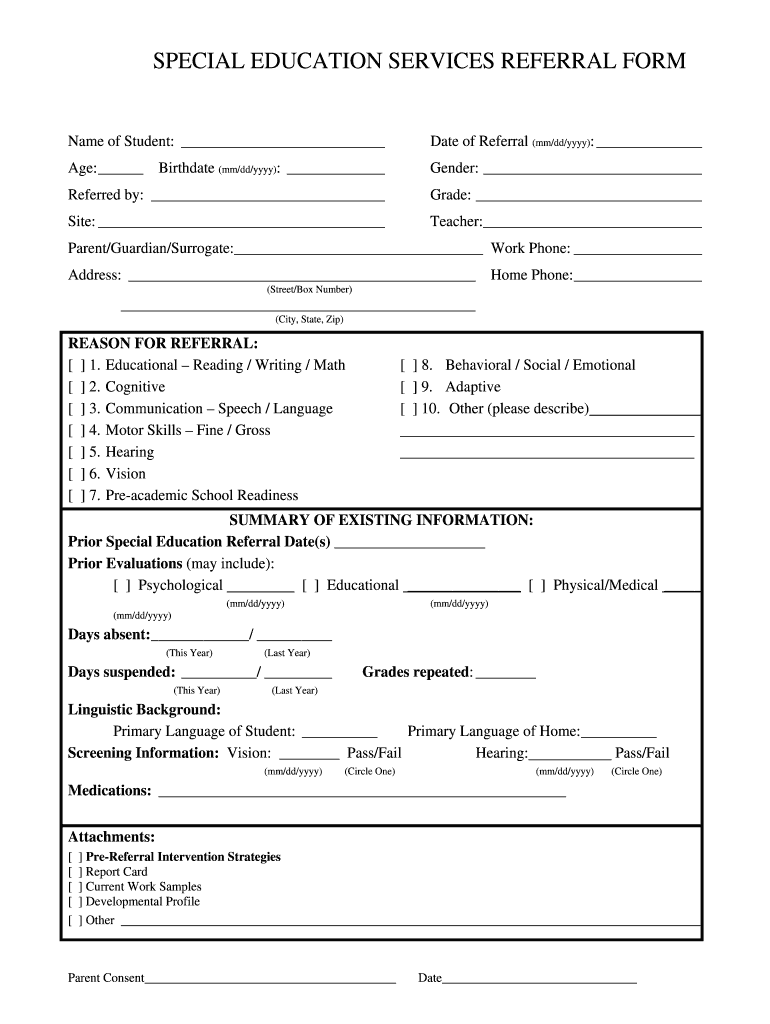
The Special Education Services Referral Form is a critical tool in the process of identifying and supporting students who may require special education services. This form is designed to collect comprehensive information about a student's needs, facilitating a structured evaluation process. It includes sections for personal details, educational history, and reasons for referral across categories such as cognitive and communication abilities. Gathering this information helps educators and specialists determine the most appropriate support interventions for each student.
Key Elements of the Special Education Services Referral Form
The form contains several key elements essential for thorough evaluation:
- Student Personal Details: Includes name, age, grade, and contact information, serving as the foundational information necessary for record-keeping and follow-up.
- Reasons for Referral: Documents specific concerns or issues that have prompted the referral, categorized into educational, cognitive, emotional, or communication needs.
- Previous Assessments: Information about any prior evaluations or interventions the student has undergone, providing context for current concerns.
- Family and Linguistic Background: Details about the student's primary language and any relevant cultural factors, essential for understanding the student in a broader context.
- Attendance Records and Academic Performance: Documentation of the student’s attendance and academic history, which may highlight trends or issues impacting learning.
Steps to Complete the Special Education Services Referral Form
Completing the form requires several precise steps to ensure accuracy and comprehensiveness:
- Collect Student Information: Begin by gathering personal and educational details, including prior assessment records.
- Document Concerns: Specify the areas of concern that warrant special education service consideration, using categories provided in the form.
- Attach Supporting Documents: Include relevant documentation, such as previous evaluations or teacher reports, which can aid in developing a comprehensive understanding of the student’s needs.
- Review for Completeness: Check that all fields are filled accurately and that all necessary information is included before submitting the form.
- Obtain Parent/Guardian Consent: Ensure that parental consent is obtained and properly documented, as it is a critical component of the referral process.
Who Typically Uses the Special Education Services Referral Form
This form is used primarily by educators, school psychologists, and special education coordinators. They initiate the referral process after observing or being informed of concerns regarding a student's ability to succeed in a traditional educational setting without additional support. Parents and guardians are also involved as they provide consent and may contribute additional contextual information regarding the student's needs and history.


Important Terms Related to the Special Education Services Referral Form
Understanding the terminology associated with this form is crucial:
- IEP (Individualized Education Plan): A customized educational plan developed for students eligible for special education services.
- Eligibility Criteria: Specific conditions that determine whether a student qualifies for special education services, based on evaluations.
- 504 Plan: A plan developed to ensure that a child who has a disability identified under the law receives accommodations that will ensure their academic success and access to the learning environment.
Why Should You Use the Special Education Services Referral Form
The form is indispensable in ensuring that all students receive appropriate educational opportunities tailored to their needs. It formalizes the referral process, providing a clear and comprehensive framework for evaluating and addressing each student's unique challenges. Utilizing this form helps educators and institutions maintain consistent practices while ensuring compliance with federal and state regulations related to special education.
Legal Use of the Special Education Services Referral Form
The form adheres to U.S. education laws and guidelines, such as the Individuals with Disabilities Education Act (IDEA). Compliance with legal standards ensures that students' rights to receive a free appropriate public education (FAPE) are upheld. The form and its process must be executed meticulously to prevent any legal challenges related to discrimination or denial of educational access.
Form Submission Methods
Typically, the form can be submitted through various channels:
- Online Submission: Some school districts offer secure online portals for submitting forms, which provide a fast and traceable method.
- Physical Submission: Forms can be completed on paper and delivered in-person to the school’s special education department to ensure personal handling.
- Mail Submission: Sending the completed form via mail, which requires attention to deadlines to ensure timely processing.
Adhering to these submission methods ensures that the process continues smoothly and without delay in addressing the student's needs.


