




01. Edit your will search county court online
Type text, add images, blackout confidential details, add comments, highlights and more.

Type text, add images, blackout confidential details, add comments, highlights and more.

Draw your signature, type it, upload its image, or use your mobile device as a signature pad.

Send it via email, link, or fax. You can also download it, export it or print it out.
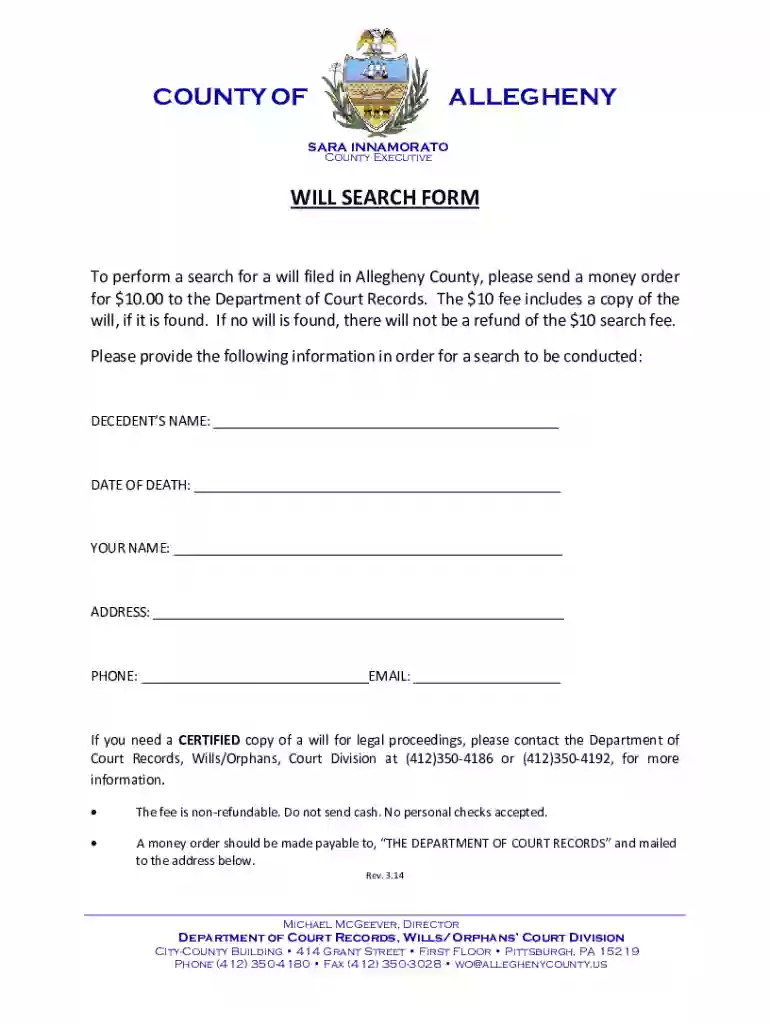
The "Will Search Request Form - Allegheny County, PA" is a formal document used to request a search for a will filed in Allegheny County, Pennsylvania. This form is typically utilized by individuals seeking to verify the existence of a will or obtain a certified copy of a will for legal purposes. Ensuring that the correct document is requested can prevent delays in legal processes, particularly in probate matters where the timely location of a will is critical.
Using the "Will Search Request Form - Allegheny County, PA" involves several critical steps. Firstly, interested parties must accurately complete the form, providing all necessary details about the deceased person, including full name and date of death. The form requires a standard fee of $10, which is non-refundable, to initiate the search. After completion, the form should be submitted through one of the designated submission methods, accompanied by the appropriate payment.
In Pennsylvania, the process for will searches is rigorous, with each county potentially operating under slightly different rules. For Allegheny County, specific local regulations must be observed, such as fee schedules and submission protocols. Understanding these local peculiarities is essential to ensure a seamless process and avoid unnecessary delays.
When submitting the Will Search Request Form, additional documents may be required:
The form is primarily used to facilitate legal transactions concerning estate settlement or probate processes. It legally obliges the county to conduct a thorough search of its records for the document in question. The results can be used in court proceedings to validate estate claims or settle disputes among beneficiaries.
Using the form appropriately ensures compliance with Allegheny County's legal requirements, aiding in the transparent and efficient processing of estate matters. The comprehensive use of this form prevents miscommunication and facilitates the timely settlement of estates, making it an essential tool for legal practitioners and individuals alike.
We've got more versions of the will search county court form. Select the right will search county court version from the list and start editing it straight away!
At DocHub, your data security is our priority. We follow HIPAA, SOC2, GDPR, and other standards, so you can work on your documents with confidence.


