
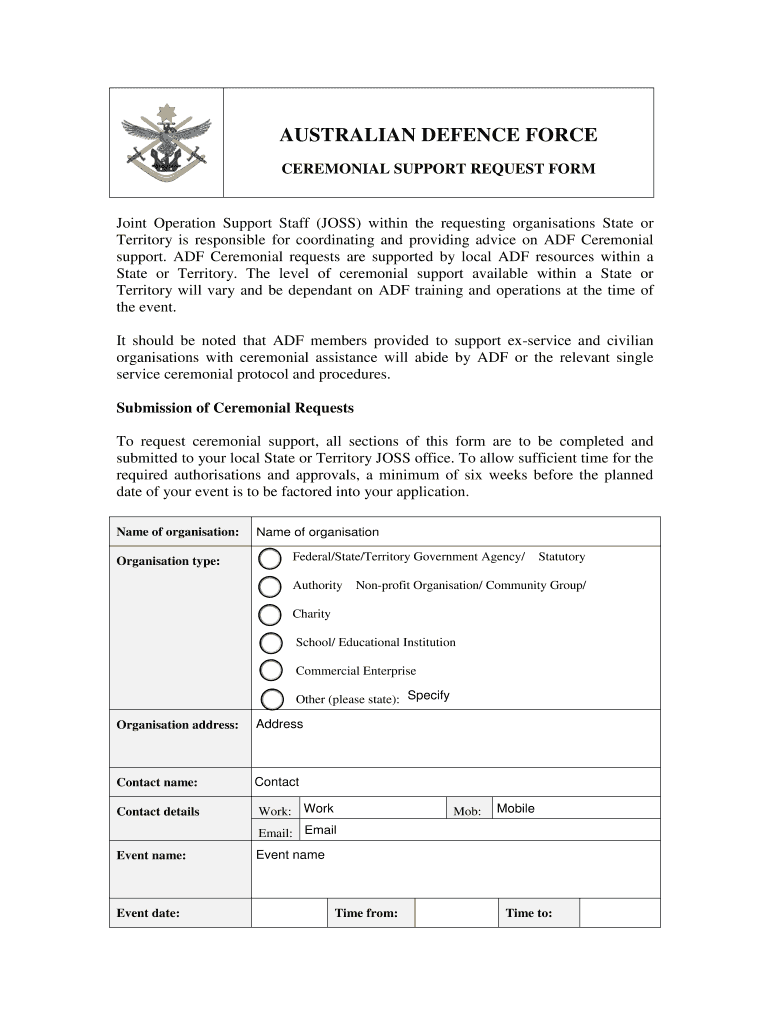







Key Elements of the Request for Ceremonial Support from Defence
The request for ceremonial support from defense encompasses several crucial components that are essential for successfully obtaining support from the Australian Defence Force (ADF). Understanding these elements can aid organizations in drafting a complete and compliant request. Primarily, organizations must specify the type of ceremonial assistance required, whether it's band performances, honor guards, or other forms of support. Each request must clearly articulate the event's details, including the purpose, date, location, and expected audience size.
Additionally, it's imperative to outline the responsibilities of coordinating bodies like the Joint Operation Support Staff (JOSS) within the application, ensuring effective support orchestration. Documentation should also acknowledge privacy considerations, outlining how the applicant organization will handle any sensitive information obtained during the process.
An efficient request also provides detailed contact information for various state offices associated with the application process. These offices may offer guidance and facilitate smooth communication regarding the application status and any additional steps the organization may need to take.
Steps to Complete the Request for Ceremonial Support from Defence
Completing the request for ceremonial support is a thorough process that involves several key steps. Below is a streamlined sequence of actions to help organizations properly fill out and submit the necessary documents:
-
Identify the Event Requirements: Determine the specific type of ceremonial support required for the event.
-
Download the Form: Obtain the form from the relevant authority's website or directly from the associated state office.
-
Gather Necessary Information: Compile critical details about the event, including date, location, and the nature of the event.
-
Fill Out the Form: Enter all required information accurately, ensuring clarity and correctness.
-
Include Contact Information: Provide precise contact details for both the organization and key contacts within associated authorities.
-
Attach Supporting Documents: Collect and attach any supporting documentation that may strengthen the request, such as event summaries or community endorsements.
-
Submit the Application: Send the completed form and attachments to the designated contact within the defense offices, either online, by mail, or in person.
-
Follow Up: After submission, follow up with the office to confirm receipt and get updates about the approval process.
How to Obtain the Request for Ceremonial Support from Defence Form
Securing the request form for ceremonial support is a straightforward task that can be achieved by following a few simple steps. First, visit the official website of the relevant defense authority or agency linked to ceremonial affairs. Most often, these forms are available directly on the site for download.
If online retrieval is not ideal, consider contacting the state office directly via phone or email, inquiring about obtaining a physical copy of the form. They can guide where physical forms can be picked up or if they can be mailed to your address.
Ensure you request the most current version, as this guarantees alignment with the latest guidelines and requirements. Availability might vary depending on the region, so checking in advance will prevent any unnecessary delays in the application process.
Legal Use of the Request for Ceremonial Support from Defence
The request for ceremonial support from defense is governed by specific legal parameters that ensure the protocol's integrity and correct usage. Such requests must only be submitted by officially recognized organizations and comply with the stipulated guidelines set forth by the defense agency.
Any false information within these requests could lead to legal repercussions and jeopardize the possibility of support. It is crucial for organizations to fully understand and adhere to the legal criteria, ensuring their requests are genuine and related to legitimate events. Compliance with privacy laws when handling shared information is also non-negotiable, emphasizing the importance of understanding each legal aspect tied to the form submission.
Why Should You Request Ceremonial Support from Defence
Requesting ceremonial support from defense offers multiple benefits, particularly in lending an event a sense of formality and enhancing its prestige. Events that involve military bands, flyovers, or honor guards are often perceived as more significant, which can increase public interest and attendance.
Additionally, defense support can elevate an organization's profile by demonstrating a connection with national symbols of strength and unity. This not only bolsters event credibility but may also attract media attention, potentially benefiting future organizational ventures. Such participation reinforces community ties with national defense entities, fostering goodwill and cooperative relationships.
Important Terms Related to Request for Ceremonial Support from Defence
When dealing with the request for ceremonial support from defense, it's essential to familiarize yourself with several key terms.
- Joint Operation Support Staff (JOSS): A critical coordinating body in charge of orchestrating defense ceremonial support logistics.
- Ceremonial Assistance: Any officially sanctioned support, including personnel, bands, or other military honors provided during an event.
- Privacy Considerations: Guidelines and legal obligations concerning the protection and handling of personal data submitted during the application process.
- Submission Timeline: The period within which requests must be submitted to be considered for support, often weeks or even months ahead of the event date.
Understanding these terms can make navigating the request process more straightforward and ensure compliance with established protocols.
Examples of Using the Request for Ceremonial Support from Defence
Real-world scenarios effectively demonstrate the application of ceremonial support requests. Consider a city commemorating its centennial with various festivities. Such an event might benefit greatly from a military band performance, with the city submitting a request months in advance to secure defense participation.
Another example could be an unveiling ceremony for a new veterans' monument, where honor guards could add ceremonial gravitas to the proceedings. Organizations must detail the historical and community significance in their applications, explicitly explaining how defense participation enhances the occasion's impact.
These examples highlight the form's utility in augmenting diverse events and underscore the value of thoughtful requests.




