







Definition & Meaning
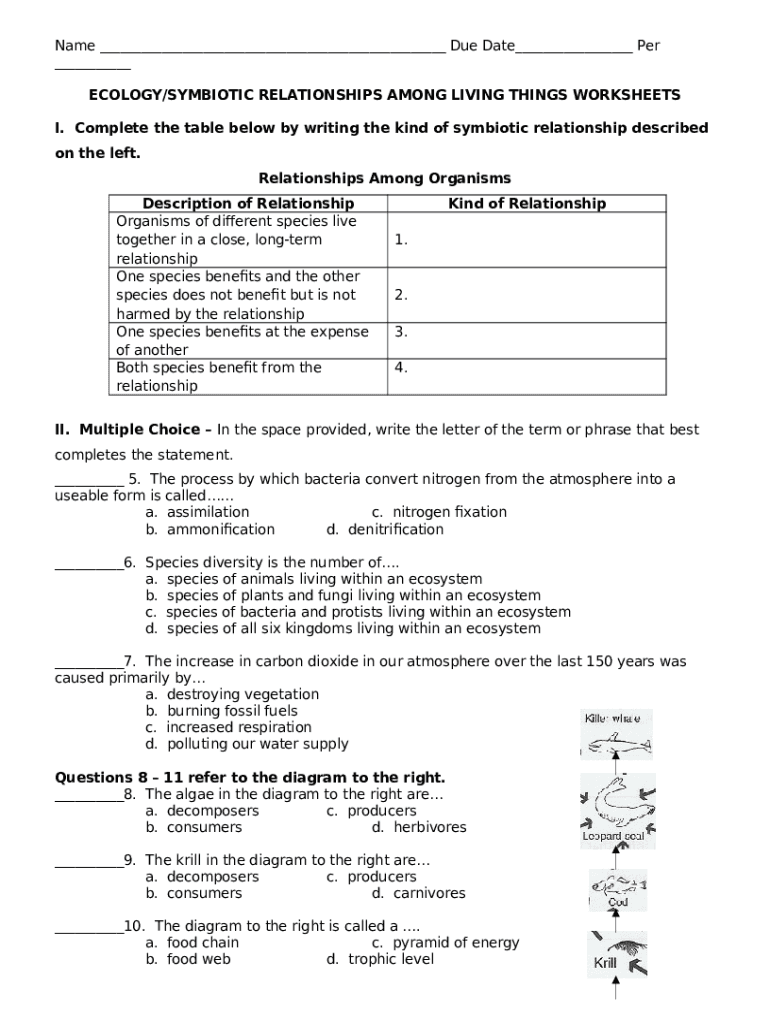
The "Symbiotic Relationships Among Living Things - Humble ISD" document focuses on the ecological interactions between different organisms and their environments. Symbiotic relationships encompass parasitism, mutualism, and commensalism, detailing how species coexist and impact each other's survival and development. The Humble Independent School District (Humble ISD) likely utilizes this form for educational purposes, offering students insights into ecological concepts critical for understanding biodiversity and ecosystems.
How to Use the Symbiotic Relationships Among Living Things - Humble ISD Form
To effectively use this form, educators and students can follow these steps:
-
Identification: Begin by using the table provided to identify different types of symbiotic relationships in various species.
-
Assessment: Complete the multiple-choice questions that test understanding of ecological concepts and interactions.
-
Classification: Use the specific examples section to classify relationships into parasitism, mutualism, or commensalism.
The form helps students visualize and contextualize ecological theories through practical examples, thus reinforcing their learning.
Key Elements of the Symbiotic Relationships Among Living Things - Humble ISD
- Types of Relationships: Clearly defined categories for parasitism, mutualism, and commensalism.
- Interactive Worksheets: Designed for hands-on learning, the worksheets allow for active participation in classifying real-world examples.
- Ecological Insights: Offers students insights into the roles species play in their ecosystems, promoting critical thinking and environmental awareness.
Steps to Complete the Symbiotic Relationships Among Living Things - Humble ISD
- Review the Definitions: Familiarize yourself with symbiotic relationship definitions provided in the document.
- Collect Data: Use the ecological and relationship tables to gather specific examples.
- Complete Exercises: Answer the multiple-choice questions and complete classification sections using the collected data.
- Review Outputs: Collaborate with peers to review answers for a deeper understanding.
These steps guide users through the process, ensuring comprehensive comprehension and application of ecological concepts.
Who Typically Uses the Symbiotic Relationships Among Living Things - Humble ISD
- Students: Primarily used by students within Humble ISD to understand ecological relationships.
- Teachers: Used by educators as a teaching aid to enhance curriculum about ecosystems and biodiversity.
- Researchers: Occasionally referenced by ecological researchers studying classroom engagement with ecology.
These groups benefit from the detailed exploration of species interactions and their applications in real-world contexts.


Important Terms Related to Symbiotic Relationships Among Living Things - Humble ISD
- Parasitism: A relationship where one organism benefits at the expense of another.
- Mutualism: A cooperative interaction where both organisms benefit.
- Commensalism: One organism benefits while the other is neither helped nor harmed.
These terms form the foundational language necessary for understanding and discussing symbiotic relationships.
Examples of Using the Symbiotic Relationships Among Living Things - Humble ISD
- Parasitism Example: The interaction of a tapeworm inside a host organism, extracting nutrients and potentially harming the host.
- Mutualism Example: The relationship between bees and flowers, where bees obtain nectar, and flowers are pollinated.
- Commensalism Example: Barnacles attaching to a whale’s skin, gaining mobility and access to nutrient-rich waters without harming the whale.
These examples help illustrate each type of symbiotic relationship, making abstract concepts more tangible.
Eligibility Criteria
Educational materials like "Symbiotic Relationships Among Living Things - Humble ISD" are typically designed for students within specific grade levels, such as middle or high school. Participants should have a fundamental understanding of biology and ecology to fully engage with the concepts. This ensures that users can appropriately interact with and benefit from the form's content.





