




Here's how it works

01. Edit your form online
Type text, add images, blackout confidential details, add comments, highlights and more.

02. Sign it in a few clicks
Draw your signature, type it, upload its image, or use your mobile device as a signature pad.

03. Share your form with others
Send it via email, link, or fax. You can also download it, export it or print it out.
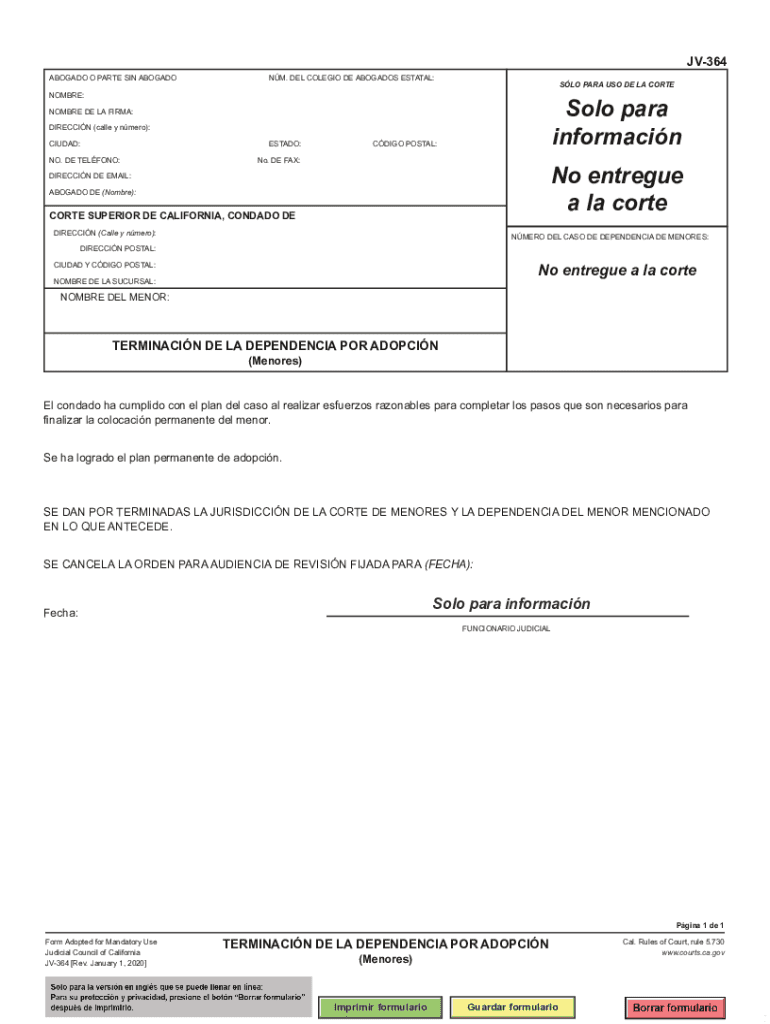
How to use or fill out TERMINACIN DE LA DEPENDENCIA POR ADOPCION Judicial Council forms with our platform

- Click ‘Get Form’ to open the TERMINACIN DE LA DEPENDENCIA POR ADOPCION form in the editor.
- Begin by entering your personal information in the designated fields, including your name, address, and contact details. Ensure accuracy as this information is crucial for court records.
- Fill in the case number related to the minor's dependency. This number is essential for tracking and referencing your case within the court system.
- Provide details about the minor, including their name and any relevant information regarding their adoption status. This section confirms that all necessary steps have been taken for permanent placement.
- Review all entered information carefully. Once confirmed, you can save or print the completed form directly from our platform for submission.
Start using our platform today to streamline your document editing and ensure a smooth completion of your forms!
Fill out TERMINACIN DE LA DEPENDENCIA POR ADOPCIN Judicial Council forms online
It's free
It's free
See more TERMINACIN DE LA DEPENDENCIA POR ADOPCIN Judicial Council forms versions
We've got more versions of the TERMINACIN DE LA DEPENDENCIA POR ADOPCIN Judicial Council forms form. Select the right TERMINACIN DE LA DEPENDENCIA POR ADOPCIN Judicial Council forms version from the list and start editing it straight away!
Got questions?
We have answers to the most popular questions from our customers. If you can't find an answer to your question, please contact us.
Contact us
Who makes up the Judicial Council?
The Judicial Council is composed of 21 voting members: The Chief Justice. 14 judicial officers appointed by the Chief Justice (1 associate justice of the Supreme Court, 3 justices of the Courts of Appeal, 10 trial court judges) 4 attorney members appointed by the State Bar Board of Trustees.
What are judicial council forms?
Judicial Council Forms. To help you make sure that your court documents have the information the court needs, the California courts have created a set of court forms called Judicial Council forms.
What is the purpose of the Federal Judicial Council?
The Judicial Council sets the direction for improving the quality of justice and advancing the consistent, independent, impartial, and accessible administration of justice by the judicial branch for the benefit of the public.
What does the Judicial Council of California do?
Under the leadership of the Chief Justice and in ance with the California Constitution, the Judicial Council: * Establishes direction and set priorities for the continual improvement of the court system; * Promulgates rules of court administration, practice, and procedure; * Sponsors and takes positions on
What is the judicial councils role in California?
0:16 7:26 However in 1926 Californians amended the state constitution to create the judicial Council toMoreHowever in 1926 Californians amended the state constitution to create the judicial Council to provide leadership for the judicial branch. Today the council is well defined as the policy-making body
Security and compliance
At DocHub, your data security is our priority. We follow HIPAA, SOC2, GDPR, and other standards, so you can work on your documents with confidence.
Learn more


People also ask
What is the Judicial Council of the United States?
Circuit Judicial Councils are panels of the United States federal courts that are charged with making necessary and appropriate orders for the effective and expeditious administration of justice within their circuits.
What is the California judicial branch responsible for?
is charged with interpreting the laws of the State of California. It provides for the orderly settlement of disputes between parties in controversy, determines the guilt or innocence of those accused of violating laws, and protects the rights of individuals.