
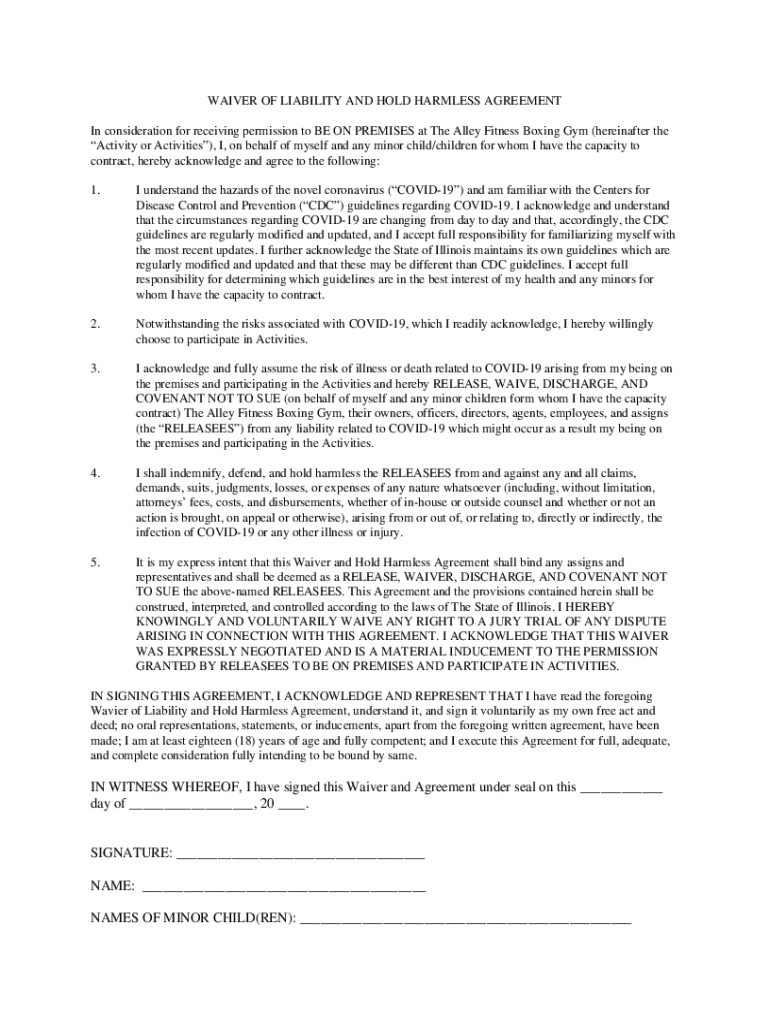







Definition & Meaning
A "Free Release of Liability and Hold Harmless Agreement" is a legal document designed to protect an entity from legal claims related to injuries or damages incurred during an activity, such as using a bounce house. By signing this waiver, the participant acknowledges the risks involved, agrees to assume responsibility for potential injuries, and waives the right to sue the provider.
Key Concepts
- Waiver of Liability: Protects businesses from lawsuits by participants who may become injured.
- Hold Harmless Agreement: Ensures participants cannot hold a business responsible for any harm.
- Indemnity Clause: Requires participants to compensate the business for any claims brought against it due to the participant's actions.
How to Use the Free Release of Liability and Hold Harmless Agreement
Using this template involves several important steps to ensure it suits your specific business or event needs.
Steps to Utilize
- Identify Necessary Customizations: Tailor the waiver to fit the specific activity and potential risks.
- Include Detailed Risk Descriptions: Clearly outline all possible risks involved in the activity to ensure participants are fully informed.
- Ensure Proper Terminology: Use precise legal language to clearly state the terms and conditions of the waiver.
- Make Available for All Participants: Provide the waiver to all participants prior to the activity, ensuring they have time to read and understand it.
Important Considerations
- Legal Review: Have a lawyer review the waiver to ensure compliance with local legal standards.
- Participant Education: Explain the document in layman’s terms to avoid misunderstandings.
Steps to Complete the Free Release of Liability and Hold Harmless Agreement
Completing the waiver accurately is a critical step to ensure its enforceability.
Step-by-Step Process
- Provide Participant Information: Include full names, addresses, and contact details of the participants.
- Detail the Activity: Describe the specific event and its location.
- Explain the Risks: List all potential risks associated with the activity.
- Signature Collection: Obtain signatures from all participants, verifying they understand and agree to the terms.
Ensure Completeness
- Date of Agreement: Record the date when the participant signed the waiver.
- Guardian’s Signature: For minors, obtain a legal guardian’s signature alongside the participant's.
Why Use a Free Release of Liability and Hold Harmless Agreement
Utilizing this waiver can save businesses from legal battles and ensure all parties are aware of their responsibilities.
Benefits
- Reduces Legal Liability: Protects from lawsuits in case of an injury or accident.
- Clarifies Expectations: Participants understand the risks and their responsibility.
- Enhances Safety Compliance: Encourages businesses to adhere to safety standards by outlining them clearly to participants.
Real-life Scenarios
- Bounce House Rentals: Essential for rental companies to mitigate risks during events.
- Sporting Events: Ensures organizers are not held liable for accidents occurring during activities.
Legal Use of the Free Release of Liability and Hold Harmless Agreement
This waiver has specific legal implications and must align with regulatory requirements.
Regulated Aspects
- Jurisdictional Differences: The enforceability of the waiver can vary significantly depending on state laws.
- Contractual Obligations: Must be drafted with contractual language that fulfills legal standards.
State-specific Rules
- Understanding Variations: Some states have strict requirements for waiver language and conditions.
- Consult Legal Experts: It's essential to consult local legal experts to ensure compliance.
Key Elements of the Free Release of Liability and Hold Harmless Agreement
Understanding the core components of the waiver is vital in drafting an effective document.
Core Components
- Risk Acknowledgment: Participants must acknowledge understanding the risks involved.
- Consent to Participate: Explicit consent from participants to engage in the activity.
- Liability Waiver: Legal agreement that participants will not hold the organizer liable for incurred injuries.
Additional Elements
- Indemnity Clauses: Participants agree to cover expenses for claims arising from their actions.
- Emergency Contact Information: For swift response in case of incidents.
State-Specific Rules for the Free Release of Liability and Hold Harmless Agreement
The legal recognition and requirements for these waivers can differ from one state to another.
Important Considerations
- Variation in Enforceability: Some states have restrictions on liabilities that can be waived.
- Mandatory Provisions: Certain jurisdictions may require additional disclosures or clauses for validity.
Examples
- California: Typically requires more detailed disclosures and plain language to ensure comprehension by participants.
- New York: May have stricter rules about excluding gross negligence or intentional conduct from waivers.
Examples of Using the Free Release of Liability and Hold Harmless Agreement
Illustrating how different organizations use this waiver can provide practical insights.
Real-World Applications
- Fitness Centers: Uses waivers for participants in exercise classes or events.
- Outdoor Adventure Companies: Provides to participants engaging in potentially hazardous outdoor activities.
Case Studies
- Successful Implementation: A bounce house rental company reduced legal claims by requiring all customers to sign the agreement.
- Challenges and Solutions: A gym adapted its waivers post-COVID-19 to include virus transmission risks.




