







Definition and Meaning
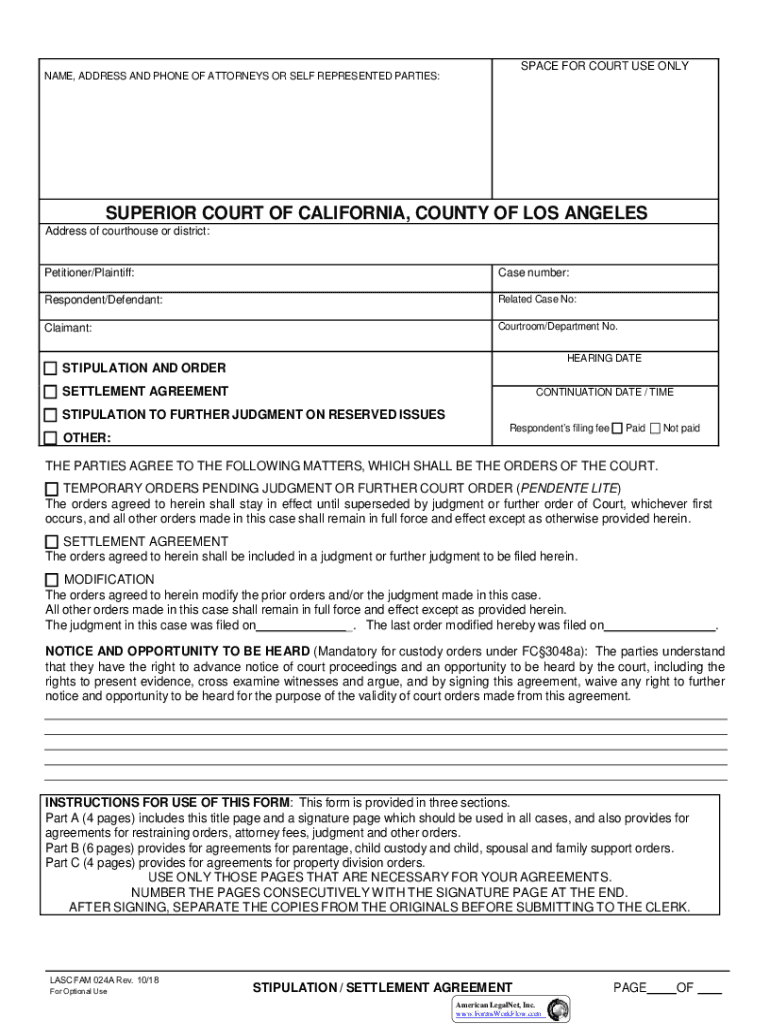
The "SUPERIOR COURT OF CALIFORNIA, COUNTY OF LOS" refers to the judicial system within Los Angeles County that addresses various legal matters including civil, criminal, family, probate, and juvenile cases. As one of the largest court systems in the United States, this court handles a broad range of cases, making it crucial for legal professionals, litigants, and the public to understand its scope and function. Within the family law context, this court frequently deals with stipulation and settlement agreements, which outline terms agreed upon by parties in family-related disputes such as divorce, child custody, and spousal support.
How to Use the Superior Court of California, County of Los Angeles
When dealing with cases within the jurisdiction of the Superior Court of California, County of Los Angeles, participants need to be familiar with the court's procedures and practices. This includes understanding how to file legal documents, respond to court orders, and comply with deadlines. Parties involved in family law disputes can utilize the court’s resources to negotiate and finalize important agreements like stipulations for custody or property division. Utilizing legal assistance or mediation services offered by the court can aid in reaching amicable resolutions.
Steps to Complete a Stipulation and Settlement Agreement
-
Draft the Agreement:
- Outline terms, including temporary orders, child custody arrangements, and support obligations.
- Ensure that all legal and personal interests of the parties involved are represented.
-
Review by Legal Counsel:
- Consider consulting with an attorney to ensure the document complies with legal standards and adequately reflects parties' intentions.
-
Filling Out the Agreement:
- Include detailed information about each party's rights and responsibilities.
- Specify procedures for compliance and enforcement, particularly in relation to custody and support.
-
Submission to the Court:
- After signing by all parties, file the agreement with the court to make it legally binding.
-
Court Approval:
- Attend a court hearing if required, where the agreement will be reviewed and approved by a judge.
Important Terms Related to the Superior Court of California, County of Los Angeles
- Temporary Orders: Provisional decisions made by the court on matters like child support and custody which remain in effect until a final settlement is reached.
- Child Custody Arrangements: Legal determinations regarding which parent a child will live with and how visitation will be managed.
- Spousal Support: Financial payments made by one spouse to another post-separation for support.
- Property Division: The legal process of dividing assets and debts between parties during a divorce.
- Compliance and Enforcement: Legal mechanisms ensuring parties adhere to the terms of an agreement.
State-Specific Rules for the Superior Court of California, County of Los Angeles
The Superior Court of California, County of Los Angeles follows specific state mandates in family law cases. For instance, California law mandates a six-month waiting period for divorce, meaning stipulation agreements must account for this time frame. Child custody determinations prioritize the welfare and best interests of the child, as outlined in California Family Code Section 3011. It's essential to be aware of the local rules and procedures, which can vary significantly depending on the nature of the case and specific court location.
Examples of Using the Superior Court of California, County of Los Angeles
- Family Law Cases: A couple in Los Angeles County settling a divorce may use a Stipulation and Settlement Agreement to agree on asset division and child custody without further court intervention.
- Civil Litigation: Businesses might engage in dispute resolution in this court, seeking a legal resolution to contractual disagreements.
- Probate Matters: Individuals involved in estate distribution after a relative’s passing may file necessary documents and conduct hearings within this court.
Required Documents for Filing a Stipulation and Settlement Agreement
- Completed Agreement Forms: All terms should be clearly defined and agreed upon by both parties.
- Proof of Service: Documentation proving all parties received copies of filed documents.
- Financial Disclosures: Comprehensive disclosure of each party’s financial status is often required to ensure fair settlements.
- Supporting Documents: Additional documents that might be requested, such as evidence of income or property ownership, to substantiate claims made within the agreement.
filing Methods for Documents in Superior Court of California, County of Los Angeles
Participants can file their legal documents through various channels, including:
- Online Through Court's E-filing System: Convenient for attorneys and registered users handling multiple cases.
- Mail: Suitable for those who prefer physical documentation but requires adequate lead time to meet deadlines.
- In-Person Submission: Allows direct communication with court clerks and immediate feedback on document acceptance or required corrections.
Penalties for Non-Compliance with a Stipulation and Settlement Agreement
Non-compliance with terms set forth in a Stipulation and Settlement Agreement can have serious legal consequences. Potential penalties include:
- Contempt of Court: Judges can impose fines or even jail time for failing to adhere to court orders.
- Modifications or Nullification of the Agreement: Persistent violations may result in the agreement being modified or nullified.
- Further Litigation: Non-compliance may lead to additional legal proceedings, resulting in increased legal fees and court costs.
Understanding the procedures and responsibilities involved in dealing with the Superior Court of California, County of Los Angeles is crucial. Properly navigating its requirements ensures efficient resolution to legal disputes and safeguards the rights and responsibilities of all parties involved.


