
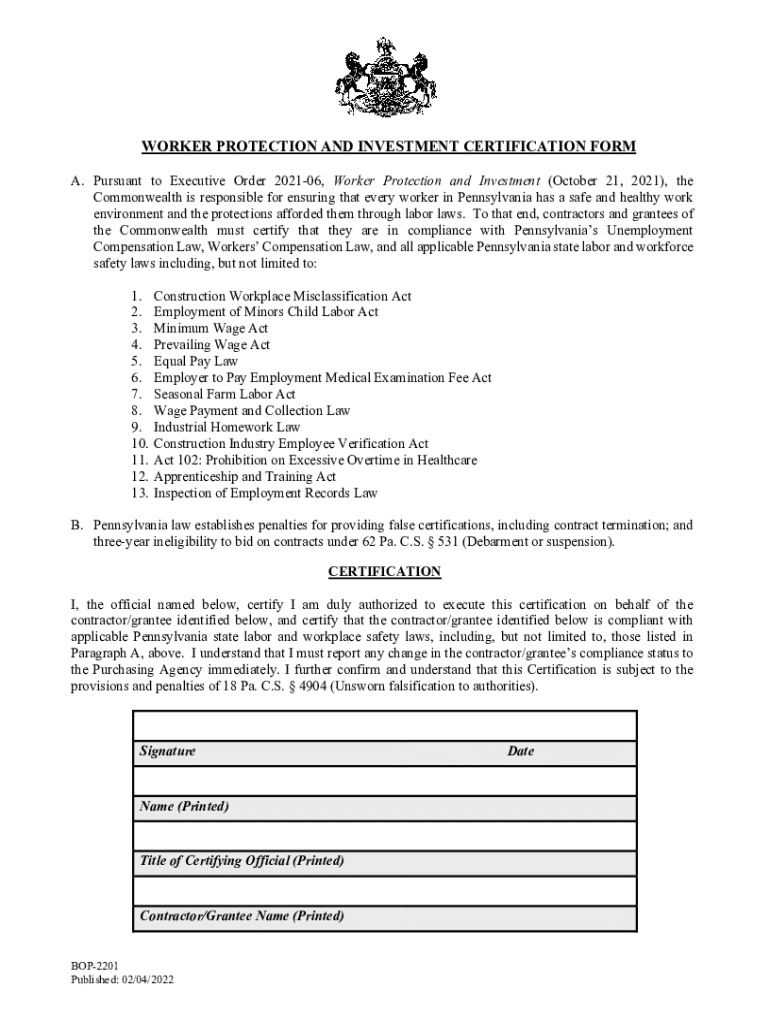







Definition & Purpose of the Worker Protection and Investment Certification Form
The Worker Protection and Investment Certification Form, mandated by Executive Order 2021-06 in Pennsylvania, is a critical document designed to ensure that contractors and grantees comply with designated state labor laws. These regulations are aimed at promoting a secure work environment for employees. This form requires certifying adherence to specific laws and outlines penalties for any false certifications, a crucial compliance measure for facilitating fair labor practices.
Key Components
- Certification of compliance: Organizations must certify adherence to applicable labor laws.
- Outline of penalties: Clearly defines consequences for submitting a false certification.
- Authorized official certification: Requires an official's signature to confirm the organization's compliance with mandated regulations.
How to Use the Certification Form
Utilizing the Worker Protection and Investment Certification Form effectively involves understanding its requirements and ensuring accurate completion. This process helps in maintaining compliance with the stipulated labor laws in Pennsylvania.
Steps for Completion
- Examine the legal requirements: Familiarize yourself with the specific state labor laws mentioned.
- Gather necessary information: Ensure all relevant data and documents are prepared beforehand to accurately fill out the certification form.
- Complete the certification section: An authorized official should thoroughly fill out and sign the certification section, thereby formalizing compliance.
Obtaining the Form
Acquiring the Worker Protection and Investment Certification Form for Pennsylvania is straightforward. It serves as a preliminary step before engaging in state-sponsored labor projects.
Where to Find
- Official state websites: Pennsylvania’s government websites often provide downloadable versions.
- Contract agreements: Check if included as part of the documentation bundle for state contracts or grants.
Who Typically Uses This Form
The Worker Protection and Investment Certification Form is primarily used by contractors and grantees involved in state projects. It plays a vital role in ensuring that these entities adhere to labor compliance requirements.
User Profiles
- Construction companies: These organizations typically deal with state contracts involving significant labor.
- Government contractors: Companies providing goods or services to the state must verify compliance.
- Nonprofit organizations: Grantees receiving public funds for labor-related initiatives often need to certify compliance.
State-Specific Rules
In Pennsylvania, particular nuances pertain to the Worker Protection and Investment Certification Form that users must be aware of, affecting how the form is handled and processed.
Pennsylvania Regulations
- Specific labor laws: Adherence to The Pennsylvania Prevailing Wage Act or other local statutes may be required.
- Compliance checks: State may conduct audits to ensure compliance, emphasizing the importance of accurate certification.
Legal and Compliance Aspects
The form’s legal significance lies in its role in assuring that entities meet required labor standards. Understanding legal obligations helps prevent any repercussions resulting from non-compliance.
Legal Obligations
- To prevent the risk of penalties, contractors should ensure their practices align with outlined laws.
- Regular audits necessitate a robust compliance mechanism to continually meet certification standards.
Penalties for Non-Compliance
Failing to accurately maintain compliance through the certification form can lead to various penalties, reinforcing the document's importance within operational practices.
Consequences
- Financial penalties: Fines may be imposed for false certifications or non-compliance.
- Contract termination: Potential removal from the eligibility list for government contracts.
Digital vs. Paper Version
The Worker Protection and Investment Certification Form may be available in both digital and paper formats, and choosing the right one is crucial for organizational processes.
Considerations
- Accessibility: Digital forms are easily accessible and facilitate straightforward submission.
- Record-keeping: Digital documentation helps maintain efficient and lasting archive systems for compliance verification.




