Definition & Meaning
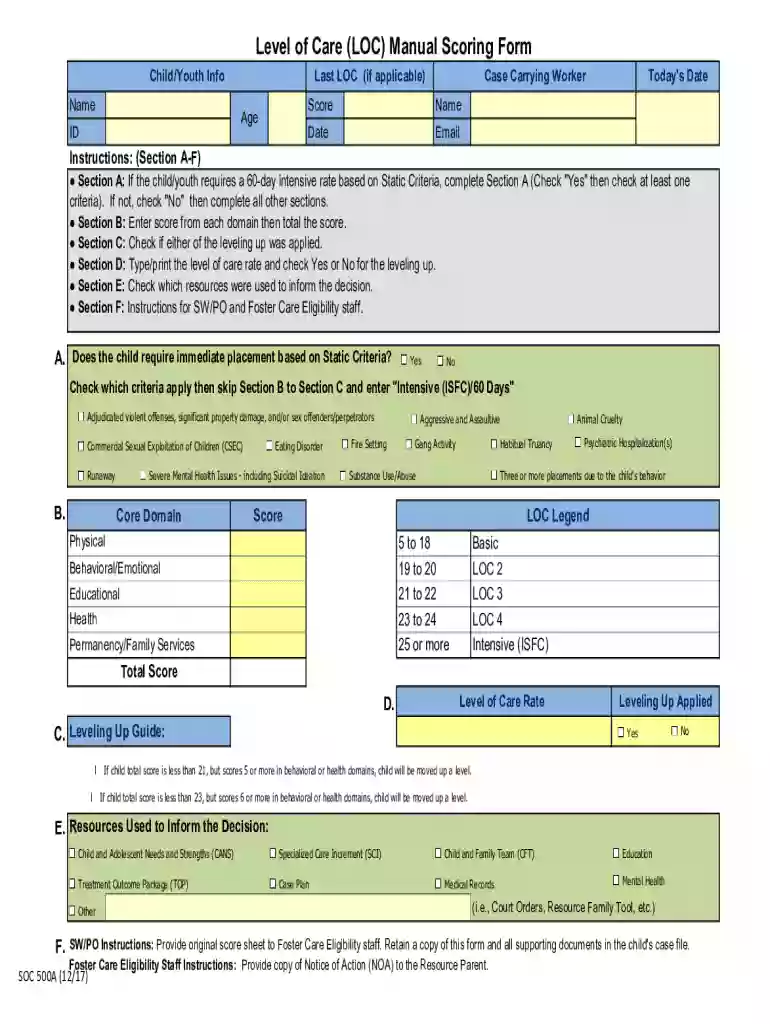
The "21 xlsx - Level of Care (LOC) Digital Scoring Form Child Youth Info" is a structured digital tool designed to assess and document the specific care needs of children and youth. This form evaluates multiple domains relevant to their care requirements, facilitating the determination of the necessity for intensive care based on standardized criteria. It serves as a critical resource for social workers and foster care eligibility staff, helping ensure thorough and accurate assessment of each child's level of care requirements.
Key Components
- Personal Information Collection: Gathers essential details about the child or youth.
- Static Criteria Assessment: Evaluates fixed criteria that influence care level decisions.
- Scoring System: Employs a quantitative approach to rate the child’s needs across various domains.
- Leveling Guidelines: Provides instructions on adjusting care levels based on assessment results.
How to Use the 21 xlsx - Level of Care (LOC) Digital Scoring Form Child Youth Info
The effective use of the LOC Digital Scoring Form involves several well-defined steps to ensure accurate assessment and efficient workflow.
Step-by-Step Process
- Open the Document: Access the digital form, ensuring compatibility with your preferred spreadsheet software.
- Complete Personal Information: Begin by entering detailed personal data about the child or youth being assessed.
- Evaluate Static Criteria: Review the predefined static criteria that impact the decision for intensive care.
- Utilize the Scoring System: Score each relevant domain, such as health, emotional stability, and educational needs.
- Apply Leveling Guidelines: Follow the guidelines to adjust and finalize the care level based on the cumulative score.
Practical Tips
- Ensure Accuracy: Carefully input data to prevent errors in the scoring process.
- Consult Colleagues: Collaborate with other professionals when uncertain about specific entries or scores.
- Use Annotations: Add notes directly to the form for additional context or clarification.
Key Elements of the 21 xlsx - Level of Care (LOC) Digital Scoring Form Child Youth Info
Understanding the pivotal components of the form is crucial for accurately assessing care needs.
Important Sections
- Static and Dynamic Fields: Distinguishes between data that remains constant and those that may change over time.
- Comprehensive Scoring Domains: Covers various dimensions such as physical health, psychological wellbeing, and familial interactions.
- Guidance for Adjustments: Offers directions for modifying the level of care based on specific situations or criteria changes.
Detailed Breakdown
- Static Sections: Typically include immutable personal identifiers, baseline medical conditions, and unchanged familial details.
- Scoring Domains: Each domain is scored based on predefined criteria considering aspects like behavioral patterns and learning abilities.
- Adjustment Protocol: Specifies how to factor in recent developments or changes in the child’s situation that warrant a reassessment of care level.
Who Typically Uses the 21 xlsx - Level of Care (LOC) Digital Scoring Form Child Youth Info
The form is predominantly utilized by professionals engaged in child welfare and care assessment.

Main Users
- Social Workers: Utilize the form to assess the current needs of children within the welfare system and recommend appropriate care levels.
- Foster Care Eligibility Staff: Evaluate potential foster care placements and verify the suitability of the environment according to the child's needs.
- Counselors and Therapists: Refer to the form for insights on the child's needs and assist in tailoring therapeutic interventions accordingly.
Real-World Applications
- Case Study Analysis: In a suburban foster care agency, social workers used the form to reassess care levels for children transitioning between homes.
- Cross-functional Collaboration: In instances where therapists and social workers collaboratively work, the form serves as a centralized tool for decision-making.
Steps to Complete the 21 xlsx - Level of Care (LOC) Digital Scoring Form Child Youth Info
Completing the form requires a methodical approach to ensure thoroughness and accuracy.
Procedure Outline
- Initiate Form Filling: Start with gathering all necessary information about the child before accessing the form.
- Enter Initial Data: Input personal details such as name, age, and existing care arrangement.
- Assess Each Domain: Score each domain thoughtfully, using professional judgment and available data.
- Finalize the Scoring: Ensure all entries are complete and consistent before tabulating the final score.
- Review and Share: Cross-check the completed form for errors, then share with relevant stakeholders for further action or approval.
Enhancements for Accuracy
- Utilize Checklists: Employ checklists to verify that each section is filled in accordance with the guidelines.
- Regular Updates: Regularly update scores and data to reflect the child's changing needs and circumstances.
Important Terms Related to the 21 xlsx - Level of Care (LOC) Digital Scoring Form Child Youth Info
Familiarity with key terminology enhances comprehension and utilization of the form.
Glossary of Terms
- Static Criteria: Unchanging factors that affect the child’s care assessment.
- Scoring Domains: Categories in the form that are evaluated for determining the level of care.
- Leveling Up Guidelines: Instructions for adjusting care levels based on assessment outcomes.
Detailed Examples
- Example of Static Criteria: A child’s diagnosed chronic health condition evaluated to determine consistent health needs.
- Illustration of Scoring: Behavioral domain scoring which considers frequency of disruptive behaviors as an indicator for additional support.
Digital vs. Paper Version
Understanding the differences between digital and paper versions of the form can impact choice and execution.
Comparison Insights
- Digital Advantage: Enhanced efficiency with automated calculations and real-time updates.
- Paper Preference: Preferred in environments where digital access is limited or for archiving physical records.
Practical Scenarios
- Digital Utilization: Used in urban settings where access to technology facilitates seamless updates and edits.
- Paper Documents: Employed in rural regions where digital infrastructure might be lacking, ensuring accessibility to all stakeholders.
State-Specific Rules for the 21 xlsx - Level of Care (LOC) Digital Scoring Form Child Youth Info
Different states may have unique guidelines affecting how the form is used and interpreted.
Focused Coverage
- Regulation Variance: States may have specific legal stipulations that alter the form’s use.
- Adaptation Requirements: Professionals must be aware of state-specific adjustments in scoring criteria or care guidelines.
Practical Considerations
- Case Example: In California, additional considerations might include culturally relevant factors impacting care levels.
- Practical Implications: Be prepared to adjust forms accordingly to align with state-mandated standards.