







Definition & Meaning
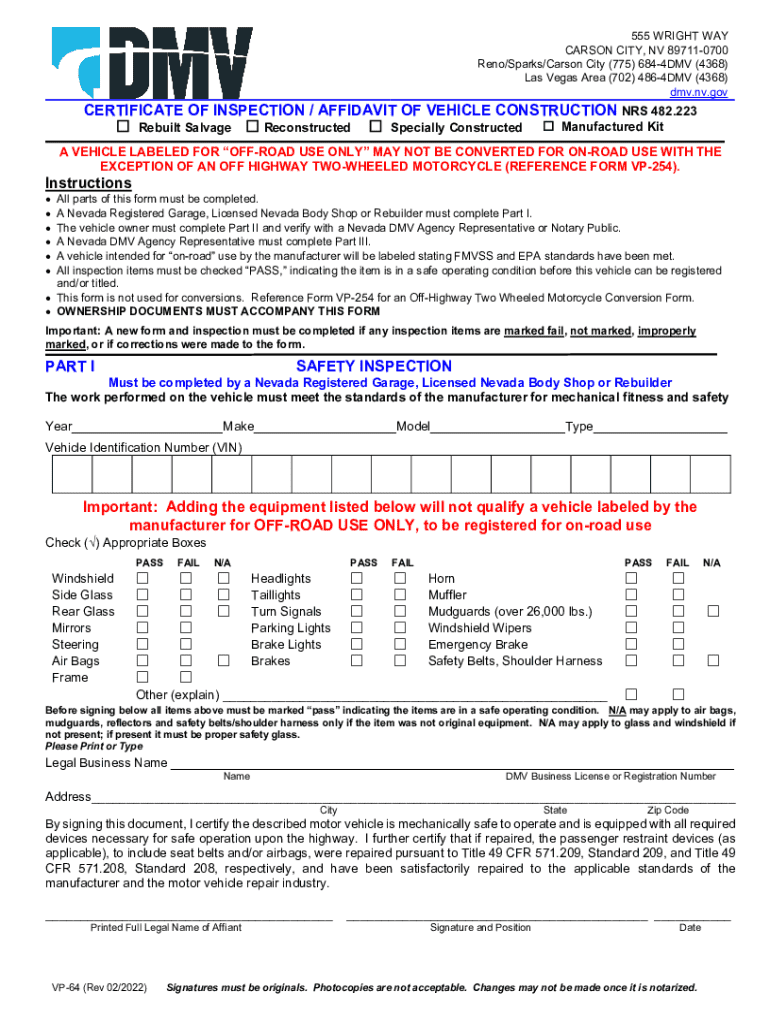
The Certificate of Inspection Affidavit of Vehicle Construction is a formal document used primarily in Nevada, aimed at verifying the construction and assembly of vehicles that fall under categories like rebuilt salvage, reconstructed, or specially constructed. This document is crucial for ensuring that vehicles meet specific safety standards and adhere to the state's regulations for road usage. The certificate acts as a conclusive statement from recognized inspectors and garages, attesting to the compliance of a vehicle's construction with the relevant regulatory and safety guidelines.
Steps to Complete the Certificate of Inspection
Completing the Certificate of Inspection Affidavit of Vehicle Construction involves several meticulous steps designed to ensure thorough verification of a vehicle's roadworthiness:
-
Initial Inspection: The vehicle must be inspected by licensed garages or qualified professionals. The inspector will check the vehicle for compliance with safety standards and construction guidelines.
-
Documentation of Parts: Vehicle owners must document all the parts used in construction and reconstruction. This is critical for verifying that all components are legal and safe for use.
-
Completion by DMV Representatives: Some sections of the form require the completion and verification by Department of Motor Vehicles (DMV) representatives to ensure compliance with registration standards.
-
Safety Standards Verification: Inspectors must verify that the vehicle meets all Nevada safety standards, which may include checks on emission systems and structural integrity.
-
Final Submission: After completion, the document is submitted to the DMV for processing to register the vehicle officially.
Required Documents
Several documents are required when preparing to submit the Certificate of Inspection Affidavit of Vehicle Construction:
- Ownership Documentation: Proof of ownership, such as the vehicle title or bill of sale.
- Parts Receipts: Receipts or invoices for any parts used in the construction or reconstruction of the vehicle.
- Inspection Reports: Reports from the licensed garage or inspector detailing the findings of the vehicle inspection.
- Proof of Identity: A valid driver's license or state-issued identification for the vehicle owner.
These documents are essential to validate the claims made on the affidavit and ensure the accuracy of the information submitted.
Who Typically Uses the Certificate
This certificate is commonly used by vehicle owners in Nevada looking to register vehicles that do not fall under standard categories, such as:
- Rebuilt Salvage: Vehicles previously deemed total losses but reconstructed to a condition suitable for road use.
- Specially Constructed Vehicles: Custom-built vehicles assembled from component parts to create a unique vehicle, often for specific or novelty uses.
- Reconstructed Vehicles: Vehicles that have been altered significantly from their original construction, potentially affecting their functionality or design.
Individuals dealing with any of these vehicle types must use the form to ensure their vehicles are compliant with state laws.


Key Elements of the Certificate
The Certificate of Inspection Affidavit of Vehicle Construction includes several critical components necessary for completion and submission:
- Vehicle Description: Detailed information about the vehicle including make, model, year, and vehicle identification number (VIN).
- Inspection Details: Dates and results of inspections carried out, including the name and credentials of the inspector.
- Owner Information: Details about the vehicle's owner including name, address, and contact information.
- Compliance Statement: A signed declaration from both the vehicle owner and the inspector confirming adherence to all relevant regulations.
Each of these elements provides essential information that ensures the vehicle's compliance with legal standards.
Legal Use of the Certificate
The legal context of the Certificate of Inspection Affidavit of Vehicle Construction primarily revolves around its use as an official document within the state of Nevada. It serves as legal proof of compliance for vehicles that have undergone significant construction or alteration. The affidavit assures the DMV and other regulatory bodies that the vehicle is safe for operation on public roads. It is vital that the form is complete, accurate, and signed by authorized individuals to be considered legally valid for vehicle registration.
Important Terms Related to the Affidavit
Understanding specific terminology related to the Certificate of Inspection Affidavit of Vehicle Construction is beneficial:
- Rebuilt Salvage: A term referring to vehicles that have been restored to operational condition after being written off as total losses.
- Specially Constructed: Vehicles assembled from a variety of parts, not conforming to a specific VIN from a singular manufactured make.
- Compliance: Adherence to a set of safety and regulatory standards mandated by the state for vehicle operation.
These terms are integral to understanding the requirements and processes associated with the form.
State-Specific Rules for Nevada
The Certificate of Inspection Affidavit of Vehicle Construction is particularly relevant in Nevada as the state has distinct regulations for registering non-standard vehicles. Nevada mandates that:
- Specially Constructed Vehicles Not for On-Road Use: Vehicles labelled explicitly for off-road use cannot be transformed for on-road use.
- Strict Safety Standards: Vehicles must meet stringent emission and safety standards, requiring thorough inspections by certified garages.
- Legal Responsibility: It is the vehicle owner's responsibility to ensure all documentation and requirements are fulfilled before registration.
These state-specific regulations highlight the importance of understanding local laws when completing the certificate.




