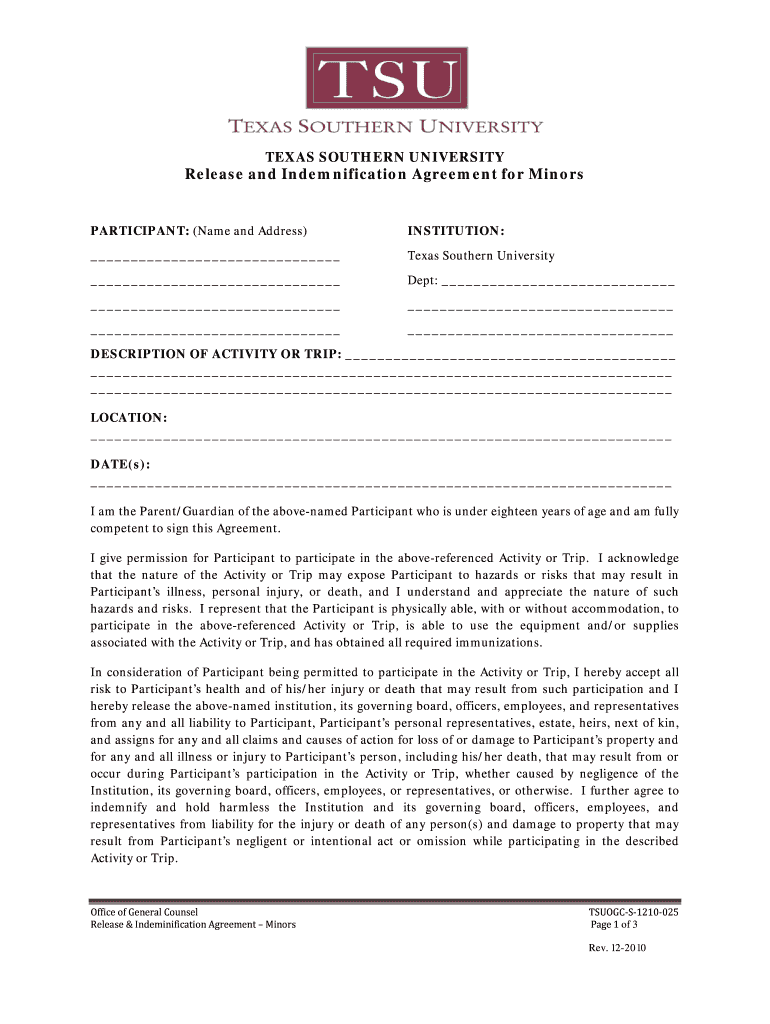
Release and Indemnification Agreement for Minors - Texas 2026

Get Form
Release and Indemnification Agreement for Minors - Texas Preview on Page 1

Here's how it works

01. Edit your form online
Type text, add images, blackout confidential details, add comments, highlights and more.
02. Sign it in a few clicks
Draw your signature, type it, upload its image, or use your mobile device as a signature pad.
03. Share your form with others
Send it via email, link, or fax. You can also download it, export it or print it out.

How to use or fill out Release and Indemnification Agreement for Minors - Texas with our platform

Form edit decoration
9.5
Ease of Setup
DocHub User Ratings on G2
9.0
Ease of Use
DocHub User Ratings on G2
  1. Click ‘Get Form’ to open the Release and Indemnification Agreement for Minors - Texas in the editor.
  2. Begin by filling in the Participant's name and address at the top of the form. This identifies who is participating in the activity.
  3. Next, enter the institution's name, which is Texas Southern University, along with the department involved in the activity.
  4. Describe the activity or trip clearly in the designated section. Include specific details about what participants can expect.
  5. Fill in the location and date(s) of the activity. This information is crucial for clarity regarding when and where participation will occur.
  6. As a Parent/Guardian, acknowledge your understanding of risks by signing at the bottom of the form. Ensure you read through all terms before signing.
  7. Finally, provide your contact information if it differs from that of the participant, ensuring that emergency contacts are readily available.

Start using our platform today to easily complete your Release and Indemnification Agreement for Minors - Texas online for free!

See more Release and Indemnification Agreement for Minors - Texas versions

We've got more versions of the Release and Indemnification Agreement for Minors - Texas form. Select the right Release and Indemnification Agreement for Minors - Texas version from the list and start editing it straight away!
Versions Form popularity Fillable & printable
2010 4.8 Satisfied (98 Votes)
be ready to get more

Complete this form in 5 minutes or less

Get form

Got questions?

We have answers to the most popular questions from our customers. If you can't find an answer to your question, please contact us.
Contact us
Indemnity Agreement: Although similar to a hold harmless agreement, an indemnity agreement is an arrangement whereby one party agrees to pay the other party for any damages regardless of who is at fault.
A release is a discharge of obligations. An indemnity is an undertaking or a legally binding promise whereby one party agrees to accept the risk of loss or damage the other party may incur as a result of a transaction or event occurring.
Put simply, an indemnification agreement stipulates that if something goes wrong in the execution of a contract, you wont be held liable. It dramatically reduces the risk associated with many types of contracts.
The release and indemnity clause typically absolves one party from liability and requires the other party to compensate for any losses, damages, or claims arising from the agreement.
Liability waivers can be enforced in Texas if they satisfy certain requirements, including that the waiver provides fair notice to anyone signing it that they are relinquishing certain rights in exchange for being permitted access to or use of the premises, activity, product or equipment, or service.

Security and compliance

At DocHub, your data security is our priority. We follow HIPAA, SOC2, GDPR, and other standards, so you can work on your documents with confidence.

Learn more
ccpa2
pci-dss
gdpr-compliance
hipaa
soc-compliance

People also ask

A release agreement involves one party giving up their right to pursue legal claims against another party for specific incidents or actions. On the other hand, an indemnity agreement involves one party agreeing to compensate the other for any losses incurred due to claims made by third parties.
Fair notice in Texas requires that indemnity provisions seeking to indemnify parties for their own negligence must meet two specific requirements to be enforceable: the express negligence doctrine; and. the conspicuousness requirement.

Related links