Alaska pub5 child aid 2026

Get Form
alaska pub5 child aid Preview on Page 1

Here's how it works

01. Edit your alaska pub5 child aid online
Type text, add images, blackout confidential details, add comments, highlights and more.
02. Sign it in a few clicks
Draw your signature, type it, upload its image, or use your mobile device as a signature pad.
03. Share your form with others
Send it via email, link, or fax. You can also download it, export it or print it out.

How to use or fill out alaska pub5 child aid with our platform

Form edit decoration
9.5
Ease of Setup
DocHub User Ratings on G2
9.0
Ease of Use
DocHub User Ratings on G2
  1. Click ‘Get Form’ to open the alaska pub5 child aid document in the editor.
  2. Begin by filling out the child's information at the top of the form, including their full name, date of birth, and current address. Ensure accuracy as this information is crucial for identification.
  3. Next, provide details about the parents or guardians. Include names, contact information, and any relevant legal documentation that supports your case.
  4. In the section regarding the child's situation, clearly describe why you believe the child is in need of aid. Use specific examples such as neglect or lack of medical care to strengthen your petition.
  5. Review all entered information for completeness and accuracy. Utilize our platform's editing tools to make any necessary adjustments before finalizing your document.
  6. Once satisfied with your entries, save your changes and proceed to sign the document electronically if required. This ensures a smooth submission process.

Start using our platform today to fill out your alaska pub5 child aid form easily and for free!

See more alaska pub5 child aid versions

We've got more versions of the alaska pub5 child aid form. Select the right alaska pub5 child aid version from the list and start editing it straight away!
Versions Form popularity Fillable & printable
2009 4.9 Satisfied (320 Votes)
be ready to get more

Complete this form in 5 minutes or less

Get form

Got questions?

We have answers to the most popular questions from our customers. If you can't find an answer to your question, please contact us.
Contact us
Sec. 47.17. preserve family life unless that effort is likely to result in physical or emotional damage to the child.
Generally, in Alaska, the maximum that can be withheld from a paycheck is 40% of the net disposable earnings. If the paying parent has health insurance coverage, the maximum that can be withheld, counting cost of the health care coverage ordered by CSED, is 50%.
Neglect means the failure of the person responsible for the childs welfare to provide the child necessary food, care, clothing, shelter, or medical attention.
Since 1982, the Dividend has averaged a payout of approximately $1,000 annually. The Permanent Fund Dividend program allows a parent, guardian, or other authorized representative to claim a Dividend on behalf of a child. Yet Alaska law currently imposes no requirements whatsoever on how parents use a childs Dividend.
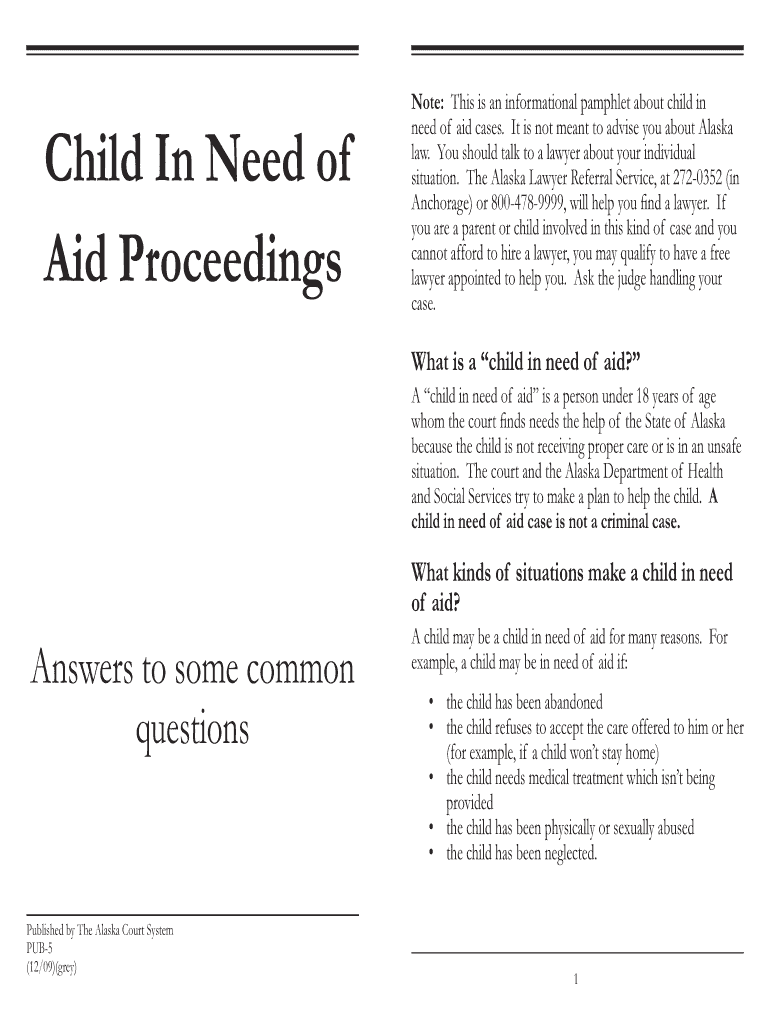
A child in need of assistance situation can arise if the DSS can prove that: the child has been abused or neglected or has a mental disorder or a developmental disability. the childs parents, guardian, or custodian does not provide proper care or attention to the childs needs.

Security and compliance

At DocHub, your data security is our priority. We follow HIPAA, SOC2, GDPR, and other standards, so you can work on your documents with confidence.

Learn more
ccpa2
pci-dss
gdpr-compliance
hipaa
soc-compliance

People also ask

You may be eligible if you: Work or attend a job training or educational program. Have children who are younger than 13 years of age who need child care. Financially qualify based on your family size and gross income.
When the state removes a child from his or her home, it must petition the state court to approve the removal and to make the child a ward of the state. In Alaska, these child welfare cases are called Child in Need of Aid cases, or CINA (pronounced China) cases.
Since 1982, the Dividend has averaged a payout of approximately $1,000 annually. The Permanent Fund Dividend program allows a parent, guardian, or other authorized representative to claim a Dividend on behalf of a child.

Related links