Definition & Meaning
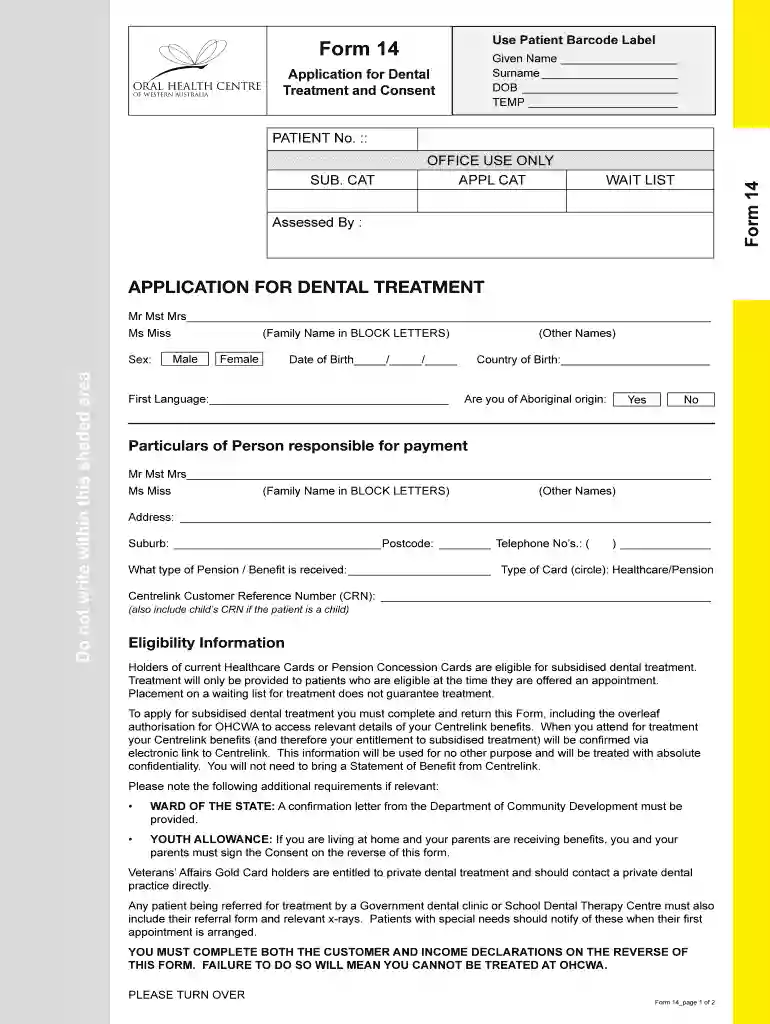
The OHCWA Form 14 serves as an application and consent form specifically designed for individuals seeking dental treatment at the Oral Health Centre of Western Australia (OHCWA). This document collects personal information to assess eligibility for subsidized dental care and secure patient consent for both treatment and financial assessment. The form is a fundamental part of accessing state-supported oral health services, ensuring patients understand their responsibilities and the scope of the dental services provided.
Key Functions of the Form
- Eligibility Assessment: Collects data to determine eligibility for government-subsidized dental treatment.
- Consent Collection: Obtains necessary patient consent for treatment and for verifying income details linked to Centrelink benefits.
- Information Gathering: Captures essential personal details such as name, date of birth, and contact information required for records and communication.
Practical Examples
- Patient Application: A senior seeking subsidy for dentures completes the form to show pensioner status.
- Student Eligibility: A university student on a low income uses the form to access preventive dental care at reduced rates.
Steps to Complete the OHCWA Form 14
Completing the OHCWA Form 14 requires careful attention to detail to ensure all necessary information is included and accurate.
Detailed Steps
- Personal Information Section: Accurately fill in your full name, date of birth, and contact details.
- Eligibility Details: Specify and confirm your eligibility status, including relevant Centrelink benefit details.
- Consent and Declaration: Read thoroughly and sign the sections related to patient consent for treatment and income confirmation.
- Double-Check Entries: Review all filled sections for accuracy and completeness to avoid any processing delays.
- Submission: Follow specific instructions for submitting the form either online, through mail, or in person at designated OHCWA locations.
Common Mistakes to Avoid
- Missing or incorrect personal details can delay processing.
- Ensure all sections are completed, particularly consent and declaration, to validate the application.
Who Typically Uses the OHCWA Form 14
The OHCWA Form 14 is predominantly used by residents in Western Australia who are eligible for state-supported dental services.

Typical Users
- Pensioners: Often qualify for low-cost dental treatments.
- Low-Income Earners: Include those receiving Centrelink benefits who are in need of dental care support.
- Students: University or vocational students who meet financial criteria for subsidized care can utilize the form.
Use Cases
- Family with Young Children: Parents may apply on behalf of their children for preventive and therapeutic dental services.
- Senior Citizens: Individuals over a certain age might apply for comprehensive dental care including dentures.
Important Terms Related to OHCWA Form 14
Understanding specific terminology associated with the OHCWA Form 14 is crucial for accurate completion of the form.
Key Terms
- Centrelink: Refers to government payments and services that assess eligibility for various benefits, including health subsidies.
- Consent: Legal agreement by the patient acknowledging and accepting the terms of treatment and financial assessment.
- Eligibility: Criteria set by the state determining who qualifies for subsidized dental care.
Contextual Understanding
- Centrelink Eligibility: Indicates whether the applicant is receiving benefits that align with the dental subsidy requirements.
- Treatment Consent: Signifies patient agreement to receive dental services and potential charges involved.
Key Elements of the OHCWA Form 14
Integral components of the OHCWA Form 14 ensure a comprehensive and legally binding application.
Primary Elements
- Personal Details Section: Includes names, identifiers, and contact information.
- Eligibility Verification: Ensures compliance with subsidy requirements.
- Consent Confirmation: Legal acknowledgment by the applicant regarding treatment and income verification.
Additional Elements
- Income Confirmation: Required when declaring eligibility based on financial status.
- Signatures: Critical for validating consent and application authenticity.
How to Obtain the OHCWA Form 14
Acquiring the OHCWA Form 14 is a straightforward process that can be initiated through various channels.
Access Methods
- Online: Downloadable from the OHCWA or related government websites.
- In-Person: Available at OHCWA offices or designated dental clinics.
- Mail Request: Can be requested for postal delivery through OHCWA administrative offices.
Examples of Acquisition
- Online Access: A patient downloads the form directly from the official website for immediate completion and submission.
- Walk-In Retrieval: Patients attending an OHCWA clinic can collect the form from the reception for new or recurring use.
Legal Use of the OHCWA Form 14
The usage of an OHCWA Form 14 carries specific legal implications related to the consent and verification of eligibility.
Legal Aspects
- Binding Consent: The form serves as a legal document where the applicant consents to treatment procedures and financial assessments.
- Data Protection Compliance: Ensures that personal information is handled following data privacy regulations such as the Australian Privacy Principles.
Examples of Compliance
- Maintaining records in a secure manner, accessible only to authorized personnel.
- Verification processes adhere strictly to the legal guidelines for health and financial data protection.
Examples of Using the OHCWA Form 14
Real-world scenarios highlight how the OHCWA Form 14 functions in various contexts.
Practical Applications
- Routine Check-Ups: A low-income family applies for routine dental check-ups for their children, ensuring preventive care at little to no cost.
- Emergency Dental Care: An elderly pensioner seeks urgent dental treatment after a fall, using the form to confirm eligibility for state support.
Scenario Outcomes
- Successful treatment access following prompt and accurate form completion results in timely care for the applicant.
- Delayed processing due to incomplete or inaccurate information can highlight the importance of thorough form handling.