
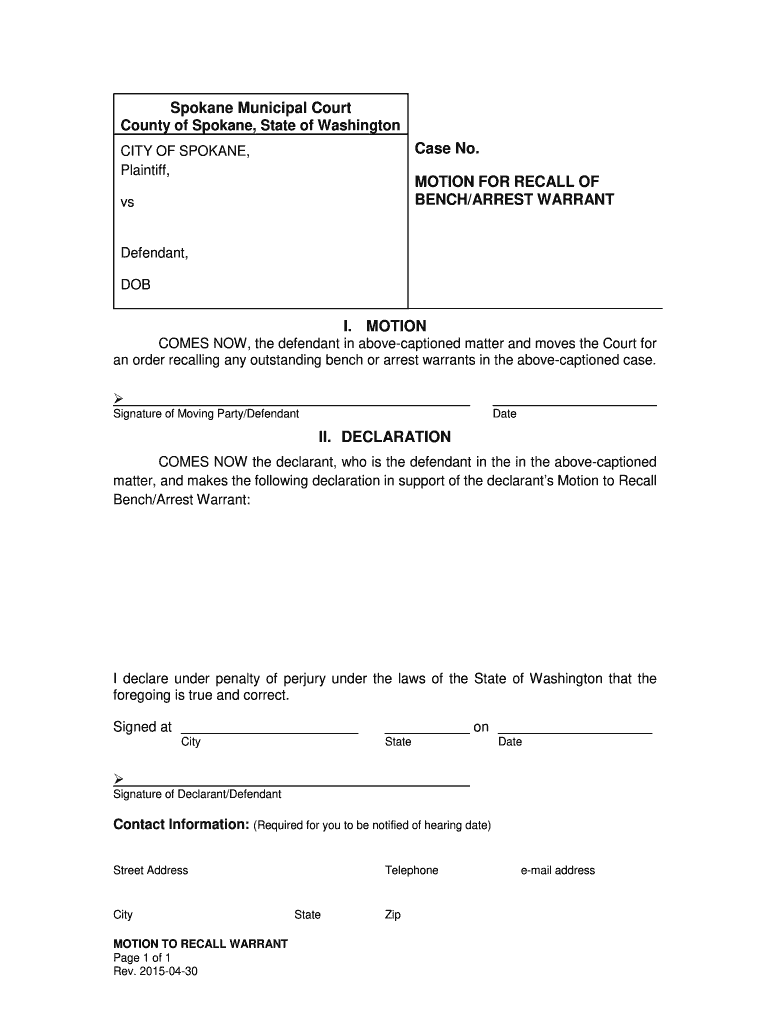







Definition and Meaning of Motion to Recall Warrant
A motion to recall a warrant is a formal legal request made to the court, aimed at revoking a previously issued warrant—typically a bench or arrest warrant. This motion is grounded in the assertion that the circumstances leading to the issuance of the warrant have changed, or that the warrant was issued in error. Understanding its legal context is essential for defendants facing outstanding warrants, as it provides a pathway for them to resolve their legal issues without unnecessary detention.
The term "bench warrant" refers to a specific type of warrant issued by a judge to authorize law enforcement to arrest a person who has failed to appear for a court proceeding. An arrest warrant, on the other hand, is more general and can be issued for various reasons, including criminal conduct. Both warrant types can significantly impact an individual's freedom and standing before the law.
Legal Use of the Motion to Recall Warrant Sample
In legal practice, the motion to recall warrant sample serves as a template for defendants seeking to request the invalidation of a warrant. Its primary usage involves providing a structured format for presenting arguments and supporting documentation to the court. The process generally includes citing relevant laws or case precedents that support the claim for recalling the warrant.
Legally, defendants must ensure they articulate compelling reasons for the motion. This can include demonstrating compliance with any prior court orders, presenting new evidence, or illustrating significant changes in circumstances that warrant the recall. Professionals usually advise securing legal counsel to adequately prepare this motion, as it can significantly influence the outcome of the legal matter at hand.
Steps to Complete the Motion to Recall Warrant Sample
Completing a motion to recall a warrant involves several specific steps:
-
Obtain the Sample Form: Access a reliable source for the motion to recall warrant sample, ensuring it aligns with state-specific requirements. This may often be found on legal websites or through court resources.
-
Fill in Personal Information: Clearly input your name, contact information, and any identifying case numbers associated with the warrant.
-
State Your Case: Concisely outline why you are requesting the recall of the warrant. Include details relevant to your situation, such as prior compliance with court orders or substantial changes in your circumstances.
-
Gather Supporting Documentation: Attach any necessary documents that corroborate your claims, such as proof of compliance or other relevant evidence.
-
Submit the Motion: File the completed motion with the court where the original warrant was issued. This can often be done in person or, depending on the jurisdiction, electronically.
-
Attend the Hearing: If required, be prepared to attend a court hearing to present your case. Bring copies of your motion and supporting documents for reference.
Important Terms Related to the Motion to Recall Warrant Sample
Familiarizing oneself with important legal terms can be incredibly beneficial during the motion process:
- Bench Warrant: A court order for arrest due to failure to appear in court.
- Arrest Warrant: Issued by a judge, authorizing law enforcement to arrest an individual for alleged criminal activity.
- Motion: A formal request made to the court, seeking a specific ruling on legal matters.
- Defendant: The individual against whom legal action is initiated.
- Perjury: The act of lying or making false statements under oath, which is a serious crime.
Understanding these terms will provide a clearer perspective on the legal proceedings and enhance the preparation of the motion.
Why Should You File a Motion to Recall a Warrant?
Filing a motion to recall a warrant can be essential for several reasons:
-
Avoid Arrest and Detention: Successfully recalling a warrant prevents immediate arrest by law enforcement, allowing individuals to manage their legal issues without unnecessary disruption to their lives.
-
Rectifying Court Records: A recalled warrant can correct any inaccuracies in court records, which can positively influence future legal interactions.
-
Mitigate Legal Consequences: Demonstrating proactive engagement with the court system may mitigate potential penalties, as it showcases a willingness to address the underlying legal issues directly.
-
Reinstate Rights: Recalls can also help restore certain legal rights, such as the ability to travel freely or participate in other court-mandated obligations without the looming threat of arrest.
Examples of Using the Motion to Recall Warrant Sample
Practical examples help illustrate how this motion is utilized in various scenarios:
-
Case of Missed Court Appearance: A defendant may have missed a scheduled court date due to unforeseen circumstances, such as a medical emergency. They can file a motion, explaining their absence, providing medical documentation, and requesting a recall of the bench warrant.
-
Change in Circumstances: Consider a defendant whose financial situation has drastically improved and is now able to pay a previously unpaid fine linked to their warrant. A motion could outline these changes and request the court to consider lifting the warrant based on their newfound compliance.
-
Legal Errors: If the warrant was issued based on incorrect information, such as a mistaken identity, filing a motion with detailed supporting evidence can help rectify the situation.


