
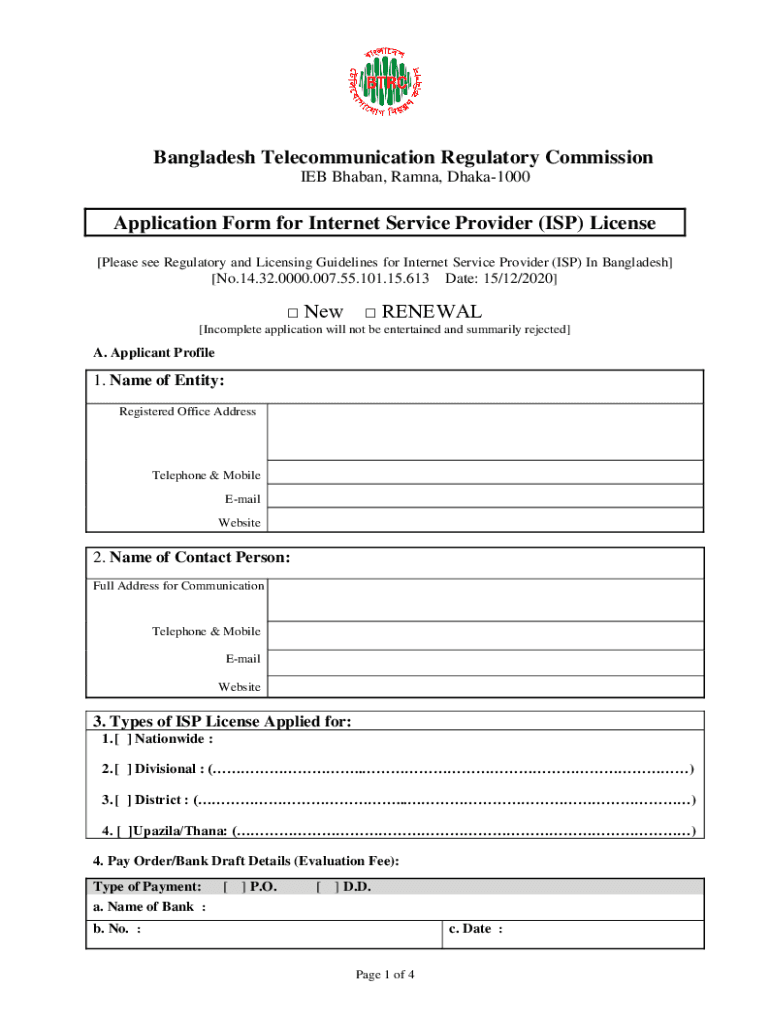







Definition and Purpose of the ISP License Application Form
The application form for an Internet Service Provider (ISP) license serves as the official document required by regulatory bodies, such as the Bangladesh Telecommunication Regulatory Commission, to authorize organizations to operate as ISPs. This form is pivotal for ensuring that applicants meet all necessary legal and technical standards before delivering internet services. Key information typically captured includes applicant details, type of license sought, compliance declarations, and required supporting documents.
Importance of Accurate Completion
Accurate and thorough completion of the ISP license application form is essential to avoid rejection or delays. The form must be completed in full, with stringent attention to detail, ensuring that all personal and organization details are correct and verifiable. Failure to meet these requirements can result in penalties or denial of the licensing application.
Steps to Complete the Application Form
Completing the ISP license application form involves several steps, each critical to ensuring accurate and successful submission:
-
Gather Required Information
- Collect all necessary personal and organizational data including contact information, business registration details, and descriptions of technical infrastructure.
-
Select License Type
- Identify specific licenses offered by regulatory bodies and select the appropriate one based on the nature and scope of the ISP services intended to be provided.
-
Compile Supporting Documents
- Assemble all required documentation such as business registration certificates, proof of technical capabilities, and financial statements.
-
Fill Out the Form
- Accurately enter the required information into the form. Ensure clarity and completeness, especially in sections detailing technical and operational capacities.
-
Review and Submit
- Double-check all entries for accuracy and completeness, then submit the form per the specified instructions, typically online or via mail.
Eligibility Criteria for ISP Licensing
Eligibility to apply for an ISP license is determined by regulatory standards. It generally requires:
- Registered legal entity status within the country where services will be provided.
- Adequate technical infrastructure to support internet services.
- Financial stability as demonstrated by recent financial records.
- Compliance with local telecommunications laws and international best practices.

Entities Typically Eligible
- Local and international corporations intending to expand their services to internet provision.
- Government agencies and partnerships involved in public telecommunication services.
- Start-ups with innovative solutions for high-speed internet delivery.
Required Documents for Application Submission
Document submission is a crucial element of the ISP license application process. Typical requirements include:
- Legal incorporation documents
- Technical specifications of network equipment
- Business plan outlining service coverage and target market
- Financial statements demonstrating fiscal capacity
Common Challenges
Applicants often face challenges in compiling comprehensive technical and financial documentation. Preparation in advance can alleviate some of these hurdles, ensuring the form and accompanying documents are complete upon submission.
Key Elements of the ISP Application Form
Sections within the ISP license application form encompass key elements designed to assess organizational capability and compliance:
- Applicant Information: Legal name, registered address, and management details.
- Service Description: Types of internet services to be provided, including expected speed and capacity.
- Technical Capabilities: Inventory and description of network equipment, software, and supporting facilities.
- Financial Overview: Details on funding sources, investment plans, and current financial health.
Importance of Each Section
Each section of the form holds specific importance, serving to confirm the applicant's readiness and ability to deliver reliable internet services. The service description and technical capabilities sections are particularly scrutinized to ensure adherence to regulatory standards.
Form Submission Methods
Submission methods for the ISP license application form generally include:
- Online: Most regulatory bodies offer a digital submission platform, allowing for the direct upload of forms and documents.
- Mail: Some jurisdictions accept paper forms submitted through postal services.
- In-person: Direct submission at regulatory offices, offering applicants the opportunity to address any discrepancies immediately.
Advantages of Digital Submission
Using online methods streamlines the submission process, reduces processing time, and enhances efficiency by preventing manual handling errors. Additionally, digital submissions often facilitate quicker feedback from regulatory review panels.
Penalties for Non-Compliance
Failure to submit a properly completed ISP license can result in substantial penalties:
- Fines: Financial penalties are often imposed for non-compliance with submission guidelines or deadlines.
- Application Rejection: Inadequate applications can be outright rejected, necessitating re-application and potentially delaying operations.
- Operational Delays: A rejected application prevents the commencement of ISP services, impacting business timelines and potential revenue.
Mitigating Penalty Risks
To mitigate risks, applicants should thoroughly review form instructions, seek clarification from regulatory bodies when necessary, and consider engaging legal or professional advisors to ensure compliance with all form requirements.
Application Process and Approval Timeline
The timeline from application submission to approval typically includes:
- Initial Review and Acknowledgment: The regulatory body reviews the submission for completeness.
- Detailed Evaluation: An in-depth assessment of applicant details, technical capabilities, and legal compliance.
- Feedback Loop: If deficiencies are identified, applicants are often given the opportunity to address these before a final decision.
- Approval/Denial Notification: Final status is communicated, either granting the ISP license or outlining reasons for denial.
Expected Duration
Approval times can vary, but typically range from a few weeks to several months, depending on the completeness of the application and regulatory workload.
Understanding State-Specific Rules
State-specific procedures and regulations impact the application process significantly. Variations may include:
- Different documentation requirements
- Unique compliance standards for technical setups
- Alternate submission deadlines
Case-by-Case Examples
Applicants should review local regulatory websites or consult with legal experts familiar with specific state requirements to ensure adherence to all regional criteria.
Legal Use and Compliance
Using the ISP license application form in a manner compliant with telecommunication laws is essential. It ensures legal legitimacy and the credibility of an ISP in the eyes of customers and partners. Legal compliance involves:
- Adhering to standard business practices as required by law.
- Ensuring all information is factual and verifiable.
- Regular audits and reviews to maintain adherence post-licensing.
Long-term Compliance and Monitoring
ISPs must continuously meet operational standards and legal expectations to retain their licenses. Regular updates to application details may be necessary to reflect changes within the business operations or structure.
Examples of Successful Application Use
Understanding how similar entities have navigated the ISP license application process can be enlightening:
- Case Study 1: A tech start-up successfully expanded its services by obtaining an ISP license after initial delays due to incomplete technical data.
- Case Study 2: A multinational corporation streamlined its application by leveraging existing technical infrastructure across different jurisdictions, emphasizing the integration of their network capabilities.
Key Lessons
Successful applications often highlight the importance of preparation, thorough documentation, and proactive engagement with regulatory bodies to address any potential concerns or queries.




