
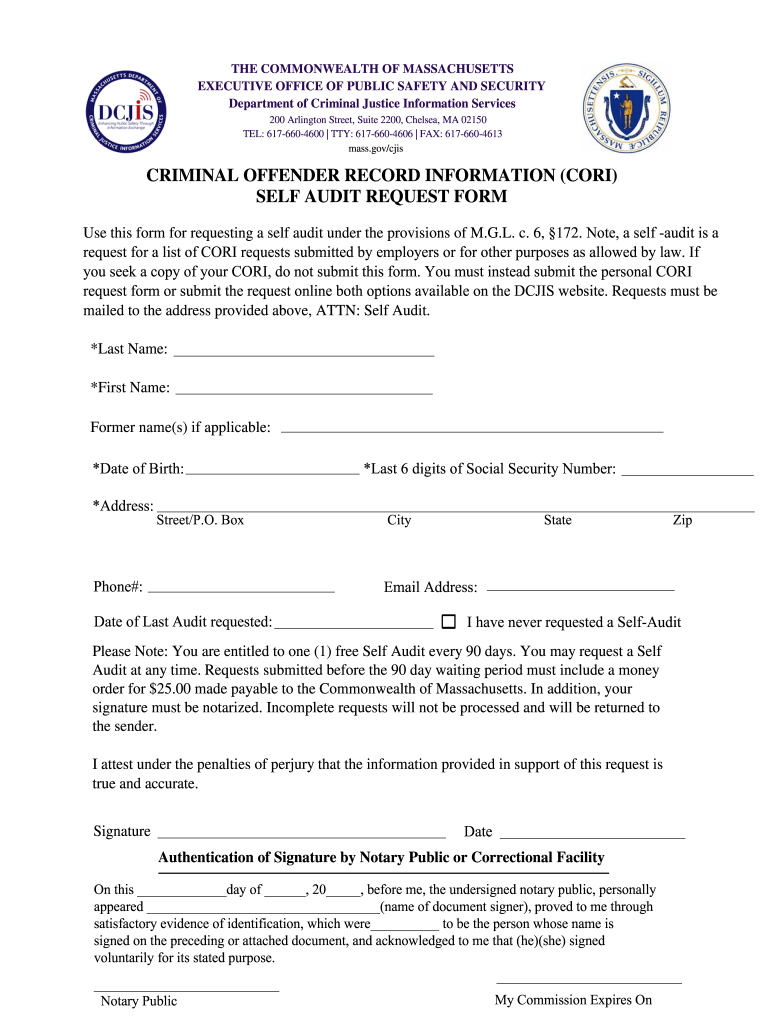







Definition & Purpose of the Self-Audit Request Form
The self-audit request form under the provisions of Massachusetts allows individuals to audit their Criminal Offender Record Information (CORI). It offers the chance for individuals to gain insights into who has requested their CORI, ensuring transparency in access to their criminal record information. This form is pivotal for maintaining personal data privacy and monitoring unauthorized access.
How to Use the Self-Audit Request Form
Using the self-audit request form involves several straightforward steps:
- Download or Obtain the Form: Begin by acquiring the latest version of the form, which can be found on the Massachusetts Department of Criminal Justice Information Services website.
- Fill Out Personal Information: Provide your full name, address, date of birth, and any other required identification details to confirm your identity.
- Specify the Audit Period: Clearly indicate the time period for which you seek information about requests made for your CORI.
- Sign and Date the Form: Ensure accuracy before signing and dating the form. Your signature is crucial for authenticating the request.
Steps to Complete the Self-Audit Request Form
Completing the self-audit request form necessitates attention to detail:
- Review Instructions: Carefully read through any accompanying instructions to understand specific document provisions and requirements.
- Accurate Information Entry: Input all necessary personal information without errors. Double-check details to avoid discrepancies.
- Consent Agreement: By signing the form, you consent to the terms and conditions set forth by the Department of Criminal Justice Information Services.
- Submission: Decide on how you'll submit the form—online or by mail—and follow the appropriate submission procedures.
Required Documents
Submitting the self-audit request form requires supporting documents for verification:
- Government-Issued Identification: A copy of a valid ID such as a driver's license or passport must accompany the form.
- Proof of Residence: Include a recent utility bill or bank statement with your current address to confirm residency.
- Request Fee (if applicable): Prepare a payment method for the processing fee unless you qualify for a fee waiver.
Who Typically Uses the Self-Audit Request Form
The self-audit request form is typically utilized by:
- Individuals Seeking Transparency: Citizens who wish to know who accessed their CORI.
- Legal Entities: Lawyers and legal representatives may use it to verify their client's CORI access history.
- Researchers: Organizations conducting studies on privacy or criminal record access may analyze CORI request patterns.


Legal Use of the Self-Audit Request Form
Adhering to legal guidelines is imperative:
- Confidentiality Assurance: The form is strictly to be used for personal record audits and not for unauthorized sharing or dissemination of CORI data.
- Penalties for Misuse: Misuse of audit information or unauthorized access can lead to legal penalties, including fines or prosecution under Massachusetts law.
State-Specific Rules for Massachusetts
- Eligibility Criteria: Only residents of Massachusetts can request a self-audit of their CORI.
- Fee Waiver Eligibility: Massachusetts law provides that certain individuals may be exempt from paying the fee based on documented financial hardship or specific need.
Key Elements of the Self-Audit Request Form
Understanding the components of the form is crucial:
- Personal Information Section: Where the applicant provides identifying details.
- Audit Request Period: Where the specific time frame for the audit is defined.
- Signature Line: Confirms consent to terms and submission validity.
- Submission Instructions: Includes available methods and important deadlines for submission.
Form Submission Methods
There are multiple methods for submitting the self-audit request form:
- Online Submission: Fast and efficient, allowing for digital signature and electronic document upload.
- Mail Submission: For those preferring or required to send physical copies, include all necessary materials in one envelope.
- In-Person Submission: Visit the Massachusetts Department of Criminal Justice Information Services office for direct submission.
Examples of Using the Self-Audit Request Form
Practical scenarios where the form is beneficial:
- Ensuring Privacy Management: Individuals can use it to verify that their criminal records are being accessed appropriately and for legitimate reasons.
- Employment Safety Net: Job applicants can check if potential employers have accessed their CORI without consent.
- Legal Defense Preparation: Attorneys might request this audit in case of alleged unauthorized access to defend clients.


