




01. Edit your form online
Type text, add images, blackout confidential details, add comments, highlights and more.

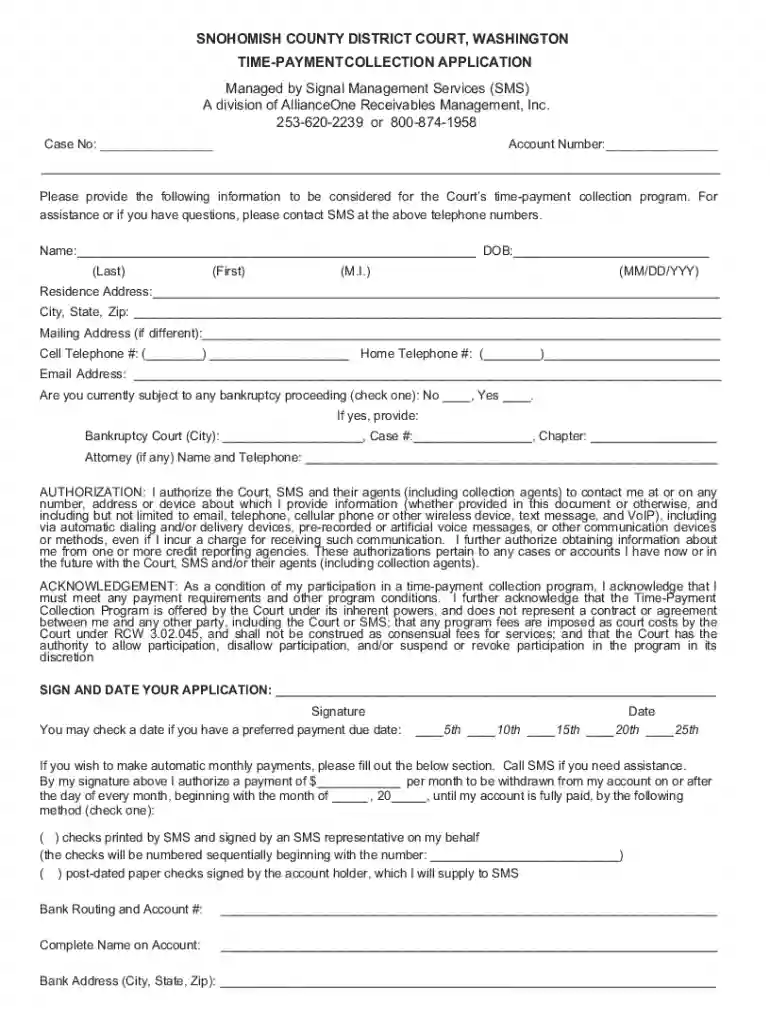
Type text, add images, blackout confidential details, add comments, highlights and more.

Draw your signature, type it, upload its image, or use your mobile device as a signature pad.

Send it via email, link, or fax. You can also download it, export it or print it out.
The Signal Management Services Time Pay Application (PDF) is a critical document used primarily in Snohomish County District Court, Washington, to facilitate the Time-Payment Collection Program. This program is managed by Signal Management Services (SMS) and is designed to assist individuals in managing court-mandated financial obligations. The application outlines the necessary applicant information, including personal details, bankruptcy status, and payment plans, allowing individuals to arrange and authorize structured payment schedules over time. It is an essential form for those seeking to comply with court-ordered financial commitments while maintaining a manageable payment plan.
To effectively utilize the Signal Management Services Time Pay Application (PDF), follow these steps:
Download the Form: Access the form from the official Snohomish County District Court website or directly through Signal Management Services.
Complete Personal Information: Enter accurate personal information such as your name, address, and contact details. Ensure all information matches court records to avoid processing delays.
Declare Financial Status: Provide details about your financial situation, including any bankruptcy declarations. This helps assess appropriate payment terms within your financial capacity.
Payment Authorization: Authorize the payment plan by detailing bank account information for automatic withdrawals. Specify preferred payment intervals and confirm the total amount to be paid.
Review Program Terms: Examine the terms and conditions, including any fees and the consequences of failing to comply with the payment plan.
Submit the Application: Once completed, submit the application as instructed, usually to the SMS or directly to the court.
Await Approval: After submission, staff review the application for completeness and eligibility. Approved payment plans are communicated promptly, establishing the framework for regular payments.
Completing the Signal Management Services Time Pay Application involves a set sequence of actions:
Gather Necessary Information: Before you start filling out the form, assemble all required documentation, including identification, court documents, and financial information.
Fill Out Personal Details: Provide your name, contact information, and case number. Accuracy in this section ensures proper registration and tracking.
Financial Disclosure: Accurately state your current financial situation. Include income, outstanding debts, and any other relevant financial commitments that might impact ability to make payments.
Choose Payment Options: Decide on a payment schedule that best fits your financial situation, selecting from monthly, bi-weekly, or custom intervals approved by the program.
Sign the Application: Ensure you sign the application. For electronic submissions, a digital signature complying with the ESIGN Act may be used.
Submit: Deliver the document via the specified method — online, mail, or in-person — ensuring it reaches the correct department.
Follow-Up: After submission, keep track of communications regarding application status and next steps for payment initiation.
The application encompasses several pivotal sections:
The Signal Management Services Time Pay Application is used legally to establish a binding payment arrangement with the Snohomish County District Court. It ensures individuals maintain compliance with court orders by detailing a structured payment plan. Additionally, it captures consent for financial transactions that are protected under privacy and financial transaction laws, such as automated bank deductions in accordance with national regulatory standards.
This application is primarily used by individuals who are required to fulfill court-driven financial obligations, such as fines or penalty payments imposed by the Snohomish County District Court. Typically, users include:


Washington State law, as applicable in Snohomish County, governs the usage of the Time Pay Application. These rules outline:
While these conditions are primarily governed by state law, local amendments may influence the administration and oversight of these payment arrangements.
Failing to comply with the payment terms laid out by the Signal Management Services Time Pay Application can result in serious consequences, including:
Understanding these penalties helps emphasize the importance of maintaining the payment schedule as designated in the application.
We've got more versions of the Signal Management Services Time Pay Application (PDF) form. Select the right Signal Management Services Time Pay Application (PDF) version from the list and start editing it straight away!
Yes, and it’s really straightforward! DocHub is an online PDF editor with advanced document processing features that allow you quickly adjust your forms, complete blank fields and drop new ones for others to fill out, and create electronic signatures in several ways. Upload your Signal Management Services Time Pay Application (PDF), provide information as requested, and select how you want to eSign your template - by typing your name, drawing your signature, uploading its picture, or using a QR code.
When you edit your Signal Management Services Time Pay Application (PDF) with DocHub, you merely need a steady internet connection and virtually any browser installed on your device. No need to install any third-party software or research guides. Simply open a tab with DocHub, drag and drop your file, and edit it immediately.
At DocHub, your data security is our priority. We follow HIPAA, SOC2, GDPR, and other standards, so you can work on your documents with confidence.
TIME-PAYMENT COLLECTION APPLICATION. Managed by Signal Management Services (SMS). 253-620-2239 or 800-874-1958. You must provide the following information toRead more
(1) pharmacy prescription number;. (2) pharmacys national identification number;. (3) patient name;. (4) patient address, including street, city, state, ZIPRead more


