







Definition & Meaning
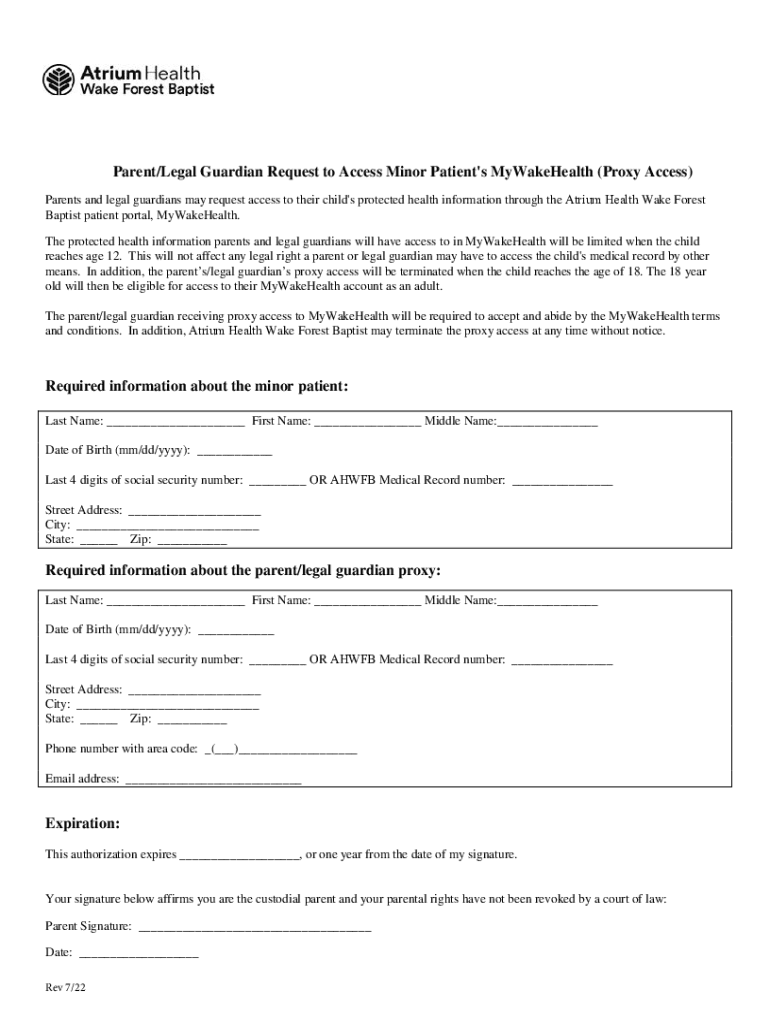
The "cdn atriumhealth -mediaParent Legal Guardian Request to Access Minor Patient's" form is a specialized document used to grant parents or legal guardians proxy access to a minor child's medical records through the MyWakeHealth patient portal. This form is required for legal guardians to request access to specific health information stored electronically and manage the child's medical care. This document serves as a legal agreement between the healthcare provider and the guardian, outlining the access terms and limitations based on the minor's age.
Purpose of the Form
- Proxy Access: Provides the legal guardian with proxy access to the child's health records.
- Age Limitations: Outlines access limitations as the minor approaches certain age milestones, such as reduced access after the age of 12 and termination at 18.
- Authorization: Establishes the legal grounds for accessing sensitive medical information on behalf of the minor.
Key Elements of the cdn atriumhealth -mediaParent Legal Guardian Request to Access Minor Patient's
Understanding the key components of the form is crucial for accurate completion and adherence to legal requirements.
Required Information
- Minor’s Details: Full name, date of birth, and specific account details through the patient portal.
- Guardian’s Details: Legal guardian’s name, contact information, and relation to the minor.
- Terms of Use: Detailing the permitted extent of access and confidentiality obligations.
Authorization and Expiry
- Authorization Period: Defined start and end dates for the proxy access.
- Termination Conditions: Conditions under which access is automatically revoked, such as when the minor turns 18.
Steps to Complete the cdn atriumhealth -mediaParent Legal Guardian Request to Access Minor Patient's
Accurate completion of this form is essential for ensuring seamless access to a minor's medical records.
- Obtain the Form: Request the form from Atrium Health’s website or directly through healthcare facilities.
- Fill Out Required Sections: Input detailed information for both the minor and the guardian, ensuring all fields are accurately completed.
- Review Terms: Carefully read the terms of use, paying attention to access limitations and privacy agreements.
- Signature Requirement: Form must be signed by both the guardian and a healthcare provider to validate the request.
- Submission: Submit the completed form via the stated method, whether through mail, in person, or online submission.
Common Mistakes in Completion
- Incomplete Information: Leaving required fields blank can lead to processing delays.
- Incorrect Details: Providing inaccurate minor or guardian information can invalidate the form.
Legal Use of the cdn atriumhealth -mediaParent Legal Guardian Request to Access Minor Patient's
Legal compliance is essential when managing sensitive health information.
Authorization Implications
- Legal Standing: Grants the guardian legal permission to access and manage the minor's health records, under specific terms.
- Scope of Access: Access is limited to predefined categories of information pertinent to the minor's health care.
Compliance & Penalties
- Non-Compliance Risks: Misuse of information or breach of confidentiality can result in penalties.
- Legal Obligations: Guardians must adhere to privacy laws such as HIPAA in managing obtained health information.
State-specific Rules for the cdn atriumhealth -mediaParent Legal Guardian Request to Access Minor Patient's
Different states may impose specific requirements or variances in the form's application process.
Key Variations
- Age of Consent Laws: Varies by state and affects how and when a minor’s healthcare information can be accessed by guardians.
- Regulatory Policies: Any state-imposed regulations dictating additional consent processes or documentation.
Who Typically Uses the cdn atriumhealth -mediaParent Legal Guardian Request to Access Minor Patient's


Typical Users
- Parents: Seeking organized access to manage their child’s healthcare needs.
- Legal Guardians: Appointed by law to care for minors in institutional or foster settings.
Practical Scenarios
- Healthcare Management for Children with Chronic Illnesses: Guardians utilize the form for efficient healthcare coordination.
- School Medical Record Requirements: Schools needing authorized health information to manage the minor's health emergencies.
Examples of Using the cdn atriumhealth -mediaParent Legal Guardian Request to Access Minor Patient's
Practical Applications
- Chronic Condition Monitoring: Enabling guardians to receive updates and manage treatments for chronic conditions.
- Routine Health Check Management: Allowing access to schedule and check the outcomes of routine health examinations.
Case Study Examples
- School Management Scenario: A guardian uses the form to provide a school with access to updated vaccination records.
- Long-term Care Coordination: Guardians for children in healthcare facilities use this form to centralize access and closely monitor care plans.
Important Terms Related to cdn atriumhealth -mediaParent Legal Guardian Request to Access Minor Patient's
Critical Definitions
- MyWakeHealth Patient Portal: The digital gateway through which guardians access the minor's medical records.
- HIPAA Compliance: Ensures that all parties adhere to federal privacy laws regarding health information.
Common Misunderstandings
- Proxy vs. Direct Access: Clarifying that guardians act on behalf of minors but do not have the right to alter medical records without consent.
Required Documents
Essential Documentation
- Proof of Guardianship: Legal documentation verifying the guardian's legal relationship to the minor.
- Identification Documents: Valid photo ID of the guardian to confirm identity at the time of submission.
Additional Paperwork
- Healthcare Provider Sign-off: Required for form validation and legal endorsement of access rights.
Form Submission Methods (Online / Mail / In-Person)
Submission Channels
- Online Submission: Utilized through Atrium Health's secure platform.
- Mail or In-Person: Alternatives for guardians who prefer traditional submission methods.
Submission Processes
- Verification Requirements: Each method requires its own verification steps to confirm identity and submission authenticity.




