




01. Edit your form online
Type text, add images, blackout confidential details, add comments, highlights and more.

Type text, add images, blackout confidential details, add comments, highlights and more.

Draw your signature, type it, upload its image, or use your mobile device as a signature pad.

Send it via email, link, or fax. You can also download it, export it or print it out.
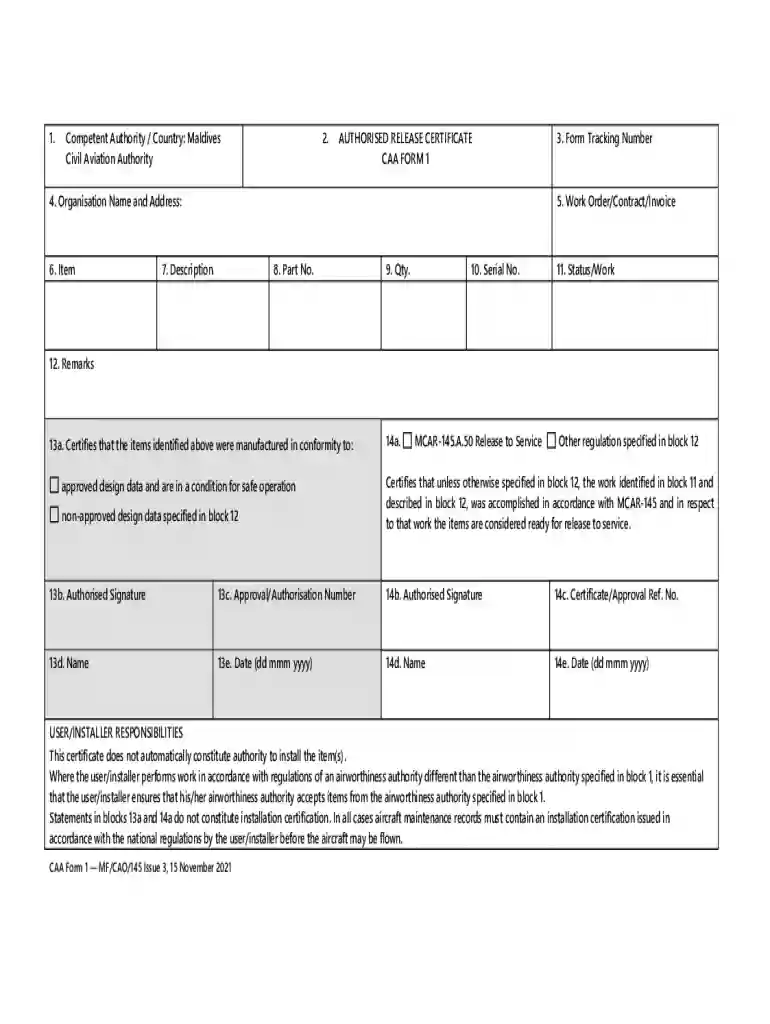
The Authorised Release Certificate (CAA Form 1) is a document issued by the Civil Aviation Authority, certifying that specific items have been produced according to approved design data and are confirmed to be safe for operation. This form is crucial for maintaining compliance with airworthiness standards, ensuring that all components have undergone necessary checks before use in aircraft. The document outlines the responsibilities of both the user and installer, particularly highlighting that possessing the certificate does not automatically authorize the installation of the component.
The CAA Form 1 contains several critical sections that must be accurately completed to meet regulatory standards. Key elements include:
Each of these sections must be filled out with utmost precision to ensure compliance with aviation standards.
Filling out the CAA Form 1 requires careful attention to detail. Follow these steps:
Ensuring accuracy in each step helps in maintaining compliance and aids in the seamless processing of the form.
The CAA Form 1 can typically be obtained through:
Requesting the form from recognized sources ensures its authenticity and alignment with regulatory standards.
The legal aspect of using the CAA Form 1 emphasizes compliance with aviation safety and airworthiness regulations. The form is a legally binding document that validates the status of aircraft parts under the jurisdiction of the Civil Aviation Authority. It assures stakeholders that each component is verified against approved design criteria before installation or use in an aircraft.
The primary users of the CAA Form 1 include:
Each stakeholder relies on the form to uphold safety and regulatory standards in the aviation industry.


Understanding key terminology associated with the CAA Form 1 is vital:
These terms form the foundation of aviation compliance and are critical for interpreting the certificates accurately.
The application process for a CAA Form 1 involves:
Approval times can vary, often depending on the complexity of the item and thoroughness of the submitted documentation.
With digital transformation, the CAA Form 1 is available in both digital and paper formats:
Both formats hold the same legal weight, yet the choice depends on infrastructure availability and compliance requirements.
Platforms like DocHub provide integration capabilities with popular aviation and document management software:
Choosing compatible software can streamline handling and submission of CAA Form 1, enhancing both accuracy and efficiency.
We've got more versions of the 2 AUTHORISED RELEASE CERTIFICATE CAA FORM 1 3 form. Select the right 2 AUTHORISED RELEASE CERTIFICATE CAA FORM 1 3 version from the list and start editing it straight away!
At DocHub, your data security is our priority. We follow HIPAA, SOC2, GDPR, and other standards, so you can work on your documents with confidence.
The Interstate Technology and Regulatory Council (ITRC) is a state-led coalition working to reduce barriers to the use of.Read more
Aug 1, 2013 e) A foreign CAA should contact the Aircraft Certification Service International Policy. Branch, AIR-40. You may DocHub AIR-40 at (202) 385-8945.Read more
aircraft maintenance records must contain an installation certification issued. AUTHORIZED RELEASE CERTIFICATE FAA Form 8130-3, AIRWORTHINESS APPROVAL : 504516


