



01. Edit your pqr format in excel online
Type text, add images, blackout confidential details, add comments, highlights and more.

Type text, add images, blackout confidential details, add comments, highlights and more.

Draw your signature, type it, upload its image, or use your mobile device as a signature pad.

Send pqr format via email, link, or fax. You can also download it, export it or print it out.
The WPS PQR WPQ format 2010 is a standardized documentation framework used primarily in the field of welding. It combines three crucial components: the Welding Procedure Specification (WPS), the Procedure Qualification Record (PQR), and the Welder Performance Qualification (WPQ). Each element has a distinct purpose:
Welding Procedure Specification (WPS): This document defines the welding parameters and processes for a specific welding procedure, including details like base materials, welding techniques, and preheat requirements. The WPS serves as a guide for welders to ensure consistent quality.
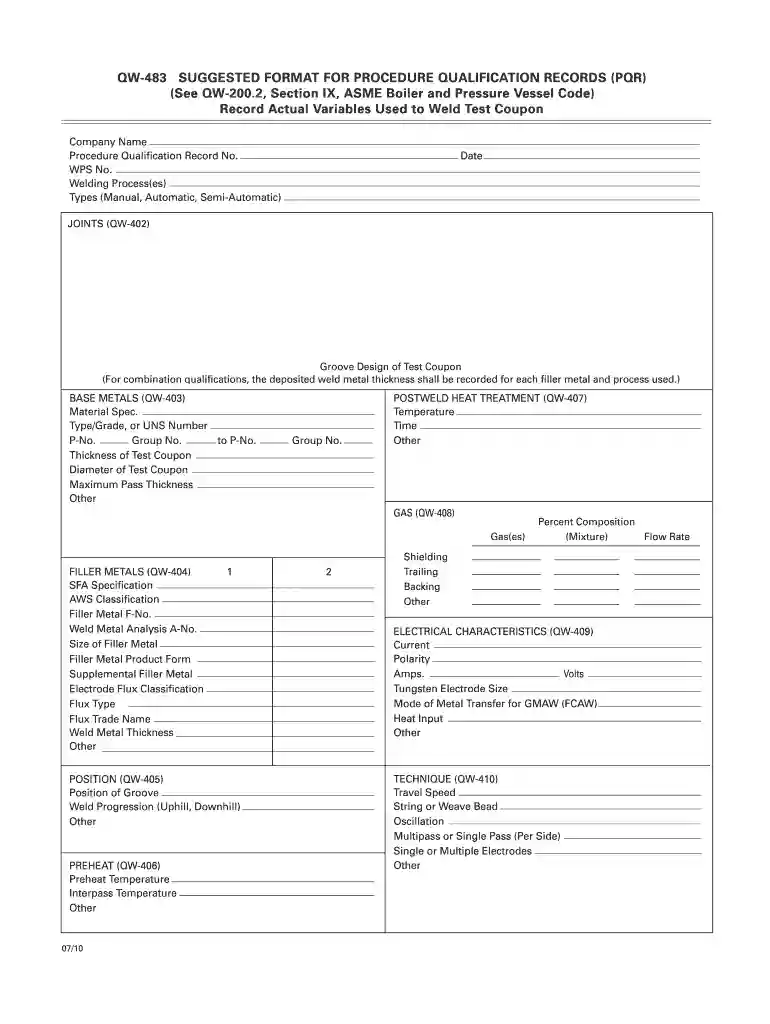
Procedure Qualification Record (PQR): This record serves to validate the WPS by demonstrating its effectiveness through testing. It includes specific data on the welding processes used, the results of various tests, such as tensile and bend tests, and other important details of the qualification process.
Welder Performance Qualification (WPQ): This document verifies that a welder is competent to perform welding in accordance with the qualified WPS. The WPQ confirms that a welder’s skills meet the specifications required for specific materials and processes.
Together, these documents form an integral part of quality assurance in welding operations, particularly in industries such as construction, manufacturing, and maintenance.
Understanding the critical components of the WPS PQR WPQ format 2010 is essential for compliance and quality assurance in welding practices. The key elements include:
Identification Information: Each document should clearly state the identification number, revision status, and applicable codes or standards referenced, such as ASME or AWS specifications.
Base Material Specifications: The WPS must detail the types of base materials involved, including specific grades and thicknesses that the procedures apply to.
Filler Materials: Information regarding the filler materials used in the welding process, including manufacturer specifications, type, and classification, is crucial for ensuring compatibility and strength.
Welding Parameters: The WPS includes specific parameters such as voltage, amperage, travel speed, and shielding gas type, which must be adhered to during the welding process for optimal results.
Testing Protocols: The PQR must outline the testing conducted to validate the WPS, including specific test types like tensile and impact tests, their results, and how they align with regulatory standards.
Welder Qualifications: The WPQ must list the qualifications and certifications of welders, including their identification numbers and the tests they passed to validate their abilities.
These elements not only help ensure proper execution of welding procedures but also provide documentation for regulatory compliance.
Following a structured approach to complete the WPS PQR WPQ format 2010 is crucial for efficiency and accuracy. Here are the recommended steps:
Develop the WPS:
Conduct Procedure Qualification:
Perform Welder Qualification Testing:
Compile Documentation:
Review and Approval Process:
This systematic approach ensures thorough documentation and adherence to compliance requirements.
The application of the WPS PQR WPQ format 2010 spans various sectors within industries where welding is a critical operation. Typical users include:
Manufacturing Companies: Organizations that fabricate metal products often rely on the WPS PQR WPQ framework to assure quality in welding.
Construction Firms: Contractors involved in building and infrastructure projects utilize these formats to ensure that welding procedures meet safety and engineering standards.
Maintenance and Repair Services: Facilities that perform repairs on equipment or structures hinge on the WPS PQR WPQ for standardizing their welding practices.
Quality Assurance Professionals: Individuals responsible for compliance and testing within organizations use these formats to certify that welding operations meet industry codes and standards.
Understanding the demographics of users helps to ensure proper implementation and adherence to the regulations surrounding welding practices.


Practical application of the WPS PQR WPQ format 2010 is pivotal in illustrating its functions. Here are some real-world examples:
Oil and Gas Industry: In the construction of pipelines, the WPS outlines the welding procedures for materials like API 5L steel, ensuring that welds meet the necessary strength requirements. The PQR documents the testing results of samples taken from welded joints to verify compliance.
Aerospace Manufacturing: Aerospace companies must adhere to strict regulations; thus, the WPS specifies welding techniques and materials for components such as aluminum or titanium alloys. The PQR provides data on weld integrity tests that confirm safety standards.
Shipbuilding: Shipyards create a WPS for various parts of a vessel, detailing the specific welding processes for different materials. The PQR captures testing data from actual ship hull welds, ensuring they meet maritime safety regulations.
These examples demonstrate how the WPS PQR WPQ format serves as a backbone for quality control, regulatory compliance, and assurance of welding integrity in specialized fields.
We've got more versions of the pqr format in excel form. Select the right pqr format in excel version from the list and start editing it straight away!
At DocHub, your data security is our priority. We follow HIPAA, SOC2, GDPR, and other standards, so you can work on your documents with confidence.
This document outlines the qualifications for welding and brazing under the 2010 ASME Boiler and Pressure Vessel Code IX.Read more
How do you qualify a welding procedure? ○. Five step process. 1. Understand the intended application for which the WPS will be used.Read more


