




01. Edit your form online
Type text, add images, blackout confidential details, add comments, highlights and more.

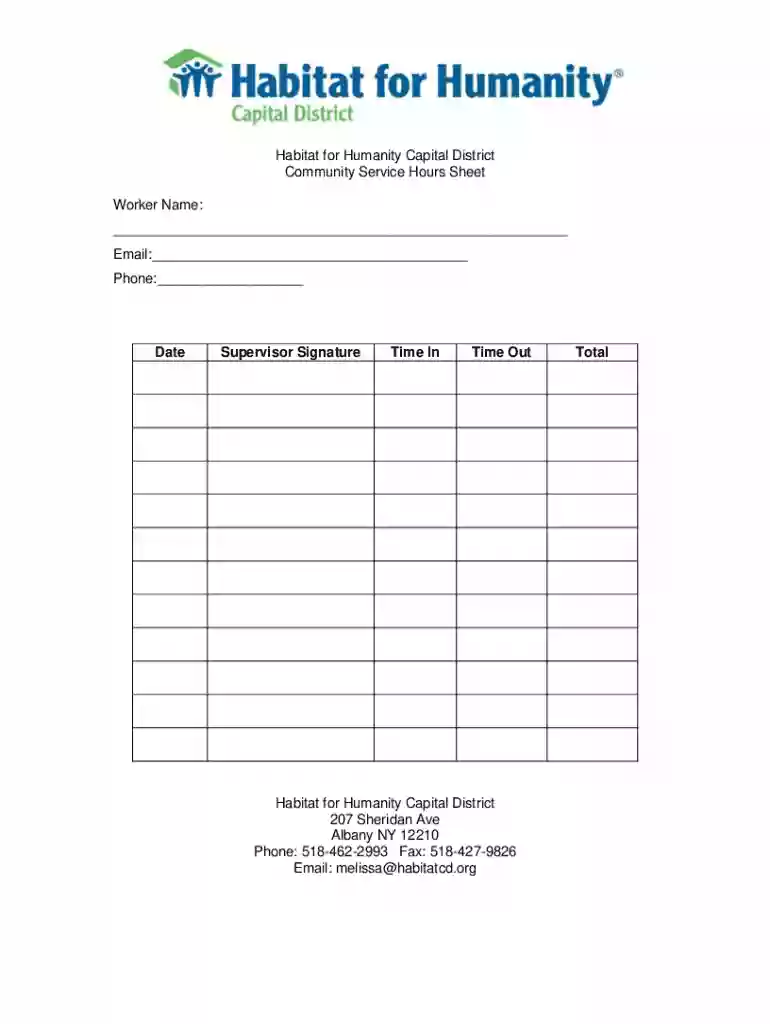
Type text, add images, blackout confidential details, add comments, highlights and more.

Draw your signature, type it, upload its image, or use your mobile device as a signature pad.

Send it via email, link, or fax. You can also download it, export it or print it out.
The "Service Hours Time Sheet - Fill Online, Printable, Fillable, Blank" is a document that records the hours volunteers work on different projects, such as community service or charitable activities. This form is frequently used by non-profit organizations, like Habitat for Humanity, to accurately capture volunteer contributions. It outlines essential volunteer details, such as names and contact info, and tracks the specific time spent on each task, adding transparency and accountability to volunteer hour reporting.
Using the Service Hours Time Sheet is straightforward, given its intuitive design:
Completing the Service Hours Time Sheet involves specific steps to ensure accurate data recording:
Preparation:
Filling Out the Form:
Verification and Submission:
Employing this time sheet substantially benefits both volunteers and organizations by:
A variety of entities find the Service Hours Time Sheet indispensable. These commonly include:


Understanding the pivotal elements of this form can optimize its use:
This form's use extends beyond simple record maintenance:
While this form is commonly used nationwide, certain state-specific rules might apply:
Adapting the time sheet to meet local regulations ensures its validity and comprehensive compliance across different jurisdictions. This awareness directs project coordinators to customize approaches based on specific geographic requirements.
Exploring real-time use scenarios sheds light on its everyday application and benefits:
By delving into each of these critical areas, the Service Hours Time Sheet's role in tracking, validating, and optimizing volunteer contributions in various settings becomes evident.
We've got more versions of the Service Hours Time Sheet - Fill Online, Printable, Fillable, Blank form. Select the right Service Hours Time Sheet - Fill Online, Printable, Fillable, Blank version from the list and start editing it straight away!
You need to use only trusted software solutions with strong security compliance to sign your paperwork electronically. DocHub is just the type of service you need! It stores data on Amazon Web Servers and complies with all required security criteria and eSignature laws, so it’s a reliable way to electronically sign your Service Hours Time Sheet - Fill Online, Printable, Fillable, Blank or other paperwork using this tool.
With DocHub, you have several convenient ways to edit your Service Hours Time Sheet - Fill Online, Printable, Fillable, Blank online. You can drag and drop the form and edit it straight at the DocHub website or use our browser extension to fill out your form right away. On top of that, you can edit your PDF on your phone, as DocHub works with all the available mobile platforms.
At DocHub, your data security is our priority. We follow HIPAA, SOC2, GDPR, and other standards, so you can work on your documents with confidence.
SERVICE TIME SHEET Month: HOURS REQUIRED: representation of the number of hours of community service performed. Supervisor (This form is to be submitted
Page 1. Volunteer Hour Log. Student Name (Please Print). L#. Date. Agency Name. Activities. Hours. Authorized Signature. Total HoursRead more
The eOPF application gives employees the ability to access all the personnel actions processed in regard to their appointments and to download and print copies.Read more


