
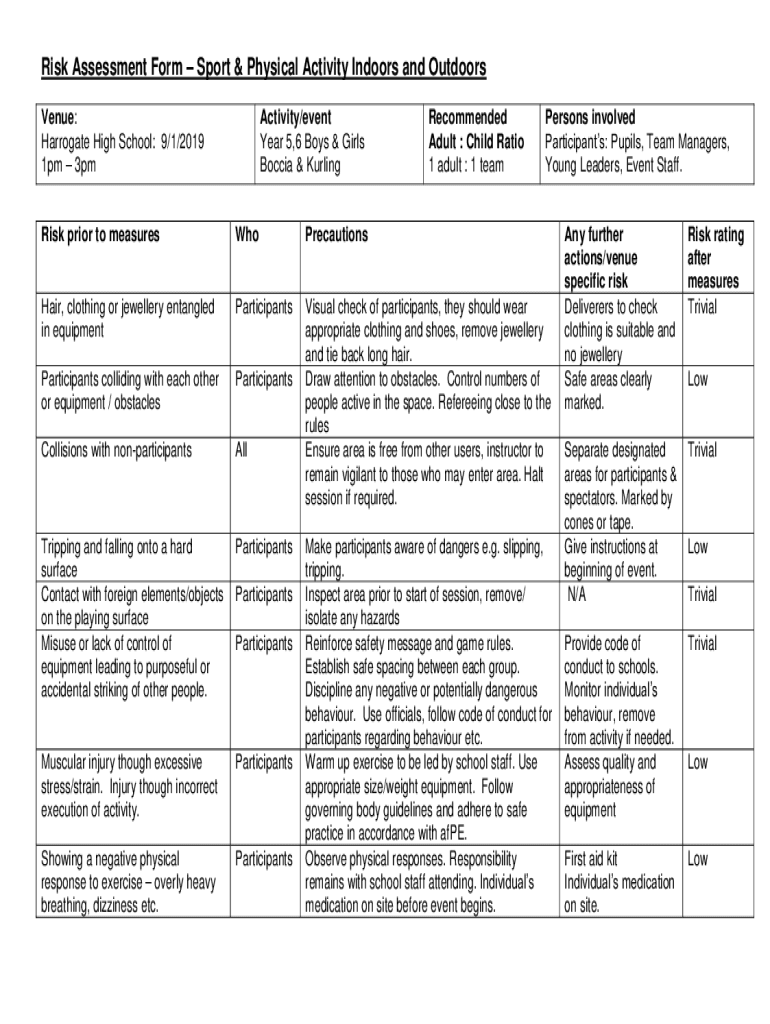







Definition & Meaning
A Risk Assessment Form for sport and physical activity indoors is a specialized document designed to evaluate potential hazards associated with indoor sports and physical activities. This form plays a critical role in preemptively identifying risks such as collisions, falls, and equipment malfunctions, hence enabling organizers and participants to implement necessary precautions. The ultimate aim is to ensure that indoor physical activities are conducted safely, minimizing the likelihood of accidents or injuries.
Purpose of a Risk Assessment Form
- Identifies potential risks: Evaluates hazards associated with specific indoor activities.
- Guides on precautionary measures: Provides a framework for implementing safety protocols.
- Assigns responsibilities: Clarifies duties of staff and participants for risk management.
Key Elements of the Risk Assessment Form
Various elements are crucial for a comprehensive risk assessment form related to indoor sports and physical activities. These include detailed descriptions of activities, identified risks, proposed control measures, and responsibilities assigned to staff and participants.
Essential Components
- Activity Description: Details of specific sports or exercises to be conducted indoors.
- Risk Identification: Lists potential hazards like slips, trips, and falls.
- Control Measures: Suggested methods to minimize identified risks, such as safety gear or supervision requirements.
- Assigned Responsibilities: Outlines roles of staff and participants in maintaining safety.
Steps to Complete the Risk Assessment Form
Completing a risk assessment form requires a systematic approach to ensure all potential risks are adequately assessed and controlled.
- Identify the Activity: Clearly state the indoor sport or activity to be assessed.
- List Potential Hazards: Detail possible dangers linked with the activity.
- Evaluate Risks: Assess the likelihood and impact of each hazard.
- Implement Control Measures: Determine measures to mitigate each identified risk.
- Assign Responsibilities: Specify who is responsible for monitoring and enforcing control measures.
- Review and Update: Regularly review and adjust the assessment as required.
Legal Use of the Risk Assessment Form
The legal importance of a risk assessment form cannot be overstated as it ensures compliance with safety regulations and helps prevent legal action in case of accidents.
Legal Compliance
- Adherence to Safety Laws: Conformity with local and national safety legislations.
- Insurance Requirements: Often required by insurers to validate coverage.
- Evidence in Legal Disputes: Serves as documented proof of proactive risk management.
Important Terms Related to Risk Assessment
Understanding specific terminology used in risk assessment forms is vital to effectively evaluate and manage risks.
Key Terms
- Hazard: A potential source of harm or adverse health effect.
- Risk: The likelihood of a hazard materializing and causing harm.
- Control Measures: Actions taken to eliminate or reduce the risk.
How to Use the Risk Assessment Form
Utilizing the risk assessment form effectively requires understanding its structure and function. Here, the focus is on ensuring the form is correctly completed and used as a tool for enhanced safety.
- Prepare: Assemble necessary information and resources associated with the indoor sport or activity.
- Complete: Accurately fill out each section of the form according to guidelines.
- Implement: Follow through with the recommended safety measures in the work or activity setting.
Who Typically Uses the Risk Assessment Form
This form is commonly utilized by various stakeholders involved in organizing indoor sports or physical activities, ensuring the safety and well-being of participants and staff.


Common Users
- Sports Coaches and Instructors: Who are responsible for conducting safe practices.
- Facilities Managers: Who oversee the maintenance and safety of venues.
- Event Organizers: Who plan and coordinate indoor physical activities.

Examples of Using the Risk Assessment Form
Practical application of the form includes scenarios and events where it has been successfully utilized to mitigate risks.
Use Case Scenarios
- School Sports Events: To ensure a safe environment for students during physical education classes.
- Recreational Sports Leagues: To maintain a standard safety protocol across various indoor games.
- Corporate Fitness Programs: To provide a safe space for employees engaging in workplace wellness activities.
Required Documents
To complete a risk assessment form effectively, certain documents and pieces of information are necessary to ensure accurate and comprehensive risk management.
Necessary Documentation
- Activity Schedule: Details timing and nature of activities.
- Participant Register: Contains information on individuals involved in the activity.
- Safety and Emergency Protocols: Lists procedures to follow in various emergency scenarios.
Software Compatibility
Compatibility of the risk assessment form with different software is essential for seamless digital handling and management.
Compatible Software
- Document Management Systems: Platforms like DocHub that support editing and sharing.
- Spreadsheet Programs: Such as Microsoft Excel for data analysis and storage.
- Collaboration Tools: For team-based reviews and updates, like Google Workspace integration.
Application Process & Approval Time
Understanding the process for application and expected timelines for approval helps in effective planning and implementation of safety measures.
Application Steps
- Submission: Complete and submit the form for review.
- Review: Form is examined to ensure all risks are addressed.
- Approval: Once reviewed, approval is granted for the activity to proceed following the outlined safety measures.
Approval Timeline
- Standard Timeframe: Usually completed within one to two weeks, depending on complexity and current workload.
- Priority Cases: May be expedited if the activity is scheduled within a shorter timeframe.




