
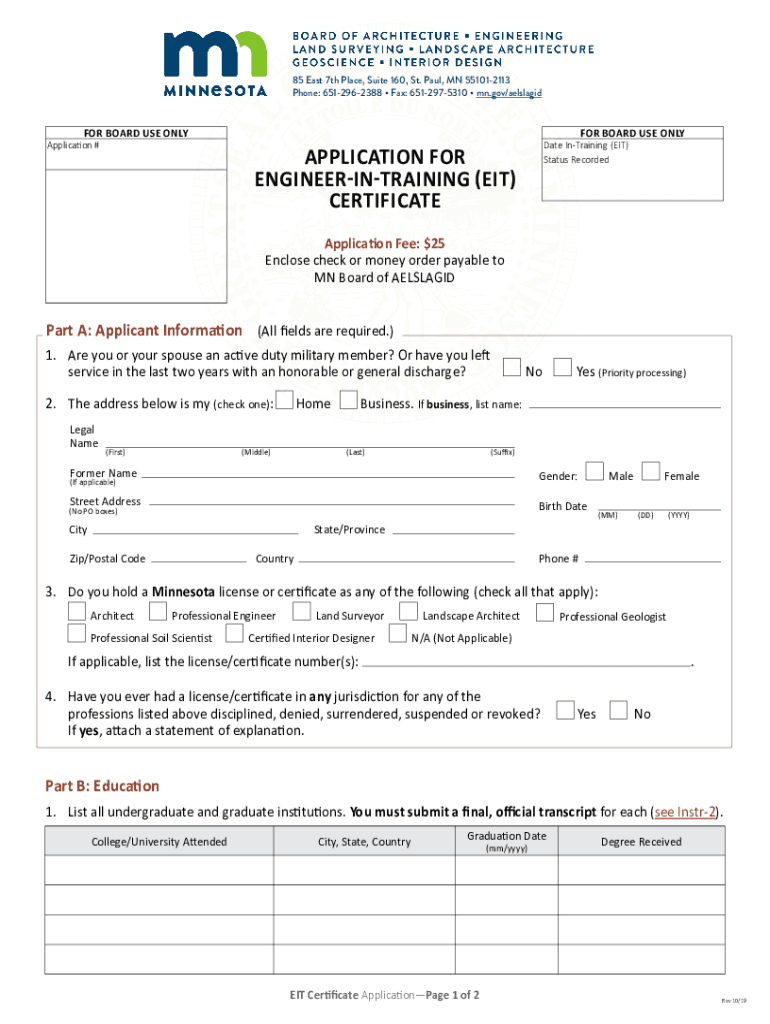







Definition of EIT Certificate
The Engineer-in-Training (EIT) certificate in Minnesota serves as a critical milestone for aspiring engineers, marking the transition from academic study to practical application in the engineering field. This credential indicates that the holder has passed the Fundamentals of Engineering (FE) exam, which is typically one of the initial steps toward becoming a licensed Professional Engineer (PE). The certification acknowledges proficiency in engineering principles and paves the way for gaining valuable work experience under the supervision of a licensed PE.
Steps to Complete the Application for EIT Certificate
-
Pass the Fundamentals of Engineering (FE) Exam: Achieving a passing score is a prerequisite. The exam is standardized and evaluates knowledge across foundational engineering topics.
-
Prepare Required Documents: Gather academic transcripts, proof of passing the FE exam, and any other relevant documents that demonstrate eligibility. For applicants with foreign degrees, additional evaluation might be required to assess degree equivalency.
-
Complete the Application Form: Accurately fill out the form provided by Minnesota.gov, ensuring all fields are completed. Double-check for errors or omissions, as inaccuracies can delay the processing time.
-
Submit the Application: Choose your submission method—online, by mail, or in-person—ensuring adherence to any provided submission guidelines.
-
Await Approval: The approval time can vary, but maintaining prompt communication with the regulatory board can aid in processing. If additional information is requested, provide it as quickly as possible to avoid delays.
Legal Implications of the EIT Certificate
Holding an EIT certificate demonstrates compliance with state-regulated pathways towards professional engineering licensure. This credential not only reflects a commitment to ethical standards and technical competency but also provides a legal framework within which the holder must operate. While holding an EIT certificate does not permit the certification holder to sign off on engineering projects independently, it is an essential step towards achieving such authority.
Eligibility Criteria for Applying
- Educational Background: An accredited engineering degree is generally required. Those with degrees from foreign institutions must provide equivalency assessments.
- Exam Requirement: Passing the FE exam is necessary to validate foundational engineering knowledge.
- Personal Identification: Providing verifiable personal details, including proof of residency, is mandatory to ensure compliance with Minnesota state regulations.


Required Documents for Submission
- Academic Transcripts: Evidence of an accredited engineering degree or equivalent.
- Proof of Passing FE Exam: Documentation to confirm successful completion of the exam.
- Personal Identification: Government-issued ID and proof of residency in Minnesota are typically required for verification purposes.
- Supplementary Forms: If applicable, additional documents relating to foreign degree assessments or other special circumstances.
Important Terms Related to the EIT Certificate
Understanding specific terms associated with the EIT certificate is critical for applicants:
- FE Exam: A qualifying test that assesses the grasp of fundamental engineering principles.
- Professional Engineer (PE): A licensed engineer who has completed all the requisite steps beyond the EIT, including obtaining work experience and passing additional exams.
- Accredited Degree: A degree from a recognized institution that meets the educational standards of the state engineering board.
- Supervision: EIT holders must work under the guidance of a licensed PE to gain practical experience.
Who Typically Uses the EIT Certificate
The EIT certificate is predominantly pursued by recent engineering graduates aiming to distinguish their qualifications and progress towards full professional licensure. Additionally, career changers or professionals educated abroad often seek this certification to validate their credentials within the U.S. engineering landscape.

State-Specific Rules for the EIT Certificate in Minnesota
The application process and requirements for the EIT certificate can vary across states. In Minnesota, specific procedures must be followed, including adherence to state-specific educational and examination mandates. Remaining informed about local rules ensures compliance and facilitates a smoother transition to licensure.
Application Process and Approval Time
The processing time for EIT certificate applications in Minnesota can vary depending on the completeness and accuracy of submissions. It typically involves several weeks from the time the application is received to when a decision is made. Applicants are encouraged to apply well in advance of when they plan to start gaining professional engineering experience.




