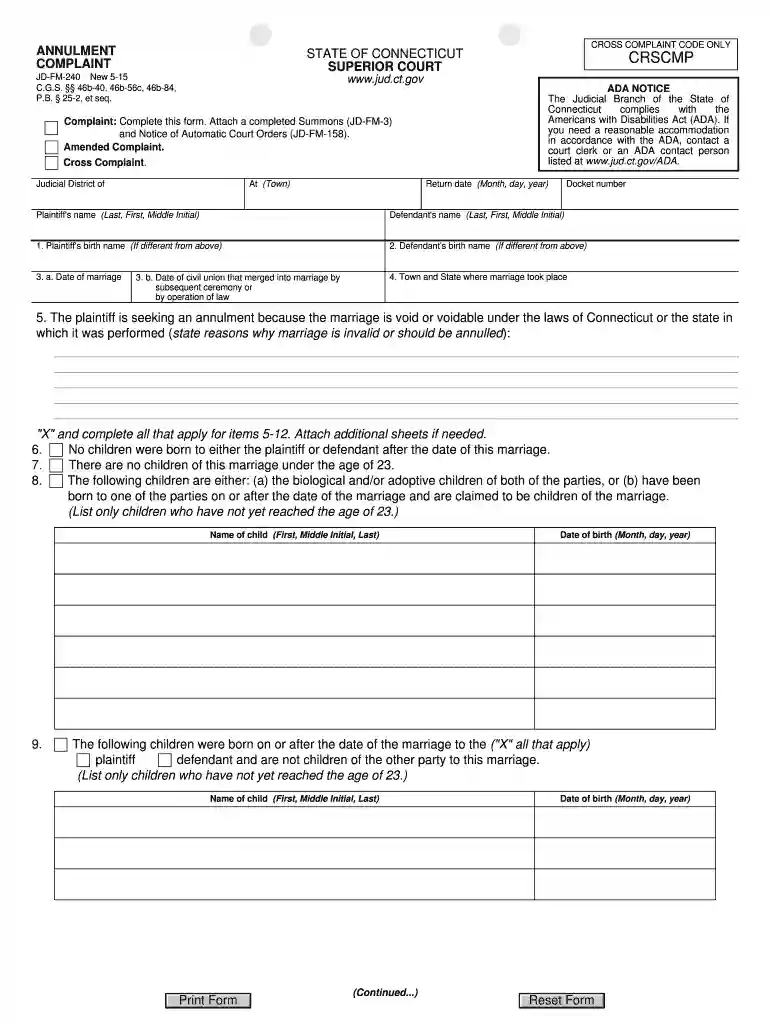
JD-FM-240 - Connecticut Judicial Branch - CT.gov - jud ct 2026

Get Form
form jd fm 230 Preview on Page 1

Here's how it works

01. Edit your form jd fm 230 online
Type text, add images, blackout confidential details, add comments, highlights and more.

02. Sign it in a few clicks
Draw your signature, type it, upload its image, or use your mobile device as a signature pad.

03. Share your form with others
Send cssd family services form jd fm 230 via email, link, or fax. You can also download it, export it or print it out.

Definition and Purpose of JD-FM-240

The JD-FM-240 form is a legal document used within the Connecticut Judicial Branch for specific family law matters, particularly associated with family services. This form is essential for individuals needing to initiate processes related to family court, especially concerning child custody, visitation, and support issues. The primary intention of the JD-FM-240 is to streamline family law proceedings, allowing parties involved to provide necessary information clearly and comprehensively.

The JD-FM-240 form serves various purposes, including but not limited to:

  • Initiating requests for court orders regarding child custody.
  • Documenting personal details of the involved parties, such as parents and children.
  • Outlining financial responsibilities related to child support or spousal support.

Each section of the form must be completed diligently to ensure that the court has accurate information to make informed decisions regarding family dynamics.

How to Obtain the JD-FM-240 Form

Obtaining the JD-FM-240 form is straightforward, as it is readily available through Connecticut's official judicial website. Users can access the form by following these steps:

  1. Navigate to the Official Website: Go to the Connecticut Judicial Branch's website at ct.gov.
  2. Search for Forms: Locate the family services section under forms or legal resources.
  3. Download Options: The JD-FM-240 is typically available in PDF format for easy printing. Ensure you have a PDF reader installed to access the document.
  4. Contact Judicial Services if Necessary: If unable to locate the form online, individuals can reach out to judicial services for assistance.

By leveraging online resources, ensuring the latest version of the JD-FM-240 is acquired is straightforward, facilitating the filing process for concerned parties.

Steps to Complete the JD-FM-240

Completing the JD-FM-240 form involves several steps to ensure accuracy and completeness. Here’s a systematic guide to help you navigate this process effectively:

  1. Gather Necessary Information: Before starting, collect vital information such as names, addresses, and financial details related to the parties involved.
  2. Follow the Section Instructions:
    • Fill out the personal details section accurately.
    • Provide comprehensive information about the child or children involved, including dates of birth and any prior custody arrangements.
  3. Detail Support Obligations: Clearly state any child support or alimony amounts, if applicable, and include relevant financial documents.
  4. Review for Completeness: After filling out the form, review each section to confirm that all required areas are addressed and that the information is correct.
  5. Signature Requirement: Ensure all parties involved sign the document where indicated to verify the authenticity of the information provided.

Properly completing the JD-FM-240 enhances the chances of your filing being processed expeditiously, minimizing delays in court proceedings.

Key Elements of the JD-FM-240 Form

The JD-FM-240 form comprises several critical sections that must be filled out accurately for legal processing. Understanding these key elements is essential for anyone submitting this form:

  • Personal Information: This section requires the names and contact information of all parties involved, including parents and children.
  • Custody Arrangements: Applicants must provide details regarding existing custody agreements or proposals for changes.
  • Financial Information: Clear documentation of any child support needs or previous support arrangements is necessary to establish financial responsibilities.
  • Court-Specific Requests: Individuals must indicate their specific requests or goals for what they aim to achieve through this filing (e.g., modifications of agreements).

Each part of the JD-FM-240 form is crucial, as it contributes to the court's understanding of the case, leading to informed decisions.

Important Terms Related to JD-FM-240

Familiarizing yourself with the legal terminology associated with the JD-FM-240 is vital for a smooth filing process. Here are some essential terms and their definitions:

  • Custody: Refers to the legal right to care for and make decisions for a child.
  • Support Order: A legal directive dictating the financial support obligations of one parent to another in relation to their child.
  • Petitioner: The individual initiating the legal action or filing the JD-FM-240 form.
  • Respondent: The party responding to the petition or the JD-FM-240 filing, typically the other parent.

Understanding these terms helps clarify the language of legal discussions and processes, supporting more effective communication throughout family court procedures.

Legal Use of the JD-FM-240 Form

The JD-FM-240 form is legally recognized by the Connecticut Judicial Branch and is integral to family law proceedings. Here’s how it is typically utilized:

  • Court Filings: The form must be submitted to the appropriate family court as part of legal documents necessary for hearings related to custody or support.
  • Enforcement of Orders: It can be used to enforce existing court orders by documenting any necessary changes or requests for modifications based on the evolving needs of the child.
  • Mediation and Alternative Dispute Resolution: The JD-FM-240 may facilitate mediation efforts by clarifying the needs and positions of both parties before court proceedings initiate.

Understanding the legal implications ensures that individuals use the JD-FM-240 form effectively, aligning their actions with Connecticut’s family law requirements.

See more JD-FM-240 - Connecticut Judicial Branch - CT.gov - jud ct versions

We've got more versions of the JD-FM-240 - Connecticut Judicial Branch - CT.gov - jud ct form. Select the right JD-FM-240 - Connecticut Judicial Branch - CT.gov - jud ct version from the list and start editing it straight away!
Versions Form popularity Fillable & printable
2020 4.8 Satisfied (156 Votes)
2015 4.3 Satisfied (161 Votes)
be ready to get more

Complete this form in 5 minutes or less

Get form

Got questions?

We have answers to the most popular questions from our customers. If you can't find an answer to your question, please contact us.
Contact us
Penalties for Late Payments If the ticket is not paid within 15 calendar dates after ticket issuance, the said fine will double. Failure to pay within 30 days of ticket issuance will result in the said fine tripling.
The summons will tell you to call the toll-free automated jury message system after 5:30 the night before each reporting date. When you call the automated jury message system at 1-866-388-2430, it will ask you to enter your 9-digit participant number shown on your summons.
If you need to reschedule your jury service, please visit eResponse to defer, or contact Jury Administration at 1-800-842-8175 for further assistance. For jurors with ten digit CT Juror ID with leading zeros (0012345678), please visit eResponse to submit a deferral request.
Paying a speeding ticket is a guilty plea, which results in fines, demerit points on your license, and higher insurance costs. Going to court can reduce or eliminate penalties, such as lowering fines, reducing points, or even dismissing charges with the help of an attorney.
Divisions of Superior Court - CT Judicial Branch. The Superior Court hears civil, criminal, family and juvenile matters. Civil Division hears cases in which someone is being sued to protect civil, personal or property rights.

Security and compliance

At DocHub, your data security is our priority. We follow HIPAA, SOC2, GDPR, and other standards, so you can work on your documents with confidence.

Learn more
ccpa2
pci-dss
gdpr-compliance
hipaa
soc-compliance

People also ask

The State of Connecticut Centralized Infractions Bureau now allows you to pay infractions online. The link below will take you to the State of Connecticut Judicial Branch to pay your infraction.
You may pay your ticket or plead not guilty online at .jud.ct.gov. You may also call the Centralized Infractions Bureau at (860) 263-2750 to pay your ticket or plead not guilty.

cssd family services