

Supercharge your productiveness with Civil Action Legal Forms

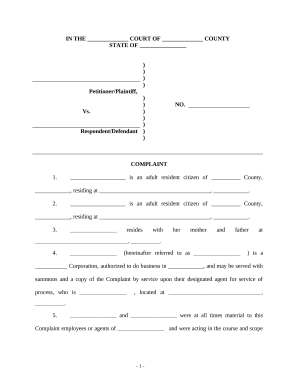
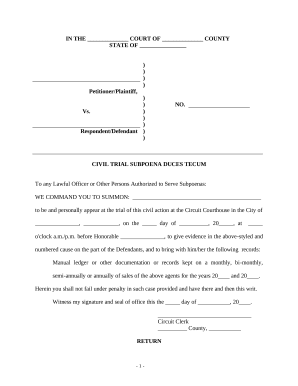
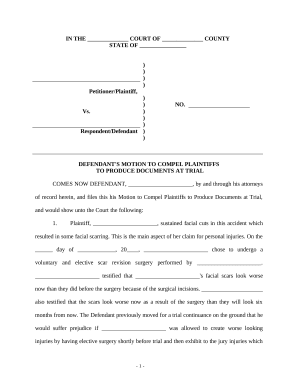
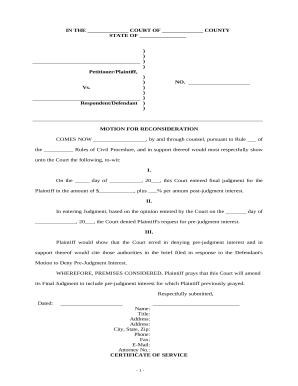
Record management takes up to half of your office hours. With DocHub, it is possible to reclaim your time and effort and increase your team's productivity. Access Civil Action Legal Forms category and investigate all form templates related to your day-to-day workflows.

Effortlessly use Civil Action Legal Forms:

  1. Open Civil Action Legal Forms and employ Preview to obtain the relevant form.
  2. Click on Get Form to begin working on it.
  3. Wait for your form to upload in the online editor and begin modifying it.
  4. Add new fillable fields, icons, and pictures, change pages order, and many more.
  5. Fill your document or prepare it for other contributors.
  6. Download or share the form by link, email attachment, or invite.

Boost your day-to-day document management with the Civil Action Legal Forms. Get your free DocHub account right now to explore all templates.

Commonly Asked Questions about Civil Action Legal Forms

If you are asking the judge for a motion, you must fill out several forms. Complete a Form 14 (Notice of Motion) and a Form 14A (Affidavit). In Form 14, you will list the orders that you are requesting at the motion.
The Rules of Civil Procedure allow many civil court forms to be filed electronically through the Civil Claims Online Portal or submitted through the Civil Submissions Online Portal.
To start the litigation process, the person who has been harmed (the Plaintiff) prepares a Statement of Claim. The Statement of Claim describes the facts and the legal reasons that the Plaintiff says he or she is entitled to compensation from the other person (the Defendant).
You can start a civil case by preparing and filing a statement of claim that describes the facts and legal reasons you are entitled to compensation. This is called an action. You can also start a civil case by preparing and filing a Notice of Application that describes the order you want the court or judge to make.
A civil action or suit starts when individuals or corporations disagree on a legal matter, such as the terms of a contract or the ownership of a piece of property. A civil suit can also result if someone is injured or property is damaged.
About Civil Proceedings The Superior Court of Justice hears all civil proceedings in Ontario, including commercial matters, personal injury, bankruptcy and insolvency cases, and litigation involving wills and estates.
As indicated below, relatively few civil trials are held each year in Ontario. Party as a result, the average age of a case making it to trial in 2019 in Toronto was almost 5 years and 9 months (5.73 years), with a standard deviation of 1.49 years.

