







Understanding the AM-PAC Basic Mobility Outpatient Short Form
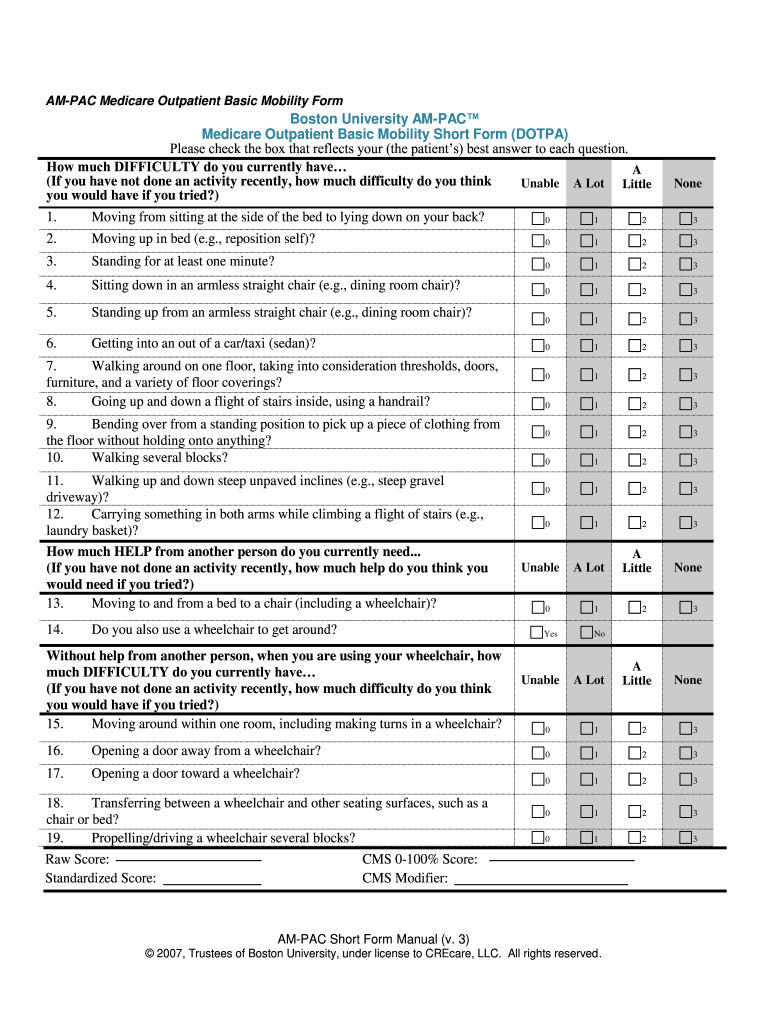
The AM-PAC Basic Mobility Outpatient Short Form is an essential tool used in healthcare settings to assess a patient's mobility and functional abilities. Designed primarily for outpatient settings, this form evaluates patients’ capabilities across various mobility tasks. It incorporates a straightforward series of questions aimed at gauging the difficulty patients experience while performing everyday activities, such as moving in bed, standing, walking, and using a wheelchair. The ultimate goal of the form is to determine each patient's level of difficulty with these tasks and the assistance they require, thus facilitating tailored rehabilitation strategies.
How to Use the AM-PAC Basic Mobility Outpatient Short Form
Using the AM-PAC Basic Mobility Outpatient Short Form involves a systematic approach to ensure accurate assessment of a patient's mobility needs. The following steps outline the process:
-
Preparation: Ensure that the patient understands the purpose of the form. Providing a brief overview can help them feel more comfortable.
-
Administration: Present the form to the patient, explaining each item clearly to avoid any confusion. It may be beneficial to ask the questions in a conversational manner to promote openness.
-
Scoring: Once completed, assess the patient’s responses using the standardized scoring chart. This involves tallying the scores for each activity to generate an aggregate score reflecting the patient's overall mobility status.
-
Interpretation: Utilize the AM-PAC score interpretation guidelines to ascertain the patient's functional ability level. This step is crucial in informing subsequent rehabilitation planning.
-
Follow-Up: Schedule follow-ups as necessary to monitor progress, using the form periodically to track changes in the patient's mobility.
How to Obtain the AM-PAC Basic Mobility Outpatient Short Form
The AM-PAC Basic Mobility Outpatient Short Form can be obtained through several avenues:
- Healthcare Providers: Many healthcare professionals have direct access to the form and can provide it during routine evaluations.
- Online Resources: The form is available via medical websites and platforms specializing in rehabilitation and outpatient care documentation.
- Professional Associations: Organizations related to physical therapy may offer access to the AM-PAC form as part of their resources for practitioners.
Proper channels for acquiring the form ensure that users have the most up-to-date and accurate version for use.
Key Elements of the AM-PAC Basic Mobility Outpatient Short Form
Understanding the key components of the AM-PAC Basic Mobility Outpatient Short Form is essential for effective use:
-
Sections: The form typically includes sections for various mobility tasks, each with clearly defined questions assessing difficulty levels.
-
Response Options: Patients usually provide responses on a Likert scale, offering flexibility in reporting their experiences.
-
Purpose: Each section is designed to capture the necessary information to evaluate functional capabilities and identify specific assistive needs.
These elements are crucial for ensuring the form serves its intended purpose effectively and efficiently.
Legal Use of the AM-PAC Basic Mobility Outpatient Short Form
The AM-PAC Basic Mobility Outpatient Short Form is compliant with federal guidelines governing patient assessments. It is crucial to use this form in contexts where informed consent has been obtained, and the patient's privacy is maintained per HIPAA regulations. Understanding the legal context includes:
-
Patient Confidentiality: Ensure that any data collected through the form is securely stored and only accessible to authorized personnel.
-
Documentation Integrity: Maintaining accurate and complete records is vital for legal compliance and patient care continuity.
-
Use in Clinical Trials: If utilized in research settings, proper permissions and participant agreements must be in place, adhering to institutional review board (IRB) requirements.
Examples of Using the AM-PAC Basic Mobility Outpatient Short Form
Real-world application of the AM-PAC Basic Mobility Outpatient Short Form can enhance understanding of its utility. Here are some scenarios:
-
Physical Therapy Assessments: A physical therapist uses the form at the initial evaluation of a patient recovering from knee surgery to establish a baseline measure for mobility.
-
Home Health Services: Nurses in home health settings employ the AM-PAC to monitor patients with chronic illnesses, allowing for adjustments in care plans based on mobility assessments.
-
Rehabilitation Centers: These facilities utilize the AM-PAC to evaluate progress during inpatient rehabilitation, ensuring a tailored therapeutic approach that reflects the patient's evolving needs.
These examples illustrate the versatility and importance of the AM-PAC Basic Mobility Outpatient Short Form within patient care.
Important Terms Related to the AM-PAC Basic Mobility Outpatient Short Form
Familiarity with key terminology enhances comprehension of the AM-PAC Basic Mobility Outpatient Short Form’s context and application:
-
Functional Mobility: A term referring to a patient's capability to move around and perform daily tasks independently.
-
Scoring Chart: A tool used to interpret the responses from the AM-PAC form, assigning scores that reflect patient mobility.
-
Rehabilitation Goals: Objectives set based on the patient's assessment scores to improve functionality and independence.
Understanding these terms aids healthcare providers and patients in effectively utilizing the AM-PAC Basic Mobility Outpatient Short Form for optimal outcomes.




