CC 377, Petition for Personal Protection Order (Nondomestic) 2026

Get Form
ppo order Preview on Page 1

Here's how it works

01. Edit your ppo order online
Type text, add images, blackout confidential details, add comments, highlights and more.

02. Sign it in a few clicks
Draw your signature, type it, upload its image, or use your mobile device as a signature pad.

03. Share your form with others
Send ppo paperwork via email, link, or fax. You can also download it, export it or print it out.

How to use or fill out CC 377, Petition for Personal Protection Order (Nondomestic) with our platform

Form edit decoration
9.5
Ease of Setup
DocHub User Ratings on G2
9.0
Ease of Use
DocHub User Ratings on G2
  1. Click ‘Get Form’ to open it in the editor.
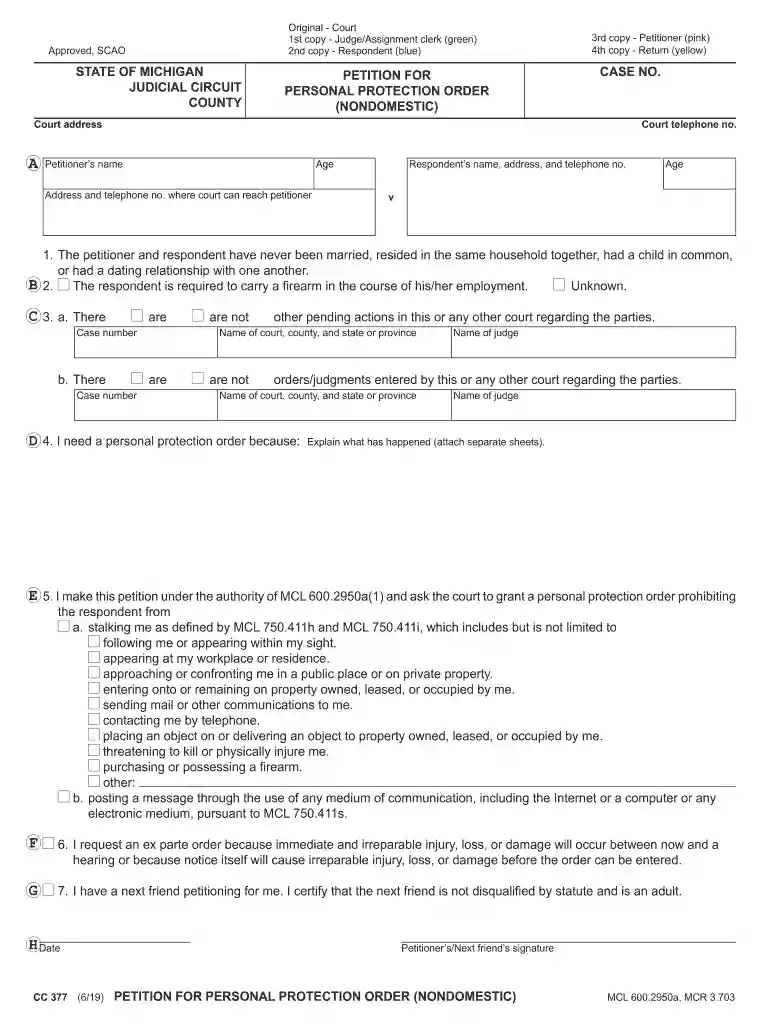
  2. Begin by filling out the 'Petitioner' section with your name, address, and telephone number. If you are under 18, include your age. For the 'Respondent', provide their details as well.
  3. In section B, indicate if there is a pending action between you and the respondent. If so, fill in the case number and court details.
  4. For section C, check if there are any existing court orders or judgments involving both parties and provide relevant information.
  5. In section D, detail why you are requesting a personal protection order. Include specific incidents that justify your request.
  6. If you believe immediate harm may occur, check for an 'ex parte order' in section E. Otherwise, prepare for a court hearing as outlined in section F.
  7. Complete sections G and H by signing and dating the form before submitting it to the county clerk.

Start using our platform today to easily fill out your CC 377 form online for free!

be ready to get more

Complete this form in 5 minutes or less

Get form

Got questions?

We have answers to the most popular questions from our customers. If you can't find an answer to your question, please contact us.
Contact us
As a victim, you have the right to ask a judge for a Protective Order. A Protective Order from the court orders the person who has been harassing, stalking, or abusing you to stop doing so or be punished by the court. A Protective Order is only a court paper.
To ask the court for a nondomestic PPO, prepare and file a petition. You can use the Do-It-Yourself Personal Protection Order (PPO) tool to prepare your petition. File the petition at the circuit court in any Michigan county.
An Extreme Risk Protection Order is designed to prevent individuals who are at high risk of harming themselves or others from accessing firearms by allowing an intimate partner, family, household members, and law enforcement to obtain a court order when there is demonstrated evidence that the person poses a significant
There are three types of orders of protection that can provide victims with legal protections to support their safetyemergency protective orders, temporary restraining orders, and permanent restraining orders.
A PPO is a court order to protect a person from someone who has sexually assaulted you, or someone who has made you afraid of being assaulted.

Security and compliance

At DocHub, your data security is our priority. We follow HIPAA, SOC2, GDPR, and other standards, so you can work on your documents with confidence.

Learn more
ccpa2
pci-dss
gdpr-compliance
hipaa
soc-compliance
be ready to get more

Complete this form in 5 minutes or less

Get form

People also ask

A PPO is a court order to protect a person from someone who has sexually assaulted you, or someone who has made you afraid of being assaulted. The court can order that person not to: Have contact with you. Follow or approach you.
The main difference between a protective order vs. a restraining order is the law by which they are applied and the jurisdiction in which the order is issued. Protective orders usually apply in criminal cases with criminal charges associated with the guilty, while restraining orders are mostly used in civil cases.
To get a Domestic Relationship PPO, you must prove that there is reasonable cause to believe that the abuser might physically hurt you, threaten you, stalk you, or do something else that interferes with your personal liberty or safety. Reasonable cause is a lower level of proof than what is required in a criminal case.

Related links