




01. Edit your basketball scouting report template google docs online
Type text, add images, blackout confidential details, add comments, highlights and more.

Type text, add images, blackout confidential details, add comments, highlights and more.

Draw your signature, type it, upload its image, or use your mobile device as a signature pad.

Send basketball scouting report template via email, link, or fax. You can also download it, export it or print it out.
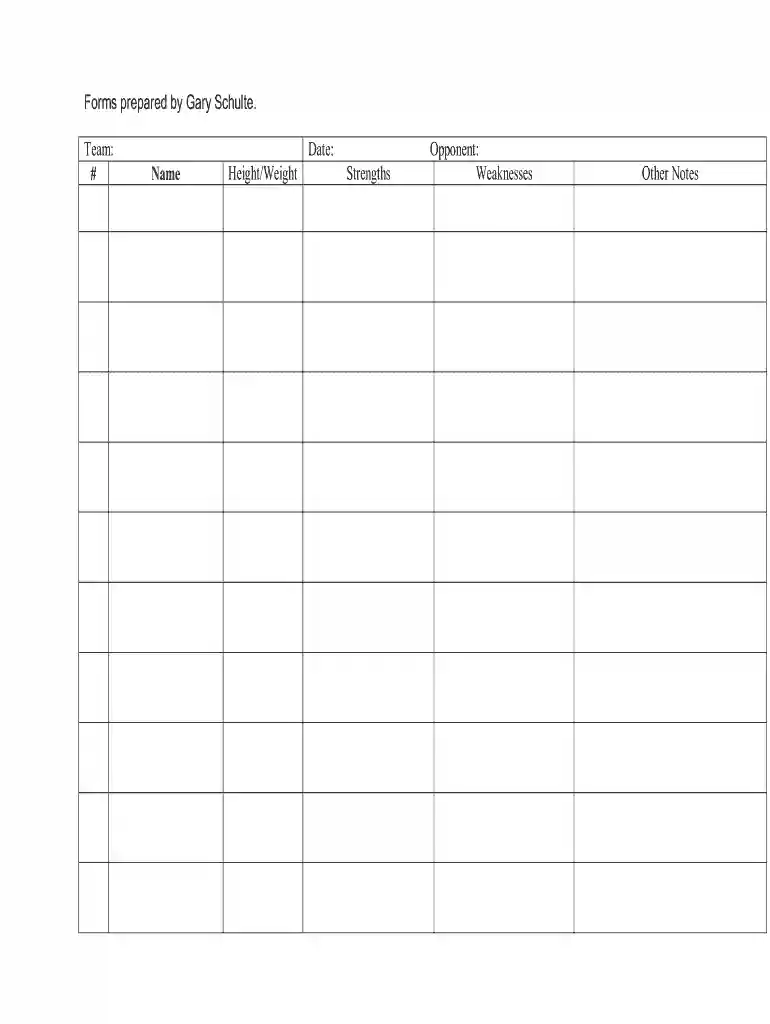
A basketball scouting report template is an organized document used to evaluate players or teams. It serves as a guide for coaches, scouts, and analysts to systematically record observations and critiques about athletic performances. The focus of these reports typically encompasses various factors, such as player statistics, strengths and weaknesses, and tactical insights regarding both individual players and the opposing team.
The template usually includes sections for player information, offensive and defensive skills, shooting accuracy, and specific game strategies, such as how the team executes half-court offenses and defenses or transitions between plays. By standardizing this crucial assessment tool, teams can streamline their preparation and planning, improving overall performance on the court.
Understanding the essential components of a basketball scouting report template is vital for effective use. This template typically includes the following elements:
This holistic approach ensures that all relevant data is captured for informed decision-making and future strategy development.
Utilizing a basketball scouting report template requires a systematic approach that promotes effectiveness. Here’s a step-by-step guide on how to make the most of this tool:
Gather Data: Start by collecting game footage, statistics, and player assessments from recent matches. This background information is essential for making educated judgments.
Fill Out Player Information: Enter the fundamental details in the designated section of the template, laying the groundwork for your analysis.
Input Statistics: Analyze the collected data and populate the statistical analysis section. Be specific and include trends over multiple games to add depth.
Evaluate Strengths and Weaknesses: Use your observations to define clear strengths—for example, a player’s shooting range or defensive agility—and pinpoint weaknesses, such as struggles with ball handling.
Analyze Game Strategies: Document notable tactical approaches observed during games. For instance, did the player consistently favor one side during drives? Understanding such patterns is crucial for game planning.
Conduct a Comparative Analysis: Finally, review the report in conjunction with other similar players, noting differences, which can help adjust strategies for upcoming games.
Following these steps helps ensure a thorough and insightful scouting report that can significantly impact game preparation.
Employing a basketball scouting report template can provide practical advantages in real-world scenarios. Here are some illustrative examples:
Game Preparation: A high school basketball team utilizes the template to scout an upcoming opponent. They analyze the opponent's shooting stats and defensive setups to tailor their offensive strategies accordingly. The insights garnered provide a distinct edge in anticipation of defensive adjustments during gameplay.
Player Development: A college coach uses the template to assess individual players during training sessions. The insights gained reveal that a player excels in three-point shooting but struggles with defensive positioning. The coach can then focus on targeted drills to enhance that player's overall game.
Post-Game Analysis: After a game, a professional team reviews the scouting reports generated from earlier assessments. They evaluate discrepancies between anticipated and actual performance based on player tendencies documented in the templates. This helps make quick adjustments in the following practices and games.
These examples illustrate how structured information can lead to improved strategies, enriching both player and team performance.
Familiarity with specific terminology enhances the effectiveness of using a basketball scouting report template. Understanding these terms can help streamline communication among coaches, players, and analysts. Key terms include:
Familiarity with these essential concepts enhances the overall analysis and improves the communication and implementation of game strategies derived from the scouting reports.
There are various adaptations of the basketball scouting report template designed for specific scenarios or levels of play. Recognizing these variants is beneficial:
NBA Scouting Report Template: Tailored for professional teams, this version emphasizes advanced statistical analysis, including player efficiency ratings and detailed play trends.
College Basketball Scouting Report Template: Applicable for collegiate teams, this variant often includes sections to highlight recruitment potential and development progress.
High School Basketball Scouting Report Template: This template might simplify the data collection process, focusing on fundamental skills and gameplay basics, making it more applicable for younger athletes.
Printable Basketball Scouting Report Template PDF: Designed for physical documentation, it retains all the standard elements while allowing coaches to jot down observations directly during games.
Adapting the scouting report template to these specific scenarios ensures that the resulting insights are most relevant to the player's and team's unique needs.
Various stakeholders within the sport of basketball find the scouting report template invaluable. Common users include:
Recognizing the diverse applications of the basketball scouting report template highlights its importance in the sport's ecosystem and enhances the potential for improved performance outcomes.


Signing paperwork on a mobile device is fast, simple, and doesn’t require software installation if you have an account with DocHub. Log in from any browser, complete your blank fields with your information, and click on Sign → Create your signature. You can draw your electronic signature just as you usually do on paper, add its image to your scouting report template, or type in your name and stylize its look. No matter what option you choose, your document will be valid.
Having a swift editing system like DocHub, you do not require anything but a browser and internet connection to modify your nba scouting report template on the internet swiftly. Upload your file or get the relevant form in DocHub’s catalog, open our editor with a single click, and finish it electronically. To revise your forms anytime, register a free profile with DocHub.
At DocHub, your data security is our priority. We follow HIPAA, SOC2, GDPR, and other standards, so you can work on your documents with confidence.


