
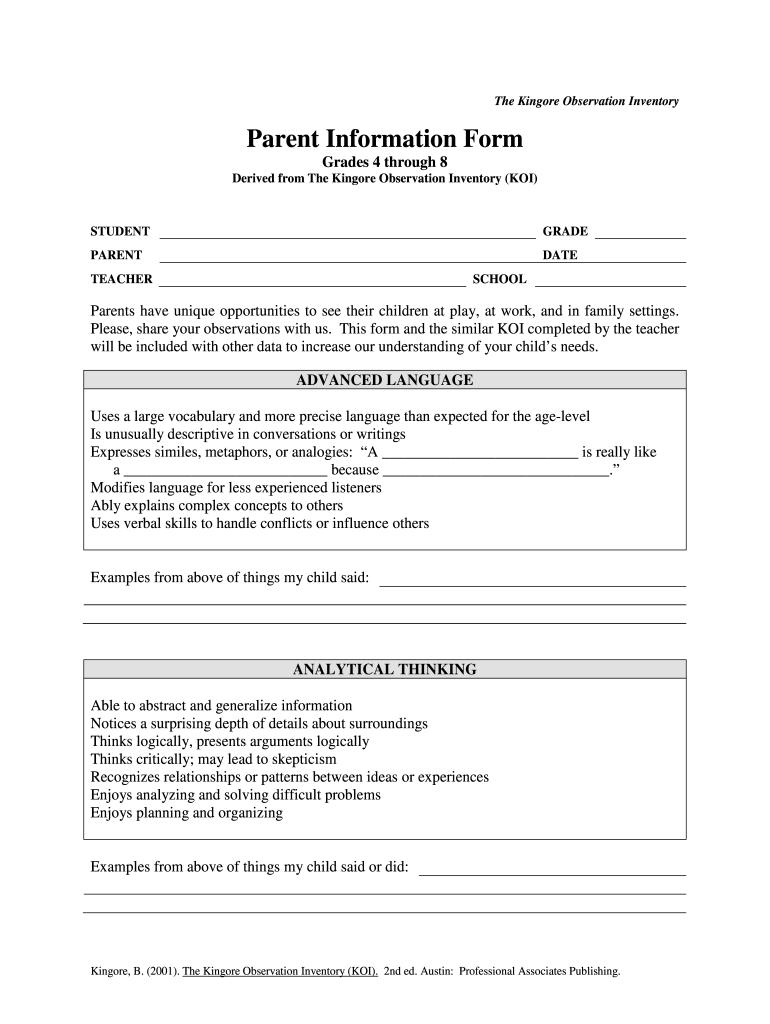







Understanding the Kingore Observation Inventory
The Kingore Observation Inventory (KOI) is an assessment tool designed to gather valuable insights into a child's advanced capabilities in various areas. Specifically tailored for students in grades four through eight, the KOI allows parents to provide observations that can inform educational approaches and enhance teaching strategies. Insights collected can significantly aid educators in understanding individual learning needs and fostering environments where children can thrive.
How to Use the Kingore Observation Information
The KOI requires parents to observe their children's interactions and behaviors in a variety of contexts. Parents should look for:
- Language Skills: Noting instances where the child demonstrates advanced vocabulary or complex sentence structures.
- Analytical Thinking: Identifying moments when the child solves problems creatively or thinks critically.
- Motivation: Observing the child's enthusiasm for learning new concepts or completing tasks.
- Social Interactions: Evaluating how the child engages with peers, including leadership skills and empathy.
When filling out the observation information, specificity is key. Rather than general statements, provide concrete examples, such as:
- “My child explained the concept of gravity using everyday objects, showing a deep understanding.”
- “During a group project, my child took the initiative to divide tasks and motivate team members.”
Steps to Complete the Kingore Observation Information
Completing the Kingore observation form involves several clear steps:
- Read the Instructions: Familiarize yourself with the sections of the form and the type of information required.
- Reflect on Observations: Spend time thinking about your child’s behaviors over a specified period. Consider utilizing a journal to note observations regularly.
- Document Specific Examples: Write detailed accounts of your child's abilities, using descriptive language to articulate their strengths.
- Review and Revise: Before submission, review your responses to ensure clarity and completeness. Take the opportunity to add any additional insights.
- Submit the Form: Follow the specified submission methods, whether electronic or physical, ensuring it’s sent by the required deadline.
Important Terms Related to the Kingore Observation Information
To effectively utilize the KOI, it's beneficial to understand key terms associated with the form:
- Advanced Language Skills: A child's ability to use complex vocabulary and articulate thoughts coherently.
- Analytical Thinking: The capacity to analyze problems, draw conclusions, and propose solutions.
- Motivation: The internal drive that compels a child to engage deeply with learning.
- Sensitivity: Awareness and responsiveness to the emotions of others, which can indicate social-emotional aptitude.
Familiarizing yourself with these terms will enhance the quality of the observations recorded.
Examples of Using the Kingore Observation Information
Examples provide clarification on how to effectively use the KOI to gather insightful data:
-
Example 1: A parent noting that their child built a complex structure using blocks and explained to friends the principles of balance and gravity highlights analytical thinking.
-
Example 2: A child voluntarily participating in a school debate on environmental issues and articulating a clear position reflects advanced language skills and motivation.
-
Example 3: Observations of how a child helps a friend who is struggling with homework, demonstrating empathy and supportiveness, can feed into assessments focusing on sensitivity.
By embedding these observations with practical examples, the overall assessment becomes richer and more beneficial to educators.
Legal Use of the Kingore Observation Information
The KOI is a legally compliant tool used to assess children's abilities within educational frameworks. Parents and educators alike are encouraged to utilize this information:
- Confidentiality: All observations and documentation are protected under educational privacy regulations.
- Usage in Schools: Schools can incorporate KOI findings into differentiated instruction plans to better serve diverse learning needs.
Understanding the legal framework surrounding the KOI ensures parents feel secure in their contributions to their child's educational journey.
Who Typically Uses the Kingore Observation Information
The primary users of the Kingore observation data include:
- Parents: Who provide detailed observations that inform teachers about their child’s unique strengths.
- Educators: Who utilize the information to tailor instruction and provide support for advanced learners.
- School Psychologists: Who may analyze the data as part of broader assessments for gifted and talented programs.
This collaborative approach ensures that the child’s educational experience is enriched and responsive to their needs.


State-Specific Rules for the Kingore Observation Information
Although the KOI is standardized, states may have particular regulations regarding its use:
- Gifted Education Programs: Requirements for documentation and assessment may vary by state; therefore, it's essential to check local guidelines.
- Submission Protocols: Some states may require specific formats or additional documentation to accompany the KOI.
Staying informed about these state-specific rules can ensure compliance and effectiveness in utilizing the KOI.
Key Elements of the Kingore Observation Information
Key elements that are foundational to the KOI include:
- Observation Criteria: Defined metrics that guide parents in evaluating their child's capabilities.
- Documentation Format: A structured form that assists in recording observations consistently and legibly.
- Feedback Mechanism: A process for teachers to provide constructive feedback based on the insights gathered.
These elements contribute to a coherent understanding of student abilities and needs.
Conclusion
Functional understanding of the Kingore observation information design enables parents and educators to better assess children's advanced abilities. By following the procedures and utilizing the forms thoughtfully, insights garnered can greatly enhance educational outcomes.




