





What the form is
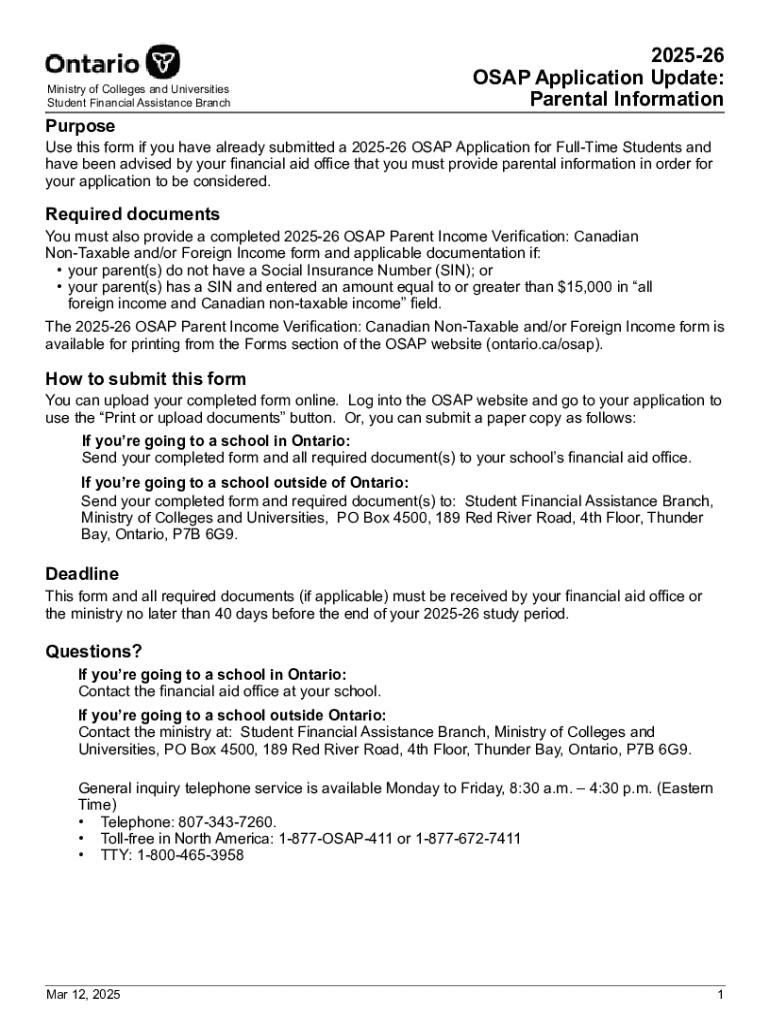
The 2025-26 OSAP Parental Information Form is a supporting document used in Ontario Student Assistance Program applications for full-time postsecondary students when parental financial information is needed to assess funding eligibility. It helps OSAP determine a student’s expected family contribution and whether grant, loan, or other aid amounts should be adjusted based on family circumstances.
This form is not usually a stand-alone application. It is part of a broader OSAP assessment process, and it is typically requested when the student’s file requires parental income, household, or relationship details. In practice, the form serves as a verification and disclosure tool, allowing the ministry to review information that is relevant to needs-based aid decisions.
The form may be needed when a student is considered dependent for OSAP purposes, or when family details are necessary to complete the funding review. That can include situations where parents live together, are separated, or where one parent’s information is unavailable and special circumstances need to be explained. Because OSAP rules are specific, the form is often tied to the student’s individual application status rather than being universally required.
For students and families, the key purpose is accuracy. OSAP relies on this information to calculate assistance fairly and consistently. A complete and truthful submission helps reduce delays, requests for clarification, and adjustments later in the year.
The form also plays a documentation role. If family income changes, if a parent is unable to provide information, or if there are unusual household circumstances, the form may help the reviewer understand why the standard application flow does not fit the student’s situation neatly.
In many cases, the form functions like a financial disclosure statement for the parent or parents. The student still remains the primary applicant, but the parental information can influence the final funding outcome.
Who usually needs it
The 2025-26 OSAP Parental Information Form is most often used by full-time students whose OSAP assessment depends on parental financial details. This usually applies to younger dependent students, although age alone is not the only factor. OSAP considers family structure, dependency status, and other eligibility rules when deciding whether parental information is required.
A common example is a first-year undergraduate student applying for OSAP while living away from home for the first time. Even if the student is financially independent in daily life, OSAP may still require family information if the student does not meet the criteria for independent status. In that case, the form helps complete the assessment.
Another common scenario involves students whose parents are separated or divorced. The form may be used to clarify which parent information is needed, whether both households must be considered, and whether one household provides primary support. This is especially important when the student has complex living arrangements or irregular financial support.
The form may also be needed when a parent’s income is difficult to document. For example, if a parent is self-employed, works seasonally, or has non-standard income, OSAP may request additional information to verify the family’s financial situation. The form may be paired with tax documents or explanation letters in those cases.
Typical groups that may encounter the form
- Dependent full-time students applying for OSAP
- Students with separated, divorced, or remarried parents
- Students whose family income must be verified
- Students with unusual household support arrangements
- Students whose application is flagged for additional review
In some cases, the form is requested because the student’s file is incomplete, inconsistent, or missing supporting evidence. The form is then used to resolve the issue before funding is finalized.
Information the form collects
The 2025-26 OSAP Parental Information Form generally asks for details that help establish a parent’s identity, household composition, and financial circumstances. The exact fields can vary, but the information usually centers on data that OSAP needs to review family-based eligibility.
A parent may be asked to provide legal name, address, contact details, and relationship to the student. The form can also request marital status, living arrangement status, and whether the parent shares a household with another adult. These details help determine which income figures OSAP should consider and whether any household changes affect the assessment.
Financial information is often the most important part. Depending on the student’s situation, the form may ask for employment income, self-employment income, benefits, pensions, support payments, or other sources of earnings. If a parent had a major change in income, the form may include an explanation space for those circumstances.
In more sensitive situations, the form may ask for details about a parent’s inability or refusal to provide information. This can matter when the student has limited contact with one parent, when there are safety concerns, or when one parent is not legally or practically involved in the student’s support. OSAP may require additional documentation in these cases.
Common information categories
- Parent identity and contact information
- Marital or relationship status
- Household composition
- Income from work or benefits
- Self-employment or business income
- Unusual or exceptional family circumstances
The information is used for assessment, not for general academic review. That means the form is designed to capture only the data needed to evaluate financial eligibility under OSAP rules.
How to complete it correctly
Completing the 2025-26 OSAP Parental Information Form usually begins with reviewing the request carefully and confirming which parent or parents must provide information. The form should be completed with the same level of care used for tax or financial aid documents, because small inconsistencies can trigger follow-up questions.
The first step is identifying the correct year and version. Because this form is tied to the 2025-26 aid year, older versions may not match the current OSAP system or required wording. Using the correct form helps avoid processing delays and ensures the information aligns with the current application cycle.
Next, the parent should enter personal and household details exactly as requested. Names should match government-issued identification or tax records where relevant. If the form asks about living arrangements, separation dates, or remarriage, the answers should reflect the actual current situation rather than assumptions about the student’s dependency status.
Financial sections should be completed using accurate and supportable figures. If the form requests annual income, the numbers should generally align with tax records, notices of assessment, or other proof requested by OSAP. If an estimate is allowed, it should be clearly identified as an estimate, not presented as a final filing amount.
Practical completion steps
- Confirm whether the student file requires one parent, both parents, or a supporting explanation.
- Gather income and household records before entering information.
- Fill out each section fully, including explanation fields when needed.
- Review all names, dates, and income figures for consistency.
- Attach any requested documents before submission.
When a form includes signature or declaration language, that section should not be skipped. The certification is important because it confirms that the parent understands the information is used for aid assessment and that the answers are accurate to the best of their knowledge.
If the family situation is unusual, the form should include clear explanations instead of leaving blanks. For example, if a parent has no contact with the student, has not contributed financially, or lives outside the household, that may need to be stated directly with any supporting evidence OSAP requests.
Documents to gather first
The most useful documents for the 2025-26 OSAP Parental Information Form are the ones that support income, identity, and family structure. Having these ready before starting the form can reduce mistakes and prevent the need to revisit sections later.
Tax-related documents are often central. Depending on the parent’s situation, this may include a T1 General, Notice of Assessment, tax slips, employment statements, or proof of self-employment income. If a parent received employment insurance, disability benefits, pension income, or support payments, those records may also be relevant.
Household and relationship documents can matter just as much as income records. If parents are separated, divorced, remarried, or living apart, OSAP may require details that show the current family structure. In some cases, legal separation agreements, custody arrangements, or letters explaining the situation may be needed.
Identification documents are also useful, especially when names differ across records. A parent may use a legal name on tax filings and a different everyday name in informal records. Matching the form to government records helps avoid confusion during review.
Helpful records to prepare
- Recent tax documents
- Notices of Assessment
- Pay statements or employment letters
- Self-employment income records
- Benefit or pension statements
- Separation or custody documents, if relevant
If a parent’s income has changed substantially since the last tax year, supporting records for the change may be important. Examples include layoff notices, termination letters, reduced-hour schedules, or benefit award letters. These materials can help OSAP understand why the current financial picture may differ from the prior year.
For households with complicated support structures, a written explanation may be as important as a financial document. For instance, if a student is supported by one parent, but the other parent’s information is unavailable, the form may need a clear explanation and possibly additional corroboration.
Where and how to submit
The 2025-26 OSAP Parental Information Form is typically submitted as part of the student’s OSAP file through the applicable online process or through the submission channel specified by the program request. The correct method depends on how the form was issued and what the student’s OSAP account instructions indicate.
Digital submission is often the most efficient option because it allows the form and supporting documents to be associated directly with the student’s application record. This reduces the risk of lost pages, unclear scans, or mismatched identifiers. If a digital upload is available, file quality matters, and all text should be legible.
Paper submission may still be relevant in some situations, especially if the request or local institution guidance specifies mailing or dropping off documents. In those cases, every page should be complete, signed, and dated if required. Incomplete packets are among the most common reasons for delay.
Before submitting, it is important to confirm whether supporting documents must be attached with the form or uploaded separately. A completed form without required backup documentation may not be enough for OSAP to finalize the assessment. Likewise, extra documents that are not clearly identified can slow review time.
Common submission formats
- Online upload through the OSAP application system
- Secure electronic document upload, if offered
- Paper submission through mail or institutional processing
- In-person document drop-off, where permitted
If multiple documents are being submitted together, file naming and order can matter. A clear label such as the student’s name, OSAP file number, and document type helps reviewers match records quickly. This is especially useful when families have several documents with similar names or when both parents submit separate statements.
Timing also matters. Submitting the form after a review deadline can delay funding release, even if the rest of the application is complete. For students relying on aid to cover tuition, books, or living costs, that delay may affect the start of term or enrollment confirmation.
Deadlines and timing
The 2025-26 OSAP Parental Information Form should be submitted within the timeline specified by the student’s OSAP application or follow-up request. Deadlines can vary depending on the school, the application stage, and whether the form is being used to complete an initial file or respond to a review request.
In general, earlier submission is better because OSAP processing can take time, especially when parental information must be reviewed alongside tax or household records. If the form is submitted late, aid may not be finalized before tuition charges or residence deadlines come due.
Students often encounter timing issues when they wait for a parent to gather records or sign the form. That is a common and understandable delay, but it can still affect processing. A partially completed form cannot usually be assessed fully, so it is best to coordinate all necessary signatures and documentation before submission.
Another timing issue arises when family circumstances change after submission. For example, if a parent’s income changes, a household composition changes, or separation status becomes different during the aid year, OSAP may require an updated review. In that case, an earlier form may no longer reflect the current situation.
Timing scenarios that can matter
- Initial OSAP application review
- Request for clarification after a file is flagged
- Updated family information after a change in circumstances
- Appeals or special consideration requests
- Resubmission after missing documents are corrected
Even when there is no formal deadline printed on the form itself, the related OSAP deadline should be treated as controlling. Missing that date can delay funding, and in some cases it can affect whether the student is able to receive aid for the term in question.
Legal and privacy considerations
The 2025-26 OSAP Parental Information Form involves personal and financial information, so privacy and accuracy are both important. The form is used within the framework of Ontario student aid administration, which means the information is collected for a specific public-program purpose rather than general use.
Parents should expect to provide information that may be compared with tax data, supporting documents, or previous OSAP submissions. Because of that, consistency matters. Numbers that do not align with tax records or statements may lead to requests for clarification or proof.
The signature or declaration section is legally significant. By signing, the parent typically confirms that the information is complete and accurate to the best of their knowledge. False statements, omissions, or altered documents can create serious problems for the application and may affect funding eligibility.
Privacy is also a concern for families with sensitive circumstances. If a parent is unavailable, abusive, estranged, or not involved in the student’s life, OSAP may still need a clear explanation. In such cases, the student and parent should provide only the information requested and any supporting evidence the program requires, without adding unrelated personal details.
Legal and privacy points to keep in mind
- Use only accurate, verifiable information
- Do not leave required sections blank without explanation
- Keep copies of submitted materials for personal records
- Share sensitive family details only as requested
- Expect the form to be used for eligibility assessment
If another person helps prepare the form, the parent remains responsible for confirming the accuracy of the final submission. This is especially important when a student, spouse, or family member fills in financial details on the parent’s behalf.
Common mistakes and issues
Errors on the 2025-26 OSAP Parental Information Form often come from incomplete family information, mismatched income figures, or unclear explanations. Even when the form is filled out in good faith, small omissions can cause processing delays.
A frequent issue is using the wrong tax year or mixing estimated income with prior-year figures without explaining the difference. If the form expects one year’s income and the parent supplies another, the assessment may be flagged for review. Consistency between the form and supporting documents is critical.
Another common problem is unclear household status. For example, a student may write that parents are “separated” without giving a separation date or without explaining whether the parent providing the form lives with another adult. Those details can change how OSAP calculates family contribution.
Missing signatures are another frequent source of delay. If the form requires a parent declaration, a signature field left blank can prevent processing even when all other information is correct. The same issue can occur with dates, initials, or checkbox acknowledgments.
Common issues that slow review
- Missing or partial signatures
- Income figures that do not match documents
- Unclear separation or household status
- Unreadable scans or photos
- Using an outdated form version
- Leaving explanation fields blank in special cases
In more complex families, the biggest issue is often not the form itself but the explanation. A brief, clear note describing why a parent’s information is being provided, limited, or unavailable can make the difference between a straightforward review and repeated follow-up requests.
Related versions and special cases
The 2025-26 OSAP Parental Information Form may not be the only document that affects a student’s application. Depending on the situation, OSAP may use other financial disclosure forms, family status declarations, or supporting statements to complete the review. The parental information form is one part of that larger process.
Older versions of the form should not be assumed to work for the 2025-26 aid year. Even if the content looks similar, year-specific forms can change due to updated policy language, revised instructions, or revised income references. Submitting the wrong year can create avoidable processing delays.
Some families face special cases that require additional documentation alongside the form. These might include estrangement, inability to locate a parent, death of a parent, remarriage, shared custody, or a parent living outside Canada. In those cases, the form may still be necessary, but it may be supplemented by letters, legal documents, or proof of household composition.
There can also be differences in how the form is used depending on whether the student is applying as dependent, independent, or with special family circumstances. While the basic purpose remains the same, the supporting documentation and review path may differ.
Examples of special cases
- A parent is self-employed and has irregular annual income
- Parents are separated and share financial responsibility unevenly
- A parent cannot be contacted or refuses to provide information
- A parent recently remarried and household income changed
- A parent died, and the student’s support structure changed
In practical terms, these variations matter because OSAP assessment is not only about what is written on the form, but also about how the family structure affects eligibility and financial need calculations. The more clearly the situation is described, the easier it is for the application to be reviewed accurately.


