




Definition and Legal Meaning
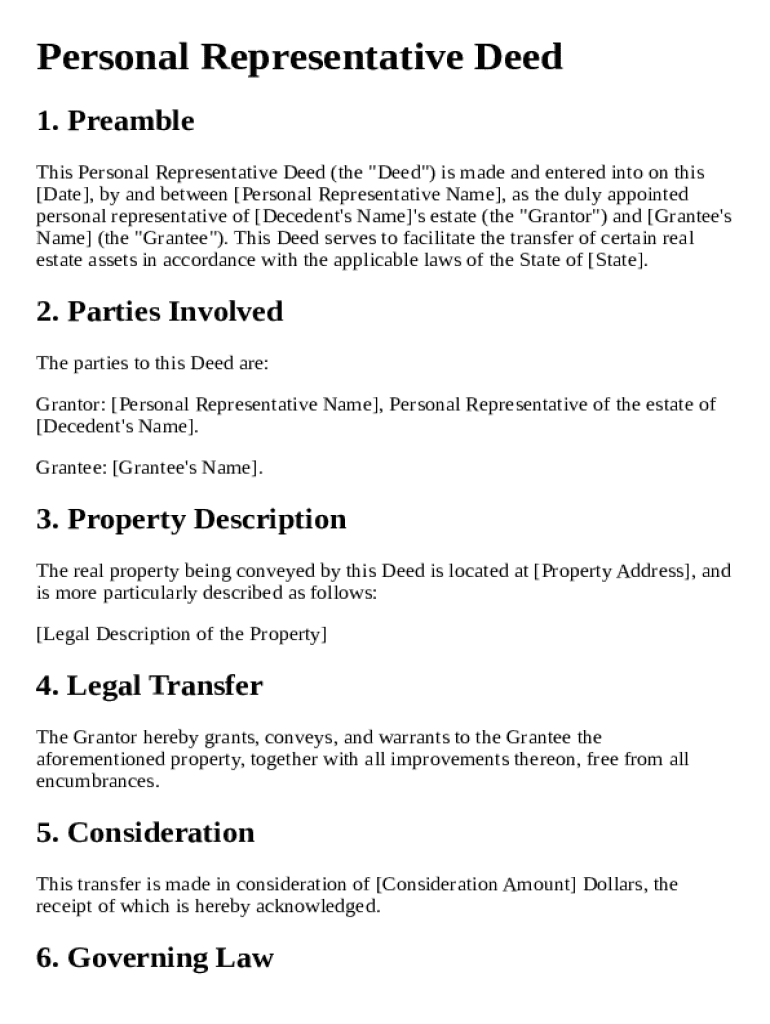
A personal representative deed template is a document format used to transfer real estate from a deceased person’s estate through the estate’s personal representative, such as an executor or administrator. In U.S. probate practice, the deed is commonly used after a court has appointed someone to handle estate matters and has authorized the transfer of property. The template provides the structure for identifying the estate, the property, the recipient, and the authority under which the transfer is made.
The word “personal representative” is the broader legal term used in many states to describe the person who manages the estate. Some states and older documents may use “executor” when a will names the person, or “administrator” when the court appoints someone without a will. The deed itself usually reflects the representative’s role in a fiduciary capacity rather than in an individual capacity.
This type of deed is different from a standard warranty deed because the personal representative usually transfers whatever interest the estate has, subject to probate authority and state law. In many cases, the deed includes limited or no warranties. That means the buyer or recipient receives title based on the estate’s authority to convey, not on broad promises about title history unless the document or local law says otherwise.
A personal representative deed template is especially important because estate transfers must be documented with care. Real estate often remains part of the estate until probate is complete, debts are addressed, and the court or governing law allows distribution. The deed provides the written evidence that the estate, through the personal representative, completed the transfer.
The legal meaning also depends on state-specific probate and recording requirements. Some states require formal court approval before the deed is signed, while others allow independent administration with fewer court filings. In either situation, the template must be completed in a way that matches local legal standards so the transfer can be accepted by the recorder’s office and recognized in the chain of title.
In practical terms, the deed is often used when a home, vacant lot, rental property, or inherited parcel must be retitled from the estate to heirs, beneficiaries, or a third-party purchaser. For example, if a decedent owned a residence solely in their name, the personal representative deed is one of the documents that can move title out of the estate and into the next owner’s name.
Common legal context
- Probate estate transfer: used after death to pass title through the estate process.
- Fiduciary authority: signed by the estate’s representative, not the deceased owner.
- Title documentation: provides the recorder and title companies with a clear transfer record.
- State law dependence: wording, authority, and notarization rules vary by jurisdiction.
How the Template Is Used
The personal representative deed template is usually used after the estate has identified the property to be transferred and confirmed that the representative has authority to act. The template serves as a framework for entering the parties, legal description, recording details, and transfer language. It is not simply a fill-in-the-blank page; it is a legal instrument that must reflect the probate status of the estate.
In many estate matters, the first step is determining whether the property should pass to a beneficiary under a will, to heirs under intestacy law, or to a buyer if the estate is selling the property. The template can be adapted for each of these outcomes, but the language should match the actual purpose of the transfer. A deed used for a beneficiary distribution may look different from one used in an estate sale.
The template is also used to maintain consistency across key deed components. Those components often include the grantor name, which is typically written as the estate acting through the personal representative, the grantee name, the consideration statement, and the legal property description. When the template is used correctly, it helps reduce omissions that could delay recording or create title defects.
A common use case involves a decedent whose home must be conveyed to a surviving spouse or child after probate administration. The representative inserts the correct estate name, the beneficiary’s full legal name, and the parcel description from the deed or title records. If the property is being sold, the grantee will be the purchaser, and the deed language will reflect a sale by the estate.
The template is also useful when there are multiple heirs or beneficiaries. In some situations, the property is transferred to one heir who then refinances or buys out the others, while in others the estate transfers the property to several people as tenants in common. The template must be completed with the intended form of ownership in mind, because that choice affects future control and disposition of the property.
When the document is prepared electronically, the workflow may include drafting, reviewing, signing, notarizing, and recording. The template helps align these steps so that each detail matches the probate file and the county recording requirements. If a title insurer or recorder identifies a mismatch, the transfer can be delayed, so careful completion of the template matters at every stage.
Typical use scenarios
- Distribution to heirs after probate administration.
- Transfer to a beneficiary named in a will.
- Sale of estate property to a third-party buyer.
- Conveyance of inherited property into joint ownership.
- Transfer of vacant land or a rental property owned by the decedent.
Who Typically Uses It
The personal representative deed template is primarily used by estate fiduciaries, probate professionals, and anyone involved in transferring real estate from a decedent’s estate. The most direct user is the personal representative, who may be named in the will or appointed by the court. That person signs the deed on behalf of the estate, subject to state law and any court order or estate authority.
Estate attorneys often prepare or review these deeds because the wording must be precise. They verify that the personal representative has the legal right to convey the property, that the estate administration supports the transfer, and that the deed language is consistent with the probate case. In more complex estates, an attorney may also coordinate with title companies, lenders, and county recorders.
Title companies use these deeds as part of the chain-of-title review. Before issuing title insurance, they often want to confirm the probate authority, the correct property description, and any required acknowledgments. A template that is incomplete or inconsistent can create underwriting concerns, especially if the property has liens, unpaid taxes, or multiple beneficiaries.
Heirs and beneficiaries may also be involved in reviewing the document, especially when the deed is transferring property to them as part of the estate distribution. They may need to confirm how title will be taken, whether as sole owner, joint tenants, or tenants in common, and whether any prior agreements among beneficiaries affect the transfer.
Real estate agents and closing professionals may encounter this deed when the estate is selling the property on the open market. In those cases, the personal representative deed functions as the vehicle that allows the estate to close the transaction. The seller listed in the closing documents is usually the estate acting through the representative, not the deceased individual personally.
County recording offices do not use the template in the same way a preparer does, but they rely on the completed deed for recording standards. If the deed does not identify the estate properly, omits signatures, or lacks a valid acknowledgment, the recorder may reject it or place it on hold until corrected.
Common user groups
- Personal representatives, executors, and administrators.
- Probate and estate attorneys.
- Title company personnel.
- Real estate closing agents.
- Beneficiaries and heirs involved in distribution.
Key Sections and Required Details
A personal representative deed template usually contains several core sections that must be completed accurately. The first is the caption or title area, which identifies the type of deed and often references the estate. This section gives the recording office and future title examiners a quick indication of the document’s purpose.
The grantor section is especially important because it identifies who is transferring the property. In a probate transfer, the grantor is typically the estate, acting by and through the personal representative in a fiduciary capacity. The exact wording should match the representative’s appointment and the probate file. If the estate name or representative name is wrong, the deed may not clearly connect to the authority being used.
The grantee section identifies who receives the property. This may be an individual beneficiary, multiple heirs, a trust, a surviving spouse, or a purchaser. The wording should be complete and should reflect how title is intended to vest. For example, the names of two beneficiaries should be entered carefully if the property is being conveyed to them jointly, because ownership language affects future rights and responsibilities.
The property description section is another critical part of the template. A street address alone is usually not enough. The deed generally needs the full legal description from the prior deed, plat, or county record. If the legal description is inaccurate or incomplete, the transfer may not properly cover the intended parcel.
The consideration clause is commonly included as well. In many estate transfers, the consideration may be nominal or may reflect the fact that the conveyance is made pursuant to probate distribution. Even when no actual purchase price is involved, the template often requires a stated consideration for recording and legal formality.
The signature, acknowledgment, and notary sections must be carefully completed. Depending on state requirements, the personal representative may need to sign in a specific fiduciary format, such as “as personal representative of the estate of [name].” Some counties require witness signatures or additional probate references, so the template should allow for those local variations.
Common information fields
- Estate name and decedent’s name.
- Personal representative’s full legal name and title.
- Grantee’s full legal name.
- Complete legal description of the property.
- Consideration language.
- Signature and acknowledgment blocks.
How to Complete the Deed
Completing a personal representative deed template usually begins with confirming the estate’s legal authority to transfer the property. Before filling in the deed, the representative should verify whether probate has opened, whether letters testamentary or letters of administration have been issued, and whether any court order or statutory authority is required. This background determines whether the deed can be signed now or only after a required event, such as approval of a final accounting or sale order.
The next step is identifying the exact property. The address, parcel number, and legal description should be checked against the prior recorded deed, title commitment, or county records. If the estate owns more than one parcel, each transfer must be matched to the correct legal description. A common error is using a mailing address that differs from the legal description or omitting an accessory parcel or lot line detail.
After the property is identified, the representative enters the grantor and grantee details. The grantor should be the estate through the personal representative, not the deceased person acting individually. The grantee should be named exactly as the title is intended to vest. If the recipient is a trust, the trust name and date may need to be included, depending on local practice.
The consideration and transfer language should then be filled in. In a beneficiary distribution, the deed may describe the transfer as being made in accordance with the decedent’s will or intestate succession. In a sale, the deed may refer to value received and the probate authority for the conveyance. The wording should remain consistent with the underlying estate transaction.
Once the text is completed, the signature block should be reviewed to ensure it matches the representative’s legal appointment. The representative signs in a fiduciary capacity, and the notary acknowledgment should reflect the signer’s role. If the state requires a specific acknowledgment form, that form should be used rather than a generic acknowledgment that may not satisfy local recording rules.
After execution, the completed deed should be checked against the probate file, closing statement, and prior deed history. Any mismatch in names, dates, or descriptions should be corrected before recording. In practice, this review step is essential because even minor errors can create title issues, rejection by the recorder, or later disputes among heirs.
Completion checklist
- Confirm estate authority and probate status.
- Verify the legal description and parcel details.
- Enter the correct grantor and grantee names.
- Add the proper transfer and consideration language.
- Sign in the correct fiduciary capacity.
- Notarize and, if required, include witness signatures.
- Review for consistency before recording.
State-Specific Rules and Variations
State law has a major effect on how a personal representative deed template should be completed. Probate statutes differ on whether the representative needs court approval, what level of authority is granted automatically, and whether the deed language must reference a specific probate case number or order. A template that works well in one state may be incomplete in another.
Some states allow independent administration, which can reduce the need for routine court supervision. In those jurisdictions, the personal representative may have broader authority to sign and record the deed without seeking a separate court order, as long as the estate documents support the act. Other states require a petition, hearing, or order approving the transfer, especially when the property is sold rather than distributed to heirs.
The form of acknowledgment also varies by state. Many recording offices are strict about notary wording, signer capacity, and the inclusion of the state and county where the acknowledgment took place. A deed that omits a required acknowledgment element can be rejected even if the substantive transfer is valid.
States may also differ on whether a deed should include statutory covenants, special warranties, or a disclaimer of warranties. In many estate transfers, the representative conveys only the estate’s interest, which can limit exposure for title defects. However, the exact drafting choice depends on local law and the nature of the transaction. If the estate is selling to a third-party buyer, the closing documents may require more detailed language than a simple distribution deed to an heir.
Some jurisdictions have special forms or preferred phrases for probate conveyances. Others require the deed to mention the authority under which the representative acts, such as a will, letters of administration, or a court order. Recording offices may also have local formatting preferences for margins, font size, page numbering, and return addresses.
Because of these differences, the same template should be treated as a starting point, not a universal final form. A deed prepared for a California probate, for example, may not look identical to one used in Texas, Florida, or New York. The legal structure may be similar, but the authority language, statutory references, and recording expectations can differ meaningfully.
Common state-based differences
- Court approval requirements.
- Independent versus supervised administration.
- Notary acknowledgment language.
- Warranty or non-warranty transfer wording.
- Recording and formatting rules.
- References to probate orders or letters of authority.
Required Documents and Supporting Records
A personal representative deed is usually supported by several underlying documents that confirm the transfer is valid. The most important is the probate appointment paperwork, such as letters testamentary or letters of administration. These documents show that the signer has been formally authorized by the court to act for the estate.
The decedent’s prior deed or title documentation is also important. It helps confirm how the property was owned before death and provides the exact legal description for the new deed. If the legal description is copied incorrectly, the new transfer may fail to match the property in the public record.
A certified death certificate is commonly needed somewhere in the estate administration process, even if it is not attached to the deed itself. Title companies, banks, and probate professionals may request it to confirm the date of death and establish the estate timeline. The death certificate can also help determine whether community property or survivorship issues exist.
If the estate is making a distribution rather than a sale, the will, trust documents, or intestacy records may be relevant. These materials show who is entitled to receive the property and whether the transfer follows the decedent’s instructions or state succession law. When multiple heirs are involved, the estate may also need waivers, consents, or family settlement agreements.
For property that is being sold, the closing file may require a purchase agreement, title commitment, payoff statements, tax prorations, and escrow instructions. The personal representative deed must align with those closing documents so the transfer is consistent with the sale terms. In some cases, a final court order approving the sale or distribution may also be required.
Recording offices may request a transfer tax affidavit, supplemental page, or exemption statement depending on the county and state. Even where tax is not owed, the deed package may still need a declaration form to document the exemption basis. Failure to include these support records can slow recording or create follow-up questions from the recorder.
Supporting file examples
- Letters testamentary or letters of administration.
- Certified death certificate.
- Prior deed or title report.
- Will, trust, or intestacy documentation.
- Sale contract or distribution approval records.
- Transfer tax forms or exemption statements.
Legal Use and Recording Process
The legal use of a personal representative deed begins with proper authority and ends with a recorded instrument in the county land records. The deed is not effective in the same way merely by being signed; recording is often necessary to provide notice to third parties and to preserve the chain of title. Until recorded, the estate transfer may not be fully reflected in the public record.
The representative’s signature must be executed in the correct legal capacity. That means the deed should make clear that the individual is signing as fiduciary for the estate, not personally. This distinction matters because the representative is not transferring personal property rights; they are acting on behalf of the decedent’s estate under probate authority.
Notarization is usually required, and some states may require additional witness signatures. The acknowledgment should identify the signer and the fiduciary role accurately. If the notary block is incomplete or uses the wrong form, the county recorder may reject the deed or record it with defects that later complicate title review.
Recording commonly occurs in the county where the property is located. The deed package may need to include the original signed deed, any required tax forms, and a return address for the recorded instrument. In some counties, the deed is reviewed for page count, margin spacing, and legibility before acceptance. These administrative details are not minor; they determine whether the deed is entered into the official records.
Once recorded, the deed becomes part of the chain of title and is used by future buyers, lenders, and title examiners. If the estate later needs to prove that a transfer occurred, the recorded deed is the public evidence. A properly completed deed can also help prevent disputes among heirs by showing exactly how the property left the estate.
The legal effect can vary depending on whether the transfer was by distribution or sale. A distribution deed may simply vest title in a beneficiary, while a sale deed may transfer title to a purchaser free of estate administration issues to the extent allowed by law. In both settings, accuracy is essential because estate conveyances often receive close scrutiny in later refinances, sales, or inheritance disputes.
Recording considerations
- Record in the county where the property is located.
- Match signatures, acknowledgments, and authority language.
- Include required tax or exemption forms.
- Use the correct legal description and parcel details.
- Confirm acceptance standards for the local recorder.
Common Examples and Practical Scenarios
A common example is a family home owned solely by the decedent. After probate opens, the personal representative uses the deed template to transfer the house to the decedent’s child who is the sole beneficiary. The deed language references the estate and the representative’s authority, and the property is recorded in the child’s name once the estate administration allows the transfer.
Another typical example involves a sale to a third party. The estate may decide to sell the property to pay debts, distribute cash to heirs, or simplify administration. In that case, the template is used to draft a deed transferring title to the buyer, and the closing company checks that probate authority and sale terms match the deed language. The buyer receives title from the estate, not from the deceased owner directly.
A more complex scenario arises when there are several beneficiaries and one receives the property while others receive cash or other assets. The deed may convey the property to one beneficiary, but the estate records must show that the distribution aligns with the will or a family agreement. If the estate is not careful, a later challenge could arise from a beneficiary who believes the property was transferred incorrectly.
A vacant lot or inherited parcel can present additional issues because it may not have a clear street address. In those cases, the legal description becomes the main identifying feature. The template must capture the lot, block, subdivision, metes-and-bounds description, or other legal identifier exactly as it appears in the public record. An incomplete description can create title ambiguity.
In some estates, property is held in a different state from where the probate case is opened. The representative may need an ancillary probate or locally compliant deed form to transfer the out-of-state property. The template still serves the same broad function, but local law will control how the deed is worded and recorded.
A final example involves a blended family or multiple heirs. If the decedent’s will directs that property pass to two children equally, the deed may need to state whether the property is conveyed to them as tenants in common or in another form of co-ownership. That ownership language can affect later sale rights, inheritance, and partition issues, so it should be selected carefully.
Illustrative scenarios
- Sole beneficiary receiving a residence.
- Estate sale to a third-party purchaser.
- Distribution among multiple heirs.
- Out-of-state property requiring extra compliance.
- Vacant land transferred after probate completion.
Alternatives and Related Transfer Forms
A personal representative deed template is one of several deed types used in estate and real property practice. It is distinct from a quitclaim deed, which generally conveys whatever interest the grantor has without broader assurances, and from a warranty deed, which typically provides stronger title promises. The estate transfer deed chosen should reflect the probate authority and the intended level of title assurance.
Some states and practitioners use an executor’s deed or administrator’s deed instead of the phrase personal representative deed. Those labels often describe the same basic function, but the exact form name may differ based on state terminology or older recording practice. If the form title is different, the substance still centers on transfer by a fiduciary of the estate.
A deed from a trust, a surviving joint tenant, or a beneficiary under a transfer-on-death arrangement is not the same as a personal representative deed. Each of those transfer methods has its own legal basis and form requirements. The correct form depends on how the decedent held title and what estate or nonprobate transfer method applies.
There are also situations where no deed is required in the usual sense, such as property that passes automatically by survivorship or through a recorded beneficiary deed, depending on state law. In those cases, the estate may not be the transferring party at all. That distinction matters because using the wrong document can create confusion in the chain of title.
Older versions of probate deed forms may contain outdated terminology or formatting. A template should be reviewed to ensure it uses current legal naming, current notary language, and current county recording standards. Even if the basic structure is still valid, older forms may omit sections that title companies or county offices now expect.
For estates with unusual assets or complicated ownership history, the personal representative deed may be only one part of a broader transfer package. Other documents may be needed to release liens, clear tax issues, satisfy court orders, or resolve beneficiary disputes. In that sense, the deed is often the final transfer instrument, but not the only document involved in the property transition.
Related transfer methods
- Executor’s deed.
- Administrator’s deed.
- Quitclaim deed.
- Warranty deed.
- Trust transfer deed.
- Beneficiary or survivorship-based transfer documents.