




Notice to Tenant for Inspection Template: Purpose and Meaning
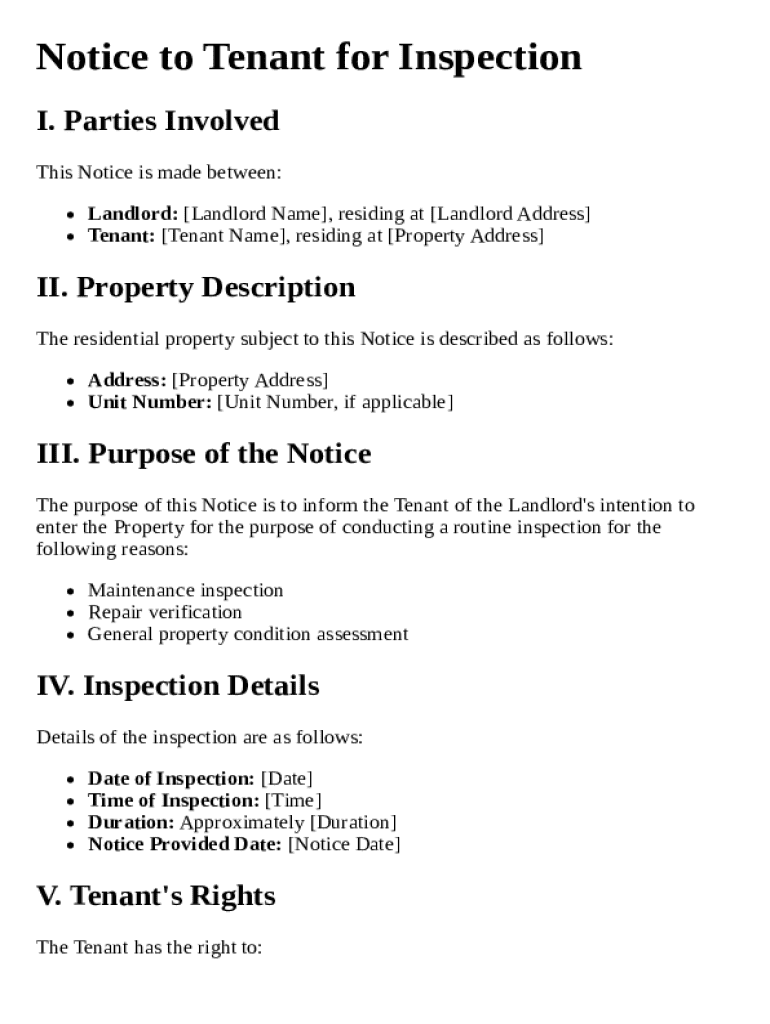
A Notice to Tenant for Inspection Template is a written document a landlord, property manager, or authorized agent uses to inform a tenant that the property will be entered for an inspection. In a U.S. rental context, the notice is meant to provide advance warning, explain the reason for entry, and identify the date and time of the visit. The template helps keep communication clear and creates a record that notice was given.
The main purpose is to balance two interests that often overlap in rental housing: the landlord’s right to maintain and inspect the property, and the tenant’s right to quiet enjoyment and privacy. A well-prepared inspection notice reduces confusion by stating why access is needed, such as a routine condition check, move-out inspection, safety review, or maintenance assessment.
This form is commonly used in residential leasing, but it can also appear in other housing arrangements, including duplexes, apartment complexes, single-family rentals, and managed community housing. The wording usually stays neutral and factual so the tenant understands the entry is for a specific, lawful reason rather than an open-ended visit.
A strong template usually includes the property address, the proposed entry window, the name of the person entering, and a contact point for questions. In practice, the notice may be delivered by email, hand delivery, posted notice, or another method allowed under the lease or state law. The record of delivery matters because it can show the landlord complied with the notice requirement.
For example, a landlord might use the form before a seasonal HVAC check, a quarterly maintenance walkthrough, or an inspection tied to a reported water leak. In another case, a property manager may give notice before a pre-sale showing or a move-out review to document the unit’s condition. Each of these situations can justify a notice, but the wording and timing should match the purpose.
The template is useful because it creates consistency. Instead of drafting a new message each time, the landlord can complete the same core fields and adapt the explanation for the specific inspection. That makes the process more organized, especially for owners who manage several units or work with third-party property managers.
When and Why It Is Used
A Notice to Tenant for Inspection Template is used whenever lawful entry into a tenant-occupied property needs to be announced in advance. The most common reason is a routine inspection to confirm that the unit is being maintained and that no urgent repair issues are developing unnoticed. It may also be used after a tenant reports a problem, such as a leak, pest concern, or electrical issue.
Another frequent use is a move-out inspection. In that setting, the notice tells the tenant when the landlord plans to examine the condition of the unit after the lease ends or near the end of occupancy. This helps document damage, compare the unit’s condition to the move-in records, and prepare for deposit accounting if permitted under state law.
Property owners also use the form for compliance-related reasons. For example, if a local ordinance, insurance requirement, or internal property management policy calls for periodic inspections, the notice becomes part of that process. The document helps demonstrate that the inspection was not random, retaliatory, or disruptive without cause.
The notice can also be useful when a unit has been vacant for a short period between occupants, or when a property manager needs access to verify that a repair contractor completed work properly. In these cases, the document often functions as both a scheduling notice and a record that the tenant was informed in advance.
Common reasons for using the form include:
- Routine property condition inspections
- Safety checks for smoke alarms, leaks, mold concerns, or other hazards
- Repair follow-up after maintenance work
- Move-in or move-out documentation
- Annual or semiannual inspection programs
- Lease-compliance reviews, where allowed by law
In practical terms, the form protects both sides. Tenants receive notice and can prepare the property, secure pets, or arrange to be present if the lease or local rules allow. Landlords, in turn, can show that they gave proper notice and entered only for a legitimate purpose.
Key Parts of the Notice
The most useful Notice to Tenant for Inspection Template includes a small set of core details that make the notice complete and clear. Without these details, the notice may feel vague or may fail to meet the requirements in the lease or under state law. Each field should support a single purpose: identifying the property, the reason for entry, the timing, and the person responsible.
The property address is essential. It should identify the unit precisely, especially in multi-unit buildings where confusion can happen easily. A notice that says only “the apartment” is less reliable than one that lists the full street address, unit number, city, state, and ZIP code.
The reason for entry should be specific enough to explain the purpose without unnecessary detail. “Routine inspection” is often enough for a general inspection, while “inspection after reported plumbing leak” is more informative when the entry responds to a repair issue. Excessive detail is not usually needed, but a tenant should be able to understand why entry is being requested.
The date and time window matter as well. Many notices use a time range rather than a single exact minute because inspection schedules can shift. For example, a landlord may state that entry will occur between 10 a.m. and 1 p.m. on a Tuesday. A flexible window is often more practical than a rigid appointment time, especially when contractors are involved.
A complete notice may also include:
- The name of the landlord, manager, or agent entering the premises
- A phone number or email for questions or scheduling concerns
- The method of entry, if relevant, such as with a key, lockbox, or tenant present
- A reminder of the tenant’s rights under the lease or applicable law
- Space for acknowledgment, if the form is designed for signature or receipt confirmation
In some situations, the notice should reference any special conditions. For example, if pets must be secured, if a building access code will be used, or if multiple units will be inspected in sequence, the notice can explain that in plain language. That kind of detail reduces misunderstandings and helps the inspection proceed smoothly.
How to Complete the Form
Completing the Notice to Tenant for Inspection Template usually begins with confirming the legal basis for entry. The landlord or property manager should check the lease agreement, house rules, and any state or local requirements before filling in the notice. This matters because some jurisdictions specify how much advance notice is required and at what times entry may occur.
The next step is to identify the tenant and the rental unit exactly as they appear in the lease. If there are multiple tenants, the notice may need to name all adult occupants or be addressed to “all residents.” Accuracy here helps avoid disputes about whether the correct person received notice.
After that, the reason for inspection should be selected or written in a concise sentence. If the template provides options, the chosen reason should match the actual purpose. For instance, a property condition review should not be described as a repair visit unless repairs are truly scheduled, because the notice should reflect the real event.
Then the date and time should be inserted. It is often best to choose a window that is realistic for the inspector, contractor, or manager. If the inspection involves a third party, such as a licensed technician, the notice should align with the person’s availability. If the date changes, a revised notice may be needed depending on the lease and state law.
A typical completion process may look like this:
- Confirm the legal notice period required in the state and lease.
- Enter the tenant’s name and property address.
- State the reason for the inspection in clear language.
- List the proposed date and arrival window.
- Include the name and contact information of the entrant.
- Add any special instructions, such as pet control or access details.
- Review the document for accuracy before delivery.
Finally, the notice should be delivered using a method that can be proven if needed. A copy should be retained with the date and method of delivery noted. In a landlord-tenant dispute, being able to show the notice was prepared correctly and delivered on time can be just as important as the notice itself.
State Rules and Legal Limits
The legal use of a Notice to Tenant for Inspection Template depends heavily on state and local law. The United States does not use a single nationwide rule for landlord entry notice in ordinary residential situations, so timing and acceptable delivery methods can vary widely. Some states require 24 hours’ notice, while others may require a longer period or follow lease language if it is more protective of the tenant.
Most states allow landlords to enter for reasonable purposes, such as repairs, inspections, or emergencies, but the standards for notice and access are not identical. A routine inspection is usually not treated the same as an emergency entry for water damage or gas leak response. The notice should therefore match the category of entry, because emergencies often do not require advance notice in the same way.
Local ordinances can add another layer. Cities and counties may impose stricter requirements than the state, particularly in rent-controlled, multifamily, or health-regulated housing. A template that works in one jurisdiction may need adjustments in another, even within the same state.
The notice should also respect tenant privacy and anti-retaliation rules. An inspection notice should not be used as a pretext for harassment or repeated, unnecessary entry. If a landlord enters too often, at unreasonable times, or without a lawful reason, the action may create liability or support a tenant complaint.
Important legal considerations often include:
- Required advance notice period
- Permitted hours for entry
- Acceptable delivery methods
- Whether tenant consent is required for certain non-emergency entries
- Whether the landlord may enter if the tenant is absent
- Rules for lease clauses that expand or limit entry rights
A careful landlord keeps the notice factual, gives it on time, and avoids language that sounds threatening or speculative. For example, instead of saying the tenant “may be violating the lease,” the notice should simply state that the property will be inspected for maintenance or compliance purposes, if that is the actual reason.
Practical Examples of Use
A routine inspection notice may be used when a landlord wants to check the condition of a rental every six months. The notice can state that the purpose is to assess general upkeep, confirm that smoke detectors are functioning, and identify repair needs. This type of inspection is common in long-term tenancies where the landlord wants early visibility into maintenance issues.
Another example involves a reported plumbing issue. If a tenant reports a slow leak under the sink, the landlord may send a notice stating that entry will occur to inspect the plumbing and determine whether further repair is needed. In that case, the reason is more specific than a general inspection, and the notice should align with the complaint.
A move-out example is also common. Suppose a tenant gives notice that they will leave at the end of the month. The landlord may schedule a pre-move-out inspection so the tenant can see any visible concerns before final turnover. A second inspection may happen after move-out to document the unit’s condition for security deposit purposes, where allowed by law.
Examples of special circumstances include:
- Inspection after storm damage to confirm there is no roof or window intrusion
- Seasonal safety review, such as testing entry points or checking visible hazards
- Inspection before a planned renovation or pest treatment
- Inspection coordinated with a contractor’s service window
- Inspection of a furnished rental to verify condition of landlord-owned items
In a multi-unit building, the notice may need to specify if the inspection is part of a building-wide process. That is helpful when several residents will receive similar notices and the property manager wants to reduce confusion. In a single-family rental, the notice may be more individualized and may explain who will enter and whether they will need garage, gate, or key access.
These examples show why the template is useful: it adapts to many lawful entry scenarios while preserving clear, documented communication.
Who Uses This Form
The form is typically used by landlords, property managers, and leasing agents who are responsible for maintaining or overseeing residential rental property. In smaller settings, the owner of a single rental home may prepare and deliver the notice directly. In larger portfolios, the property management company or on-site manager usually handles the process.
Maintenance coordinators may also use or help complete the notice when an inspection is linked to a repair visit. If a technician needs access, the manager may draft the notice, then coordinate the date and time with the service provider. The person delivering the notice should be the same person or organization that has authority to enter under the lease.
Attorneys, compliance teams, and asset managers sometimes rely on this form as part of a broader rental workflow. Their focus is often less on day-to-day communication and more on risk control, documentation, and consistency. A standardized notice helps make sure the same basic information is shared each time.
The tenants themselves may not complete the form, but they are the intended recipients and may use it to prepare for entry. For example, a tenant may arrange to be present, secure valuables, or make sure pets are contained. In some cases, the tenant may respond to request a different time, depending on the lease terms and state law.
Typical users include:
- Individual landlords
- Property managers
- Apartment community staff
- Real estate asset managers
- Maintenance or inspection coordinators
- Leasing offices handling resident communications
Because different people may issue the notice, consistency matters. A small owner might write in a personal tone, while a management company uses branded letterhead or a standardized form. Either approach can work, as long as the final notice is clear, lawful, and complete.
Form Versions and Delivery Methods
A Notice to Tenant for Inspection Template may exist in several versions, depending on the property manager’s workflow. Some versions are simple paper notices with blank lines for the date, unit number, and reason for entry. Others are digital templates that can be completed, saved, and sent electronically through property management software or email.
A paper version is still common in residential housing, especially where hand delivery or posting on the unit door is part of the landlord’s standard process. Paper notices are straightforward, easy to sign, and useful when a tenant does not rely on digital communication. They also create a tangible record if a copy is retained in the landlord’s file.
Digital versions are increasingly common because they reduce clerical work and allow faster delivery. A digital notice can be completed, stored, and shared without printing. That can be useful for multi-property managers who need consistent recordkeeping and time-stamped copies of each notice.
The method of delivery should match the lease and applicable law. Common delivery methods include:
- Hand delivery to the tenant
- Posting on the door, if allowed by law or lease
- Email, if electronic notice is permitted
- Mail, often certified or first-class depending on the required proof
- Tenant portal messaging, when the lease recognizes electronic communication
Different versions may also exist for different inspection types. A routine inspection notice may use broad language, while a move-out inspection notice may include a short checklist or request for tenant presence. A repair-related notice may identify the contractor or work order number to avoid confusion.
Some landlords also maintain older template variants for archival purposes. Even when the format changes, the essential legal and practical elements remain the same: who is entering, why, when, and how the tenant was notified.