
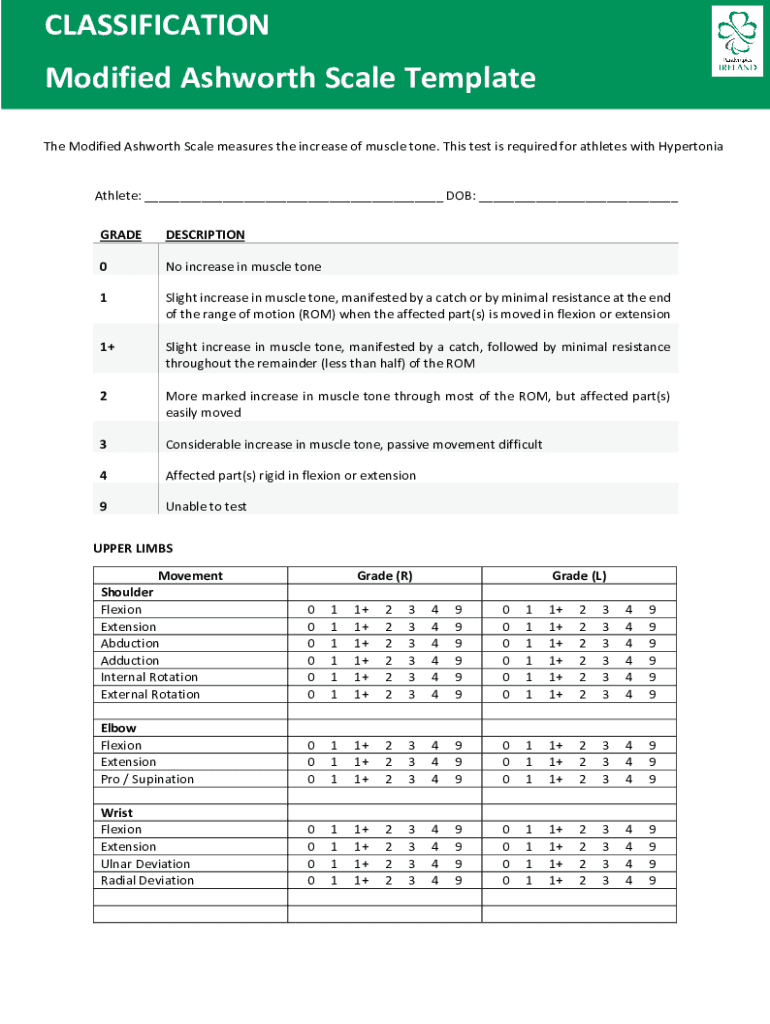







Definition and Purpose of the Modified Ashworth Scale Template
The Modified Ashworth Scale is an evaluative tool used to measure the increase in muscle tone associated with conditions like spasticity. The template facilitates structured assessment by standardizing the measurement process across different patients. Commonly used by clinicians, it provides a systematic way to record and track muscle tone over time, helping in diagnosing and managing hypertonia, particularly in athletes or individuals recovering from neurological damage.
- Muscle Tone Assessment: Evaluates resistance during passive stretching, which is crucial in understanding spasticity levels.
- Standardization: Ensures consistent use across medical practitioners to allow comparability of results over time.
- Diagnostic Aid: Assists in identifying changes in muscle tone that might affect physical function or performance.
How to Use the Modified Ashworth Scale Template
Using the Modified Ashworth Scale Template efficiently involves understanding its various sections and carefully administering the required assessments.
- Preparation: Ensure that the patient is positioned comfortably, typically lying down. This minimizes extraneous factors that could impact muscle tone assessment.
- Conduct the Test: Gently move the patient's limb through its range of motion at a consistent speed, observing the resistance.
- Record Observations: Use the template to grade muscle tone based on observed resistance, ranging from 0 (no increase in muscle tone) to 4 (limb rigid).
- Repeat if Necessary: Conduct multiple assessments to confirm findings, especially if results differ significantly from previous evaluations.
Key Elements of the Modified Ashworth Scale Template
The template is structured to succinctly capture all necessary evaluation components, facilitating a comprehensive muscle tone assessment.
- Patient Information: Includes fields for athlete's name and date of birth, ensuring records are linked to the correct individual.
- Grading Section: Provides a clear criterion for each grade from 0 to 4, with descriptions to guide the evaluator.
- Observation Notes: Allows for additional commentary on conditions not fitting neatly into the grading system, ensuring nuanced assessments.
- Signature Field: Ensures accountability by capturing the evaluator's signature after completing the test.
Steps to Complete the Modified Ashworth Scale Template
To ensure accurate muscle tone measurement, the Modified Ashworth Scale Template should be meticulously completed.
- Enter Patient Details: Input the athlete's or patient's name and other relevant data.
- Perform the Assessment: Carry out the muscle tone test following the described procedure.
- Grade Muscle Tone: Assign a grade reflecting observed muscle resistance.
- Document Observations: Use the notes section for any unusual findings or context.
- Finalize the Document: Confirm completion with your signature and date.
Key Terms Related to the Modified Ashworth Scale Template
Understanding the terminology associated with the Modified Ashworth Scale Template enhances its proper application.
- Hypertonia: A condition of excessive muscle tone leading to stiffness.
- Spasticity: A form of hypertonia characterized by increased muscle tone and reflexes.
- Resistance Measurement: The process of gauging muscle resistance during passive movement, foundational to the Scale.
- Clinical Evaluation: Medical assessment aiming to determine specific physical or cognitive conditions in a patient.
Legal Considerations in Using the Modified Ashworth Scale Template
Using the Modified Ashworth Scale Template should adhere to specific legal and ethical guidelines to ensure its validity and reliability.
- HIPAA Compliance: Protection of patient data is paramount; ensure all personal information is securely handled.
- Documentation Standards: Maintain accuracy and integrity by following standard medical documentation practices.
- Professional Training: Only qualified health professionals should administer the scale to ensure proper technique and reliability of results.
Who Typically Uses the Modified Ashworth Scale Template
This template is commonly utilized by a wide range of professionals within the healthcare sector.
- Physiotherapists and Occupational Therapists: Utilized in therapy settings to gauge and track changes in muscle tone over treatment courses.
- Neurologists: Applied in diagnosing and monitoring conditions like multiple sclerosis and cerebral palsy.
- Sports Medicine Specialists: Used to evaluate athletes experiencing hypertonia affecting performance.


Examples of Applying the Modified Ashworth Scale Template
Real-world application of the Modified Ashworth Scale Template highlights its practical utility.
- Stroke Rehabilitation: A patient recovering from a stroke is evaluated to tailor rehabilitation approaches, using the scale to track changes in muscle tone weekly.
- Cerebral Palsy Management: Periodic assessments are conducted to monitor and adapt intervention strategies in children with cerebral palsy.
- Athletic Performance: Helps athletes refine treatment protocols by providing quantifiable data on physical conditions impacting performance.
By integrating these structured headings and content elements, the use of the Modified Ashworth Scale Template becomes a comprehensive and organized part of clinical assessment practices.




