






Definition and Purpose of the NHS England IFR Application Form
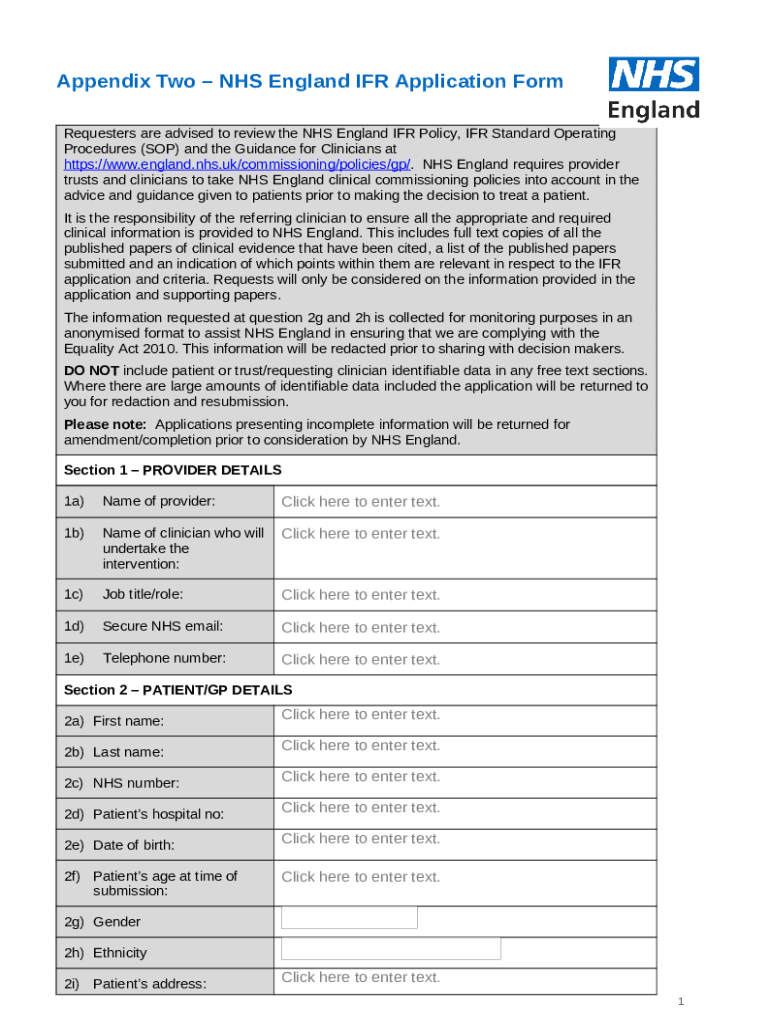
The NHS England IFR (Individual Funding Request) Application Form serves as a formal request process for accessing medical treatments not routinely available under standard NHS pathways. This process is used when a patient requires a specific intervention that falls outside the nationally or locally agreed arrangements. The form is essential for ensuring that funding requests are considered fairly, based on clinical priorities and evidence of exceptional need.
The IFR application provides a structured method for patients and healthcare providers to present their case for consideration by an NHS panel. It is a tool that facilitates careful examination of the scientific evidence, clinical circumstances, and potential outcomes associated with the requested treatment.
Key Elements of the Form
The form requires detailed patient information, including demographic details, medical history, and current treatment regimen. Healthcare providers must provide a comprehensive rationale explaining why the standard treatment protocol is unsuitable and why the requested intervention is expected to achieve significantly better outcomes.
The application also prompts providers to include any relevant clinical data, cost considerations, and evidence or guidelines supporting the request. This is crucial in demonstrating the clinical need and potential efficacy of the proposed treatment, forming the basis of the panel's decision.
How to Use the NHS England IFR Application Form
Utilizing the NHS England IFR Application Form requires careful preparation and detailed information. Both patients and healthcare providers should collaborate to ensure all relevant sections are thoroughly completed. Each entry should be precise, focusing on the specific medical context and anticipated benefits of the requested intervention.
Step-by-Step Instructions
- Gather Required Information: Begin by collecting all necessary patient details and medical records.
- Complete Patient Details Section: Ensure accurate entry of patient demographics and identifiable information.
- Provide a Detailed Medical History: Highlight relevant past treatments and their outcomes.
- Justification for IFR: Articulate the medical necessity and the expected benefits of the requested treatment compared to standard options.
- Attach Supporting Documentation: Include any clinical guidelines, research studies, or expert opinions that support the application.
- Review and Submit: Carefully review the completed form to ensure clarity and completeness before submission.
How to Obtain the NHS England IFR Application Form
The NHS England IFR Application Form can be accessed through local NHS bodies or downloaded from official NHS websites. Healthcare providers often assist patients in obtaining the form and may guide filling it out.
Different regions might have specific versions or additional guidelines about completing the form, reflecting local health priorities or resource availability.
Eligibility Criteria for NHS England IFR Application Form
Eligibility to use the NHS England IFR Application Form primarily depends on the patient’s inability to benefit from routine treatment options. It requires evidence of exceptional clinical circumstances where the proposed treatment is expected to provide higher benefits.


Detailed Criteria
- Clinical Exceptionality: The patient’s condition must significantly deviate from the cohort of patients usually considered.
- Lack of Effective Standard Treatment: The standard treatment must be ineffective or unsuitable for the patient.
- Evidence of Potential Benefit: Adequate supporting evidence that suggests the proposed treatment offers superior outcomes.
Important Terms Related to NHS England IFR Application Form
Understanding key terms is crucial for accurately completing the IFR application:
- Clinical Exceptionality: Refers to the uniqueness of a patient's health condition compared to typical cases.
- Intervention: Any medical treatment, procedure, or service being requested.
- Clinical Rationale: A logical explanation of the medical necessity for a particular treatment.
Legal Use and Compliance
The NHS England IFR Application Form is a formal document within the NHS funding protocol. It must adhere to legal and clinical standards to ensure fair and unbiased assessment.
Legal Considerations
- Data Protection: All personal and medical information must be handled in compliance with data protection laws.
- Equality and Non-Discrimination: Applications are evaluated without bias, focusing solely on clinical need and evidence.
Submission Methods for the NHS England IFR Application Form
There are multiple submission methods for the NHS England IFR Application Form:
Digital vs. Paper Submissions
- Digital Submission: Forms can be submitted electronically through secure NHS portals, ensuring swift processing and confirmation of receipt.
- Paper Submission: Printed forms can be mailed or delivered in person to the local NHS commissioning body.
These methods cater to various preferences and technological accessibility levels among healthcare providers and patients.
Examples of Using the NHS England IFR Application Form
Real-world scenarios exemplify the IFR form's application. For instance, a patient with a rare medical condition requiring a treatment not available under typical NHS services would use the form to request funding for the necessary intervention.
Case Studies
- Rare Disease Treatment: A patient with a condition supported by emerging evidence from clinical studies might seek approval for a new medication.
- High-Cost Therapy: In cases where the treatment price is significant, the form helps demonstrate the treatment's anticipated clinical effectiveness relative to cost.
These examples underline the form’s role in bridging the gap between available NHS treatments and individual patient needs.