




01. Edit your form online
Type text, add images, blackout confidential details, add comments, highlights and more.

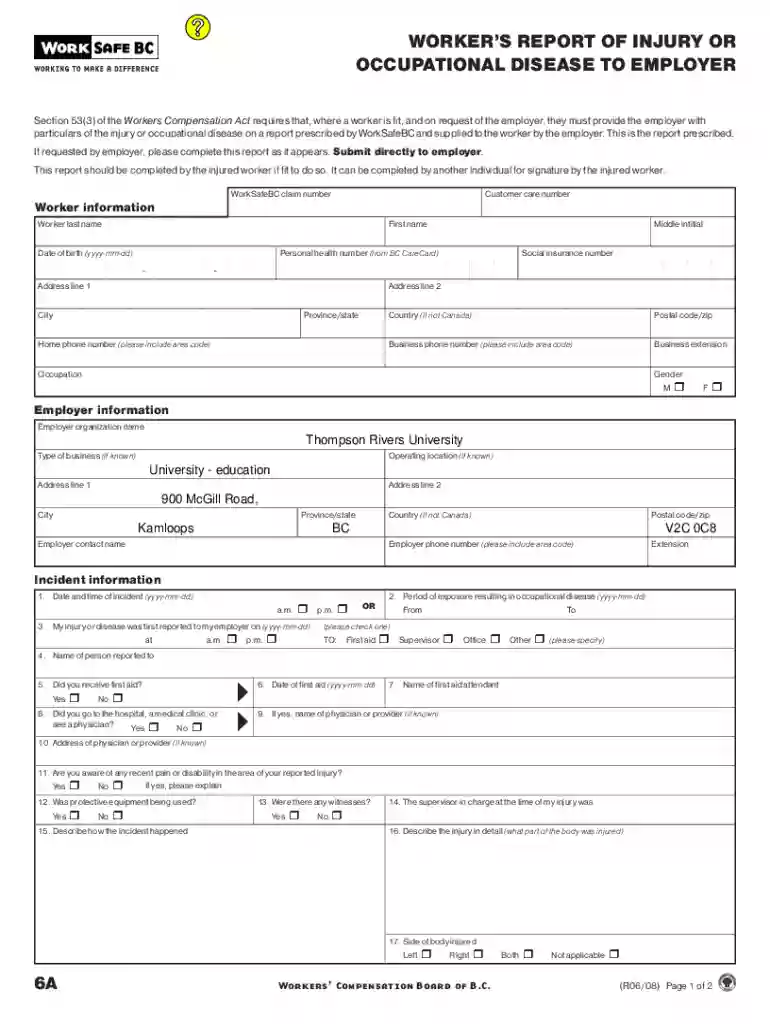
Type text, add images, blackout confidential details, add comments, highlights and more.

Draw your signature, type it, upload its image, or use your mobile device as a signature pad.

Send it via email, link, or fax. You can also download it, export it or print it out.
The Form 6A, officially known as WorkSafeBC Worker's Report of Injury or Occupational Disease to Employer, is a critical document mandated by the Workers Compensation Act in British Columbia. This form serves as a formal record for employees to report any work-related injuries or occupational diseases to their employers. It captures comprehensive information regarding the incident, including personal details and medical treatment received, ensuring that both the employer and WorkSafeBC are informed about the worker's condition and circumstances surrounding the incident.
Employers and workers in British Columbia must understand the proper use of Form 6A to ensure accurate and timely reporting:
Preliminary Information Gathering:
Completing the Form:
Submitting the Form:
Workers can acquire the Form 6A through various channels to ensure accessibility and compliance:
Online Access:
Physical Copies:
Completing the Form 6A involves several detailed steps to ensure thorough reporting:
Identify the Incident:
Describe the Injury:
Provide Incident Context:
Medical Treatment:
Submit the Form:
Filing the Form 6A is essential for several reasons:
Legal Requirement:
Ensures Worker Rights:
Employer Accountability:
The Form 6A is predominantly used by:
Employees:
Employers:
WorkSafeBC Representatives:


Understanding the essential components of Form 6A ensures accurate and effective reporting:
Personal Information:
Incident Description:
Medical Details:
Employer Information:
Real-world scenarios illustrate the practical application of Form 6A:
Case Study 1: Industrial Accident:
Case Study 2: Occupational Disease:
These examples underscore the form's role in facilitating workplace safety and health regulation compliance.
At DocHub, your data security is our priority. We follow HIPAA, SOC2, GDPR, and other standards, so you can work on your documents with confidence.






o Employers Report of Injury or Occupational Disease o Workers Report of Injury or Occupational Disease to Employer o Employers Statement of Return to WorkRead more
First report of injury form. Narrative description of employment, injury circumstances, and injury characteristics completed at the ED. Rare. InsuranceRead more


