




01. Edit your form online
Type text, add images, blackout confidential details, add comments, highlights and more.

Type text, add images, blackout confidential details, add comments, highlights and more.

Draw your signature, type it, upload its image, or use your mobile device as a signature pad.

Send it via email, link, or fax. You can also download it, export it or print it out.
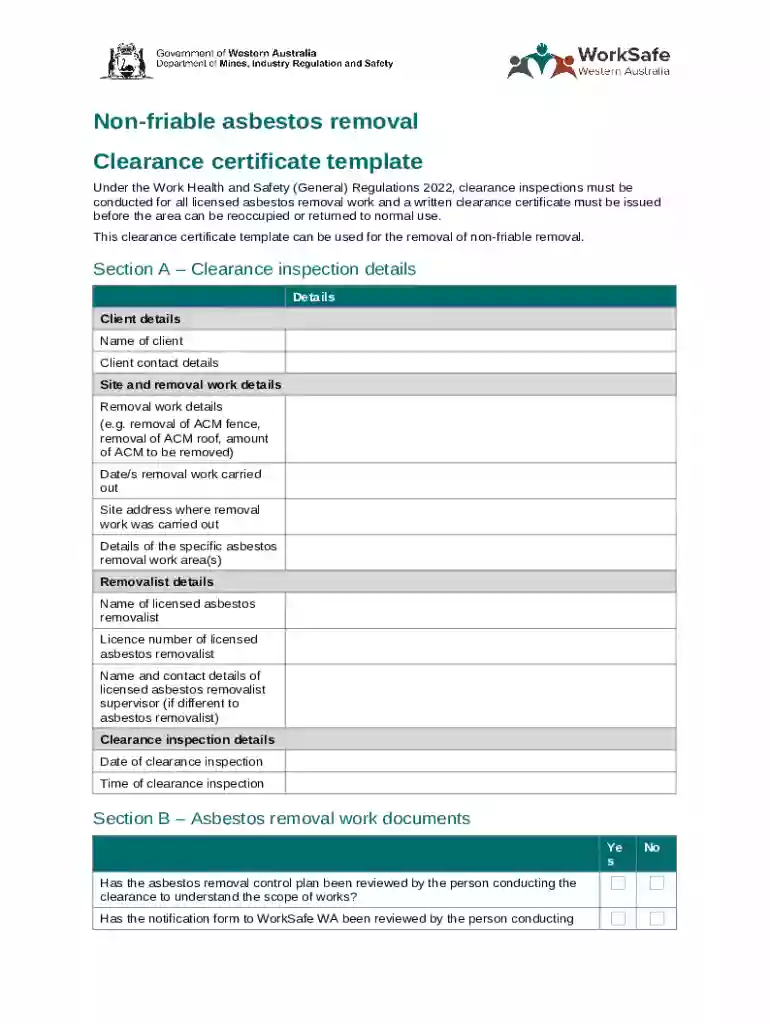
Non-friable asbestos removal refers to the process of safely extracting materials that contain non-friable asbestos. These materials, such as asbestos cement, are less likely to release fibers into the air unless damaged. This process is crucial to ensure safety and minimize health risks. A clearance certificate template is a standardized document used to confirm that a particular area is free from hazardous asbestos residues after removal activities. It verifies that all procedures were appropriately followed, ensuring the premises are safe for reoccupation.
Collecting Client and Removalist Details: Begin by gathering essential information of the client and the removalist. Include names, addresses, and contact information to ensure accountability and efficient communication.
Conducting Visual Inspection: Perform a thorough visual examination of the site to check for remaining asbestos materials. Document your findings with clear notes and photographs if necessary, ensuring meticulous records.
Air Monitoring: Conduct air quality tests to measure asbestos fiber levels. Depending on the project's complexity, you might need to perform these tests before, during, and after removal to guarantee safe conditions. Ensure all testing equipment is calibrated and in line with current regulations.
Declaration of Safety: Provide a formal declaration affirming that the area is safe for reoccupation. Include a detailed summary of findings and any corrective actions taken during the clearance process.
Final Review and Signatures: Review the completed template for accuracy and completeness. Obtain necessary signatures from qualified personnel, including the removalist and the inspector, to authenticate the document.
Using a clearance certificate template for non-friable asbestos removal is essential for legal compliance and safety assurance. This ensures full adherence to the Work Health and Safety (General) Regulations 2022. The certificate not only provides peace of mind to property owners and occupants but also serves as a documented proof of compliance with safety standards.
Legal requirements dictate that a clearance certificate must be issued by a licensed asbestos assessor upon completion of non-friable asbestos removal. This ensures that the area meets safety standards and complies with federal and state regulations. It's important to note that compliance helps prevent potential legal liabilities and penalties for non-compliance.
While federal guidelines set the standard for asbestos removal, each state may have additional requirements or variations in process. For example, some states mandate specialized training for workers, while others may require more frequent air monitoring. Always consult local regulations to ensure full compliance.
Prepare all necessary documentation to support your clearance certificate. This includes:
Typically, clearance certificates can be submitted in both digital and paper formats, depending on jurisdictional requirements. For digital submission, ensure documents are securely sent via encrypted channels. For physical submissions, keep a record of postage and delivery confirmations.
Failure to produce a clearance certificate after asbestos removal can result in significant fines and legal ramifications. Non-compliance may further lead to potential health risks, causing possible liability for future asbestos exposure cases. Ensure all processes are thoroughly documented and legally compliant.
At DocHub, your data security is our priority. We follow HIPAA, SOC2, GDPR, and other standards, so you can work on your documents with confidence.




The scope of asbestos removal work shall include, to the extent reasonable, all friable and non-friable asbestos-containing materials within the area that.
NON-FRIABLE PROJECT - Removal/abatement of non-friable asbestos containing materials. EXPIRES The date on which the agents certificate expires, or N/A if
Apr 30, 1997 This WRD incorporates and modifies the substance of WRD 92-4 Asbestos. Abatement Scheduling, which is hereby repealed. This WRD provides uniform


