







Definition and Purpose of HQP-PFF-397
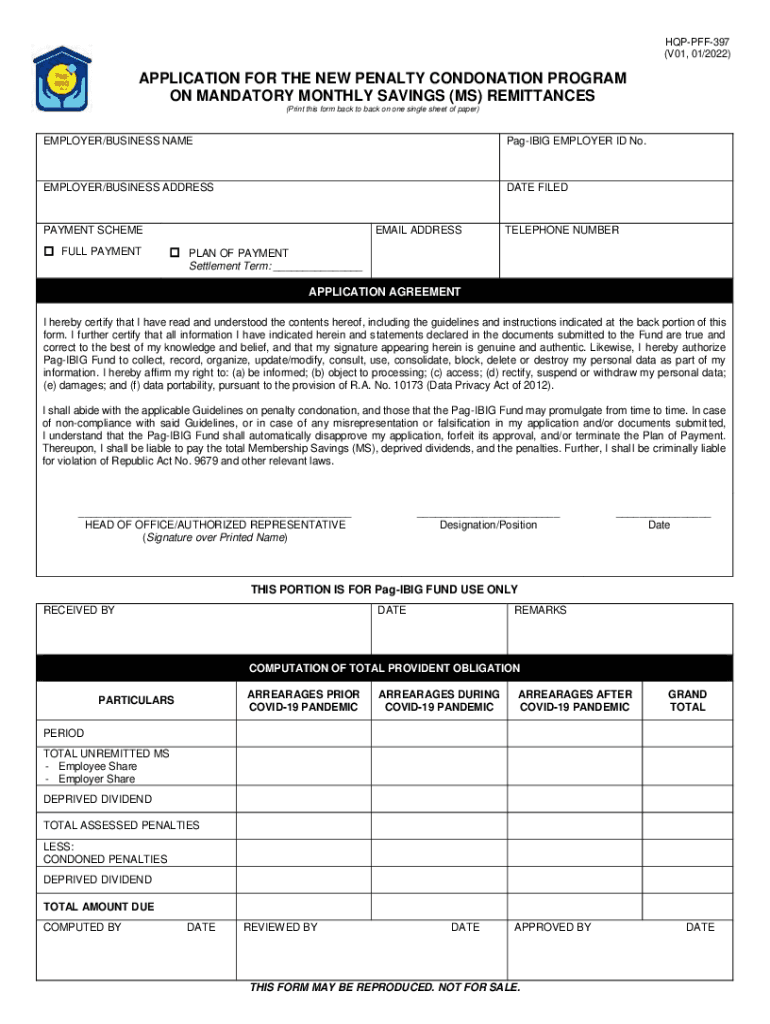
The form HQP-PFF-397 is aimed at employers dealing with the New Penalty Condonation Program for Mandatory Monthly Savings (MS) Remittances. Its purpose is to assist employers who have not met their MS remittance obligations by outlining the application process for penalty forgiveness. The form serves as an official record for applying to have penalties waived, provided certain criteria are met. By using this form, employers can mitigate financial repercussions related to past MS remittance non-compliance, allowing them to rectify arrearages that occurred before, during, or after the COVID-19 pandemic.
Eligibility Criteria for HQP-PFF-397
To qualify for penalty condonation under HQP-PFF-397, employers must meet specific eligibility criteria laid out in the form. Eligibility is primarily based on the status of MS remittance arrearages and the employer's compliance history. The form requires a declaration of the duration and amount of missed remittances. Employers must demonstrate efforts to comply with data privacy regulations and provide certification of the accuracy of the information submitted. These measures are crucial to ensure that only those genuinely facing financial distress from penalty fees can access this relief.

How to Obtain the HQP-PFF-397
Employers can obtain the HQP-PFF-397 form from official organizational websites or specific governmental portals managing MS remittances. Some institutions may offer the form in both digital and paper formats. Those opting for a digital version must download it from a secure website to maintain data privacy and security standards. Verifying the authenticity of the source before downloading is necessary to avoid phishing and other cybersecurity threats.
Detailed Steps to Complete the HQP-PFF-397
Completing the HQP-PFF-397 involves several detailed steps:
-
Download or receive the form: Access the HQP-PFF-397 via official channels to ensure you have the correct and most recent version.
-
Understand the eligibility criteria: Before proceeding, ensure you meet the required eligibility standards outlined in the form.
-
Gather necessary information: Accumulate all required documents such as past remittance records, employer identification numbers, and a statement of current arrearages.
-
Fill out the form: Carefully complete each section, ensuring that all information is accurate and legible. Provide supporting documents where required.
-
Certification and declaration: Certify the accuracy of the information and comply with data privacy requirements as requested in the form.
-
Submit the form: Depending on the instructions provided, submit the completed form via mail, online portal, or in-person delivery.
Key Elements of the HQP-PFF-397
The HQP-PFF-397 form consists of several key elements essential to the application process:
- Applicant Information: Provides details about the employer, including identification numbers and contact information.
- Remittance History: Details past MS remittance activities, including dates of missed payments and penalties accrued.
- Certification: A section where applicants certify the accuracy of the provided information.
- Data Privacy Compliance: Specifies adherence to laws protecting data privacy, requiring the applicant's acknowledgment.
These elements are designed to ensure comprehensive data collection, thereby allowing for an accurate assessment of eligibility for penalty condonation.
Submission Methods for HQP-PFF-397
Applicants can choose from several methods for submitting their completed HQP-PFF-397 form:
- Online Submission: Many institutions offer secure online portals where forms can be submitted digitally.
- Mail: Traditional mail submission is an option, although it may require additional processing time.
- In-Person Delivery: Some entities may allow in-person submission for those who prefer direct interaction.
When submitting the form, consider the method that best suits your timeline and ensure all sections are thoroughly completed to avoid processing delays.
Legal Use and Compliance
Usage of the HQP-PFF-397 form must align with legal requirements, ensuring compliance with applicable laws. Employers are required to certify that all provided information is truthful and that they have adhered to data privacy laws. Misrepresentation of data can result in legal consequences and disqualification from the penalty condonation program. Additionally, employers must meet all program deadlines to maintain eligibility.
Importance of Filing HQP-PFF-397
Filing the HQP-PFF-397 is crucial for many employers facing financial strain due to missed MS remittances penalties. By successfully applying through this form, employers can relieve themselves of significant financial penalties that could otherwise impact their financial stability. The process encourages timely compliance and helps maintain the relationship between employers and governing bodies overseeing MS remittances.




