







Definition & Meaning
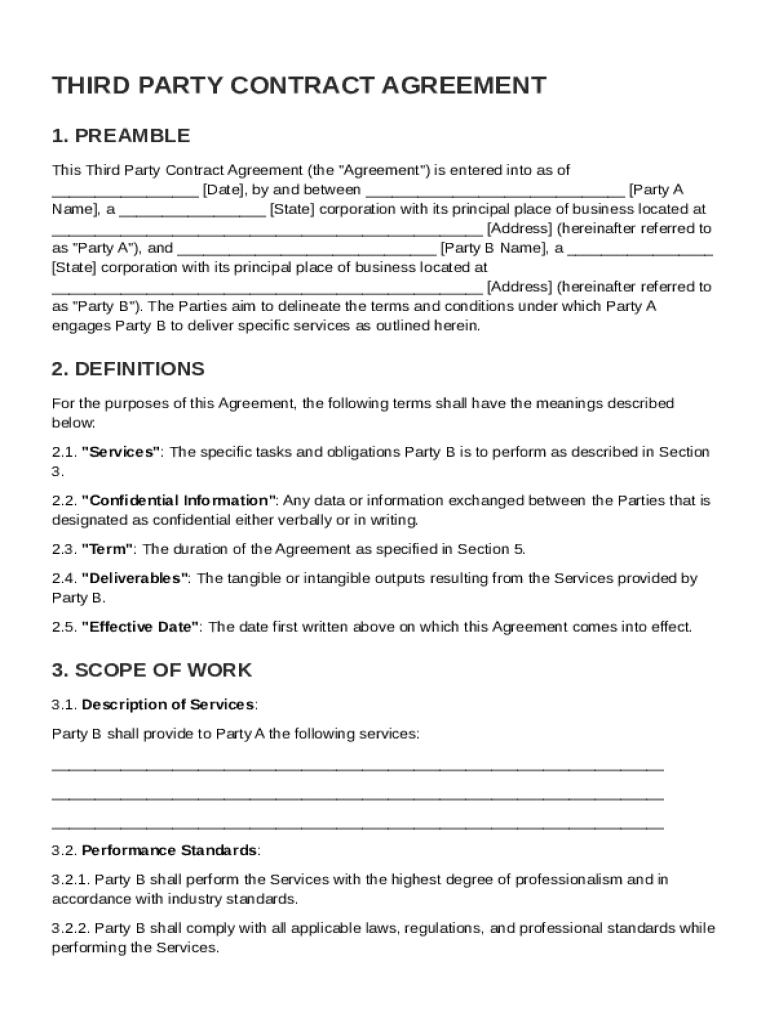
A Third Party Contract Template is a structured legal document utilized to formalize agreements between two main parties, referred to as Party A and Party B, with the inclusion of a third party. This form outlines the terms, conditions, and expectations regarding the services or materials provided by one party to another. The document serves as a legally recognized tool to establish formal obligations and rights, facilitating smooth and efficient interactions between parties. Examples of third party engagements include agreements in supply chain management, subcontracting arrangements, and partnerships in business transactions.
Key Elements of the Third Party Contract Template
The template comprises several critical components that structure the legal agreement:
-
Introduction and Definitions: Establishes the identities of the involved parties and provides definitions for specific terminologies used within the document for clarity and legal precision.
-
Scope of Work: Clearly delineates the services or products to be provided by Party B to Party A, encompassing specific tasks, responsibilities, and objectives.
-
Compensation Details: Outlines the payment terms, including the amount, period, and method of remuneration to Party B for their services or products.
-
Duration and Termination: Specifies the duration of the agreement and any conditions or processes by which the contract can be terminated by either party.
-
Confidentiality Clauses: Ensures that sensitive information exchanged between parties remains confidential and delineates the obligations regarding the disclosure of proprietary data.
-
Indemnity and Liability: Limits the responsibilities and liabilities of each party concerning potential damages or losses arising from the agreement.
-
Dispute Resolution Procedures: Sets forth mechanisms for resolving any disagreements, including mediation, arbitration, or legal proceedings.
-
Governing Law: Designates the legal framework and jurisdiction that will govern the agreement, typically based on the location of Party A or Party B.
Steps to Complete the Third Party Contract Template
-
Review the Template: Thoroughly read through the entire contract template to understand all sections and ensure that it aligns with your specific agreement needs.
-
Fill in Party Information: Input the names and contact details of the involved parties, ensuring hyper-accuracy to prevent any future disputes or miscommunications.
-
Define the Scope of Work: Clearly express the tasks, responsibilities, and obligations expected from each party, detailing the deliverables for clarity.
-
Specify Payment Terms: Record the agreed-upon compensation for services or products, including payment schedules and methods.
-
Clarify the Duration: Enter the start and end dates of the contract, alongside any conditions leading to early termination.
-
Add Confidentiality Agreements: Include clauses that secure confidential information and detail requirements for maintaining secrecy.
-
Outline Indemnity Provisions: Clearly delineate each party’s liability exposure and indemnity agreements to negate financial risks.
-
Discuss Dispute Resolution Mechanisms: Establish protocols for resolving potential conflicts to avoid costly and time-consuming litigation.
Important Terms Related to Third Party Contracts
-
Annexure/Appendix: Additional documentation or schedules attached to the main contract that provides further details related to the agreement.
-
Breach of Contract: An act or omission which results in failure to fulfill contractual obligations as outlined in the agreement.
-
Force Majeure Clause: Protects against unforeseen events such as natural disasters, acts of war, or other external circumstances beyond the control of the parties involved.
-
Non-Disclosure Agreement (NDA): A supplementary contract protecting against unauthorized sharing of classified and sensitive information.
State-specific Rules for the Third Party Contract Template
While general legal principles are universally applicable across the United States, varying statutes and precedents can influence third party contracts at the state level. For instance, the enforcement of non-compete clauses, specific indemnity agreements, and liability stipulations can differ based on local jurisdiction. Businesses should be diligent in seeking localized legal expertise to accommodate these variations and ensure compliance with state-specific regulations.
Examples of Using the Third Party Contract Template
-
Technology and IT sectors: An IT firm engages a contractor to perform specialized software development under a third party agreement to maintain confidentiality and operational boundaries.
-
Construction industry: A general contractor hires a subcontractor to complete a segment of a larger construction project, ensuring specific deliverables and project timelines.
-
Manufacturing sectors: A producer partners with a logistics company to handle the distribution and transportation of goods, spelling out detailed service requirements and performance metrics.
Who Typically Uses the Third Party Contract Template
While applicable broadly across numerous industries, certain sectors rely more heavily on third party contracts to formalize engagements and manage relationships:
-
Manufacturing Companies: Utilize these contracts to manage supply chain partnerships or subcontracting arrangements.
-
Information Technology Firms: Engage in agreements with external developers or service providers to scale operations or maintain confidentiality.
-
Logistics and Distribution Organizations: Establish clear expectations for transportation and supply chain management activities with third parties.

Digital vs. Paper Version
In today's digital age, both digital and paper versions of third party contracts are prevalent, though digital forms have become more favored. Digital contracts offer advantages such as:
-
Ease of Access and Filing: Securely stored and easily referenced from digital storage solutions, easing retrieval and management processes.
-
Immediate Updates and Modifications: Instantaneous amendments can be agreed upon and captured within the document, reflecting real-time adjustments.
-
Environmentally Friendly: Reduces reliance on paper, lowering environmental impact while streamlining operations.
However, businesses must ensure that digital agreements adhere to applicable electronic transaction laws to maintain their legal enforceability.
Legal Use of the Third Party Contract Template
Third party contracts must be crafted with due diligence to comply with legal standards and maintain enforceability:
-
Comprehensive Coverage: Ensures all necessary clauses and commitments are adequately captured to prevent loopholes.
-
Adherence to Legislation: Complies with federal, state, and local laws to safeguard the contract's enforceability.
-
Capture of Mutual Consent: Clearly expresses and records the willingness and understanding of all parties to engage in the agreement under stated terms.




