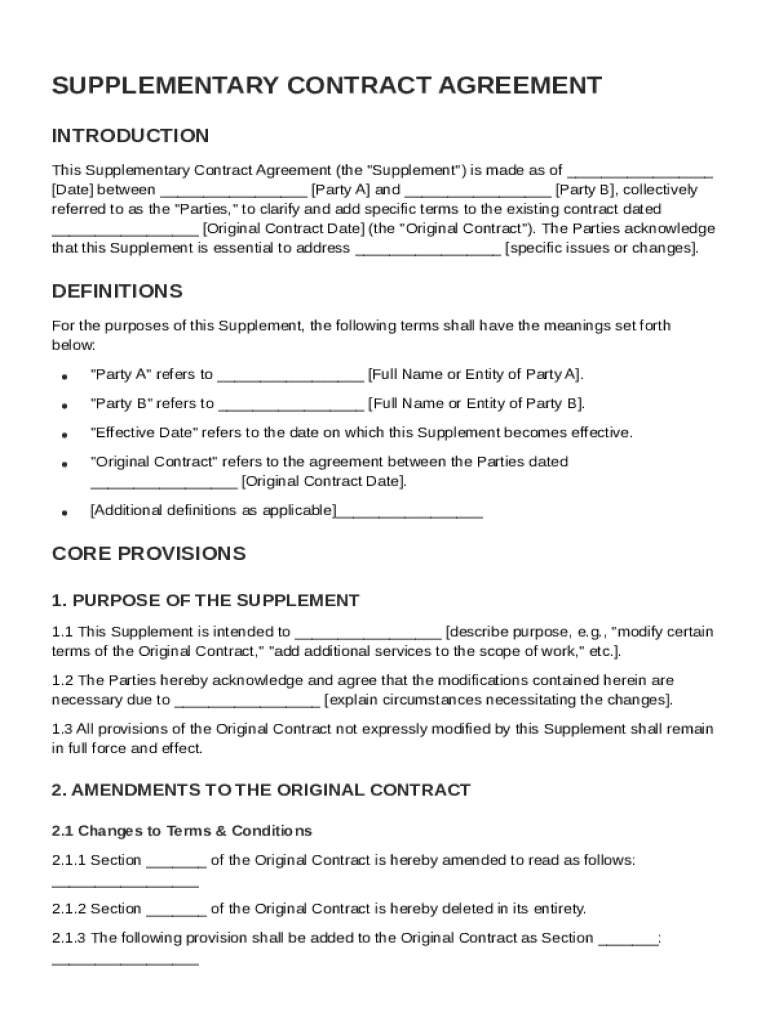







Understanding the Supplementary Contract Template
The Supplementary Contract Template serves as a pivotal legal document designed to adjust or elaborate on the terms of an existing contract. Its primary function is to introduce modifications without altering the entire original contract, offering a streamlined solution for updating agreements. By using this template, parties can clarify specific provisions, introduce new terms, and ensure that all alterations are legally binding.
- Clarity and Specificity: Ensures clear understanding by outlining updated terms.
- Legal Safety: Provides a safeguard by making new terms official.
- Efficiency: Avoids redrafting the entire original agreement.
Steps to Complete the Supplementary Contract Template
Navigating through the completion of the Supplementary Contract Template is a meticulous process that ensures accuracy and compliance. Follow these steps to execute the template successfully:
-
Review the Original Contract: Begin by thoroughly reading the original contract to identify the clauses that require alteration. Understanding the foundational terms is crucial for informed adjustments.
-
Define Amendments: Clearly outline the changes or additions you want to make. Whether it's an extension of term or clarification of duties, precision is key.
-
Draft New Clauses: Write new clauses or amendments clearly and unambiguously. Use legal language to avoid multiple interpretations.
-
Consult Legal Professionals: For complex changes, consulting a legal expert can prevent potential disputes and ensure the contract remains enforceable.
-
Obtain Consent from All Parties: Ensure all parties to the original contract understand and agree to the new terms. Written consent is crucial for legality.
-
Execute the Amended Contract: Ensure all parties sign the supplementary document. This signature signifies acknowledgment and agreement of the changes.
Key Elements of the Supplementary Contract Template
A Supplementary Contract Template contains crucial elements that form the backbone of a legitimate and useful document. Each component must be accurately filled to maintain the contract's integrity.
-
Parties Involved: Clearly stating the names of all parties involved, ensuring identification and accountability.
-
Effective Date: Indicating when the amendments come into force, which helps in understanding the operational timeline.
-
Modification Clauses: Detailed description of the changes to the original agreement. These should be explicit and clear to avoid ambiguity.
-
Governing Law: Specifies which jurisdiction's laws apply to the contract, which is critical for legal interpretation.
-
Signature Lines: Spaces for all involved parties to sign, providing formal approval of the amendments.
Legal Use of the Supplementary Contract Template
The legal application of a Supplementary Contract Template must align with state and federal laws to ensure its enforceability. Missteps in legal adherence can render the additional terms null.
-
Compliance with Contract Law: Amendments must comply with basic contract principles, including offer, acceptance, intent, and consideration.
-
Documentation of Consent: Acquisition of written consent from all parties involved guarantees mutual acceptance of the revised terms.
-
Use for Minor Amendments: Often employed for small changes that don't warrant a full re-drafting of the contract.
-
Court Recognition: Under most jurisdictions, legally executed supplementary agreements are recognized in court proceedings.
Examples of Using the Supplementary Contract Template
In practical scenarios, the Supplementary Contract Template is instrumental in adapting existing agreements without altering their core. Here are a few examples:
-
Lease Agreements: Extending lease terms or changing rental policies requires a supplementary contract instead of drafting a new lease.
-
Service Contracts: Adjustments made to service scope or delivery timelines often use supplementary agreements to ensure all parties are on the same page.
-
Employment Terms: Alteration of job roles and responsibilities is handled efficiently using supplementary contracts.
-
Partnership Amendments: In business partnerships, adding or removing partners often involves utilizing these templates to update original agreements.
How to Obtain the Supplementary Contract Template
Acquiring a Supplementary Contract Template is essential for ensuring lawful amendment processes and can be done via several avenues:
-
Online Platforms: Digital templates offer convenience and accessibility, with customizable sections for specific needs. Many legal document services provide downloadable templates.
-
Legal Professionals: Consulting with attorneys can offer tailored templates specific to your agreement's requirements.
-
Business Documentation Services: Companies offering documentation services typically provide such templates as part of their offerings, ensuring compliance and accuracy.
Important Terms Related to the Supplementary Contract Template
Understanding key terms is crucial for navigating the complexities of supplementary legal agreements.
-
Addendum: A formal addition to an existing contract, often interchangeable with supplementary contracts depending on context.
-
Amendment: Official changes made to the terms of a contract, directly involving the new agreement.
-
Binding Agreement: A legally enforceable contract that has met all necessary legal requirements.
-
Written Consent: Formal, documented agreement of all parties involved in acknowledging changes and additions to a contract.
Who Typically Uses the Supplementary Contract Template
The use of a Supplementary Contract Template is widespread among various sectors and individuals who need to adapt existing legal frameworks.
-
Legal Professionals: Lawyers frequently draft these documents to integrate into clients' existing contracts.
-
Business Managers: They use such templates to adjust service or supply agreements without disrupting business operations.
-
Real Estate Agents: Agents utilize these templates to modify lease terms, change property conditions, or update tenant agreements.
-
Human Resources Departments: HR officials often employ these templates for changes in employment contracts, such as promotions or department transfers.