
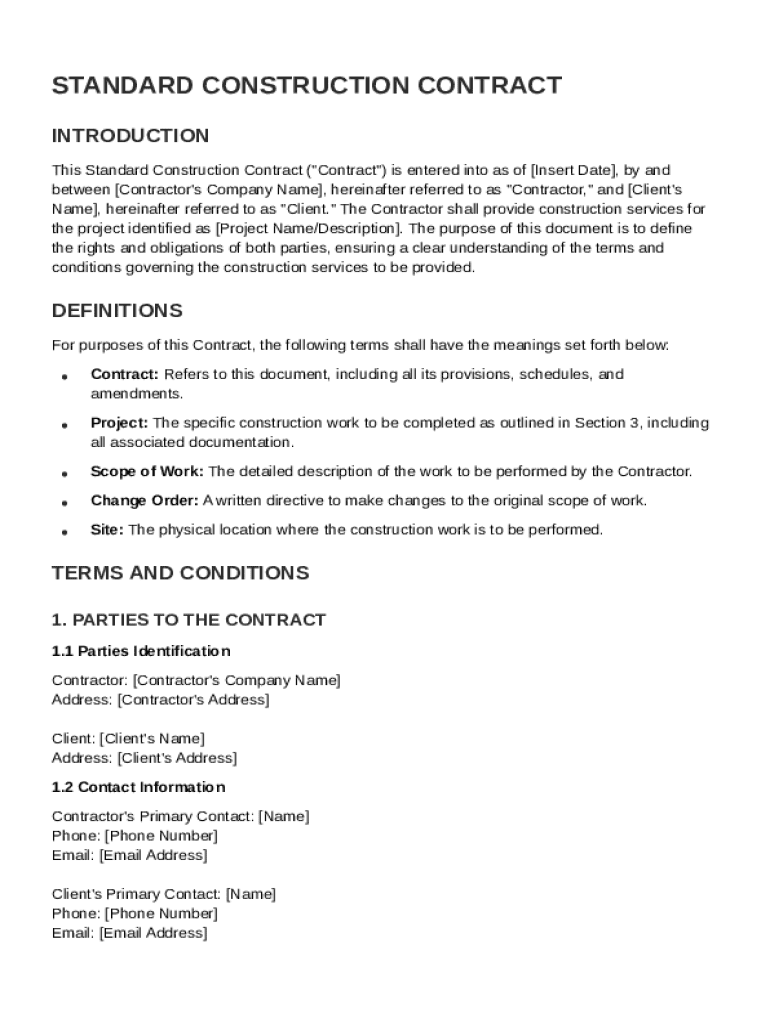







Key Elements of the Standard Construction Contract Template
The Standard Construction Contract Template is essential to formalize agreements between a contractor and client. The key elements of this template ensure that all parties have a clear understanding of rights, obligations, and expectations.
-
Project Scope: Defines the detailed description of the work to be performed, including deliverables and specific tasks. This element ensures that both parties agree on what is included or excluded from the project.
-
Payment Terms: Specifies how and when payments will be made. This includes the total contract amount, payment schedule, and terms for any progress payments or retainers.
-
Timelines and Deadlines: Outlines the start and end dates of the project, along with any interim milestones. It provides a timeline for completion and consequences for delays.
-
Change Orders: Details procedures for any changes to the project scope, including how changes will be documented and approved, along with cost implications.
-
Responsibilities of Parties: Lists the obligations of both the contractor and the client, ensuring accountability and transparency throughout the project.
-
Insurance and Liability: Includes requirements for insurance coverage, such as general liability, workers' compensation, and any additional coverage needed for the project.
-
Termination Conditions: Specifies conditions under which the contract can be terminated by either party, including breach of contract or mutual agreement.
-
Dispute Resolution: Outlines methods for resolving disagreements, such as mediation or arbitration, to avoid litigation.
Steps to Complete the Standard Construction Contract Template
Filling out the Standard Construction Contract Template can be straightforward with a systematic approach. Here’s a step-by-step guide:
-
Identify Project and Parties: Start by clearly stating the project title and the names and contact information of both parties.
-
Define Project Scope: Carefully describe the work to be done, using precise language to avoid misunderstandings.
-
Establish Payment Terms: Define the total cost, payment schedule, and acceptable payment methods. Include details on deposits and final payment.
-
Set Timelines: Agree on project start and end dates, and incorporate any key milestones or deadlines.
-
Document Responsibilities: Clearly assign roles and responsibilities, ensuring each party understands their obligations.
-
Include Insurance Details: Attach a copy of relevant insurance certificates and compliance documents.
-
Outline Change Order Procedures: Specify how changes to the contract will be handled.
-
Decide on Termination Terms: Carefully draft termination clauses suited to potential scenarios.
-
Plan for Dispute Resolution: Choose a preferred method for resolving disputes and include this in your contract.
-
Review and Sign: Ensure both parties read and understand the contract, then sign and date it to acknowledge agreement.
Important Terms Related to the Standard Construction Contract Template
Understanding the terminology within a Standard Construction Contract Template is crucial for proper usage and compliance.
-
Contractor: The party responsible for performing the construction work.
-
Client or Owner: The party for whom the construction work is performed.
-
Scope of Work: The detailed description of the activities to be carried out under the contract.
-
Retainer: An upfront fee paid to secure the contractor's services.
-
Milestone Payment: Payments made at specific stages of project completion rather than as a lump sum.
-
Indemnity: A provision in which one party agrees to compensate the other for any harm or loss arising out of the agreement.
-
Force Majeure: Circumstances beyond control, such as natural disasters, which may delay or prevent project completion.
-
Subcontractor: A secondary contractor hired by the primary contractor to perform aspects of the work.
Legal Use of the Standard Construction Contract Template
The legal framework surrounding the use of a Standard Construction Contract Template in the United States is governed by specific considerations:
-
Compliance with Federal and State Laws: Ensure that your contract complies with applicable regulations, which may vary by state.
-
Adherence to Licensing Requirements: Both contractors and subcontractors should possess the necessary licenses.
-
Use of Legally Binding Language: Employ clear, enforceable terms to avoid ambiguities.
-
Documentation of All Changes: Any amendments to the contract should be documented in writing and signed by both parties.
-
Maintaining Records: Keep comprehensive records of all contract-related correspondence and documents for legal protection.
-
Consultation with Legal Experts: It is advisable to have the contract reviewed by a lawyer to ensure legal soundness.
Examples of Using the Standard Construction Contract Template
The application of a Standard Construction Contract Template can vary significantly depending on the nature and scale of the project.
-
Residential Construction: A homeowner contracting a builder for a new home will use this template to outline construction phases and customize aspects for personal tastes.
-
Commercial Construction: A business might adapt the template for the construction of office buildings, emphasizing timelines and budgets critical to business operations.
-
Public Works Projects: Government-funded projects typically rely on detailed contracts that conform to specific regulatory standards.
-
Renovation Projects: Home remodels or office renovations require clear documentation of upgrades covered under the contract.
Each example highlights the versatility of the template in different construction scenarios, adapting to the needs of the specific building environment.
Who Typically Uses the Standard Construction Contract Template
A diverse range of professionals uses the Standard Construction Contract Template in the construction industry:
-
General Contractors: Professionally manage all stages of building projects and need well-defined contracts.
-
Architects and Designers: Often collaborate with contractors and clients to ensure the vision aligns with the contractual obligations.
-
Project Managers: Use the template to oversee timelines, budgets, and execution plans.
-
Real Estate Developers: Engage in large-scale projects and require comprehensive contract documentation.
-
Legal Consultants: Offer advice on contract law and help clients draft and negotiate construction agreements.
-
Clients and Property Owners: Are directly involved in overseeing project expectations and outcomes.
These professionals rely on the contract template to establish clear expectations and ensure all stakeholders are aligned.


State-Specific Rules for the Standard Construction Contract Template
State regulations can dramatically influence the terms of a construction contract:
-
Licensing and Permits: Vary by state; ensure all parties comply with local licensing laws and obtain necessary permits.
-
Zoning Laws: Local laws and regulations may affect project scope and property use, requiring adaptations to contract terms.
-
Consumer Protection: States have different consumer protection laws that may impact warranties and guarantees offered by contractors.
-
Lien Laws: Differences in lien laws can affect how payment disputes are resolved.
-
Insurance Requirements: States may have unique requirements dictating the minimum levels of insurance.
Understanding these regional variations is essential for tailoring the Standard Construction Contract Template to specific state requirements, ensuring both legal compliance and professional standards.
Versions or Alternatives to the Standard Construction Contract Template
Exploring other variations or options of construction contracts can be beneficial depending on project specifics:
-
Lump Sum Contract: Fixed price for the entire project scope, common in straightforward construction projects.
-
Cost Plus Contract: Covers costs incurred plus an agreed-upon profit margin; often used in complex projects with uncertain scope.
-
Time and Materials Contract: Billed based on actual costs of labor and materials, suitable for small projects with indeterminate scopes.
-
Unit Price Contract: Stipulates pricing per unit of work, efficient for repetitive tasks such as roads and other civil projects.
These alternative contract types may offer varying degrees of flexibility, risk allocation, and financial accounting, allowing for customization based on project needs and client preferences.




